High agency in the age of AI: why agents made judgment the scarcest skill in your company
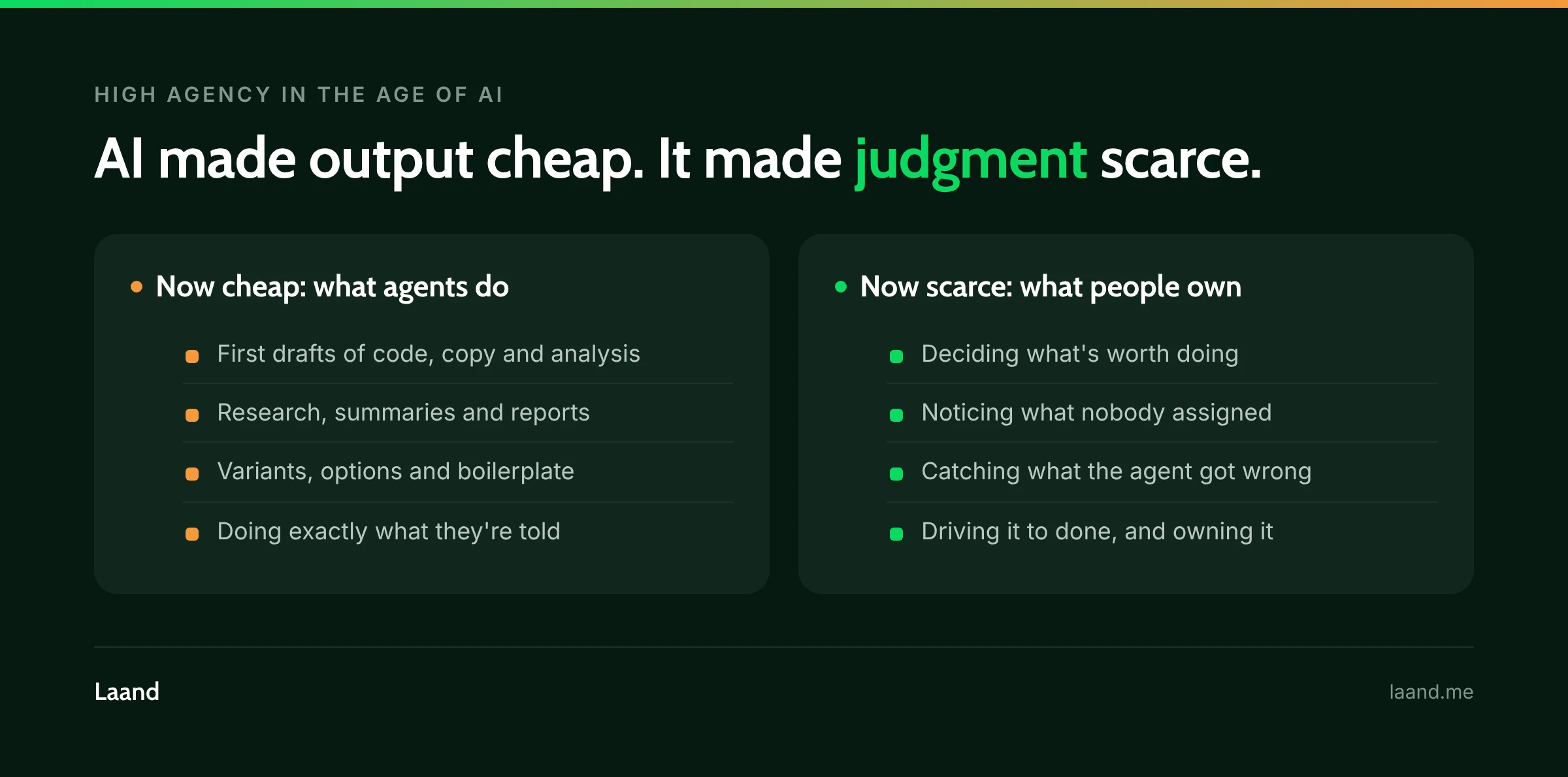
AI made output cheap. It didn't make anyone decide what's worth doing, notice what nobody assigned, or catch what the agent got wrong.

Picture a nine-person AI startup at the end of 2026. Nearly everyone on the team runs agents all day. The engineers have coding agents writing most of the code. The one marketer has agents producing ads, emails and landing pages. The ops lead has agents reconciling invoices and chasing suppliers.
On paper, the company has the output of a team five times its size.
And yet the CEO's biggest worry isn't output. It's this: the agents will do exactly what they're told, at enormous speed, including the wrong thing. Last month an agent rebuilt the pricing page from a brief nobody had checked, and it went live with last year's prices. An agent-written campaign went to the wrong segment. A refactor passed every test and quietly broke the export that three customers depend on.
None of these were agent failures. The agents did their jobs. What was missing was a person who noticed, questioned, decided and owned the result.
That's high agency in the age of AI. It didn't get less valuable when agents arrived. It became the bottleneck.
What changed when agents arrived
Before agents, a company's capacity was mostly limited by how much its people could produce. Hiring optimised for production: years of experience, skills, speed.
Agents changed the shape of work in three ways:
- Production became nearly free. A first draft of code, copy, analysis or design takes seconds.
- Volume became unlimited. Agents produce forty options as easily as one.
- Execution became literal. Agents do what the instruction says, not what the instruction meant.
Each of those moves value away from production and towards judgment: deciding what to produce, choosing among the forty, and making sure what was said is what was meant.
Why agency becomes scarce, not abundant
You might expect AI to make everyone more agentic: if anyone can produce anything, anyone can act. In practice the opposite happens. Agents remove the friction that used to force people to think.
When building something took a week, you had to decide carefully what to build. When it takes ten minutes, it's tempting to build everything and see. When an agent writes the report, it's tempting to forward it without reading it. Agents make it easy to be busy without being responsible.
So the people who still notice, question and own, who treat the agent's output as a draft rather than an answer, stand out more than ever.
Agency without taste is now dangerous
There's a second effect. AI amplifies agency in whatever direction it points.
A high-agency person without taste used to be limited by their own output: they could only ship so much of the wrong thing. With agents, they can ship ten times more of it. More campaigns to the wrong segment. More features nobody uses. More code that passes tests and misses the point.
That's why, in the age of AI, agency and taste must be hired together:
| Low agency | High agency | |
|---|---|---|
| High taste | Knows what's right. Never ships. | Ships the right thing. |
| Low taste | Waits, then ships what they're told. (Agents do this now.) | Ships the wrong thing, fast. (AI makes it faster.) |
Notice the bottom-left quadrant. The order-taker, the person who waits and then does what they're told, is doing exactly what agents now do, more cheaply and around the clock. The top-right quadrant is where the value has moved. (More in high agency and taste.)
What "steering AI" actually looks like
"Can steer AI" is easy to put in a job ad and hard to picture. Here's what it looks like in practice, compared with following it:
| Moment | Following AI | Steering AI |
|---|---|---|
| Starting | Pastes the brief in | Gives context, constraints and what good looks like |
| First output | Accepts it | Asks why, tests it, pushes back |
| Volume | Keeps all forty variants | Keeps one, says why |
| A wrong assumption | Builds on it | Catches it, often before the agent sees it |
| Something breaks | "The AI did it" | "I shipped it; here's the fix" |
| Done | When the agent stops | When the result is real |
Every row in the right-hand column is agency and taste working together.
The market is already moving
The roles most likely to describe high-agency work in job ads are the ones closest to customers and outcomes, where judgment can't be delegated. In October 2026, the Laand Hiring Index found Forward-Deployed roles led at 22%, followed by Product Marketing, Product Management and Design.

And demand is shifting toward roles built around AI. In the same month, AI & ML Engineering roles grew 28%, second only to Product Marketing.

But hiring processes haven't caught up. Among roles that explicitly ask for high agency, 79% give candidates no way to show it beyond a résumé.

Why experience can't tell you who'll steer AI
The traditional answer to "will this person have good judgment?" was experience. That was always weaker than it looked: large meta-analyses find years of experience is one of the weakest predictors of job performance, and prior experience barely predicts performance in a new organisation.
In the age of AI, it's weaker still. Most people's experience is from a world where they produced the work themselves. How they behave when an agent produces it for them, whether they steer or follow, is something their CV has never been asked to show.
The only way to see it is to watch them work, with AI, on your real problems.
How to hire high-agency people for the age of AI
- Start from the result, then ask "hire or agent?" Split the role into what agents can already do and what a person must own. Hire for the second list. Brian Chesky's rule, "Start with the results and work backwards to the people. Most [startups] start with resumes", now has an AI-era corollary: work backwards to the part only a person can own.
- Scope paid work from your real problems. About six hours, on a slice of the result the person would own.
- Allow AI, and make it visible. Ask for the chat links. Steering versus following is plain to see.
- Plant a mistake. In the age of literal agents, catching what's wrong in an instruction is the job.
- Ask what they cut. The answer separates taste from volume.
- Interview about the work, not the CV.
How Laand does it
Laand was built for exactly this shift.
Every hunt starts with "hire or agent?" Start from Slack, Claude, ChatGPT or your code editor. Laand's Deep Analysis says which parts of the role agents can already do, and which a person must own, then writes the role around the person's part.
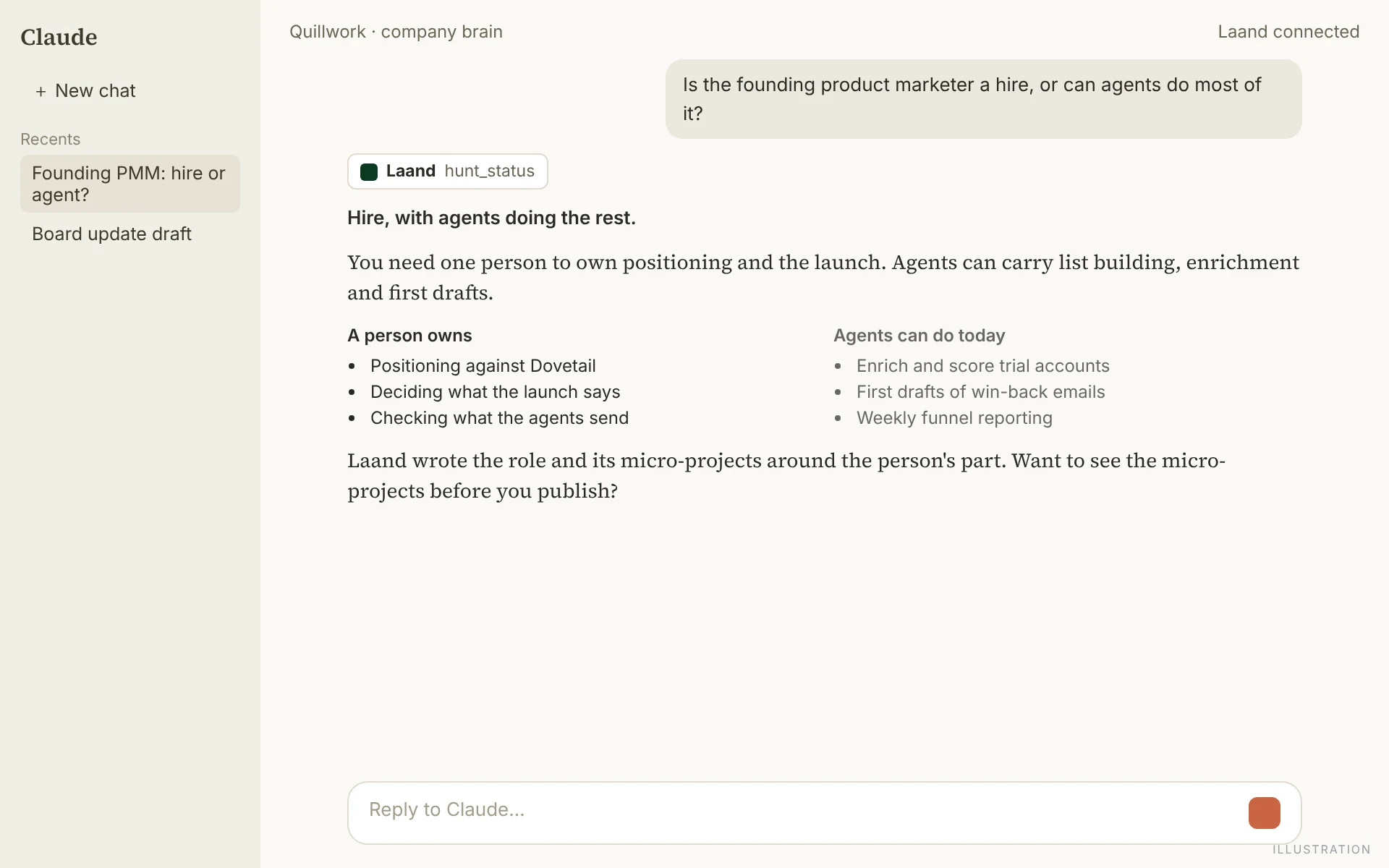
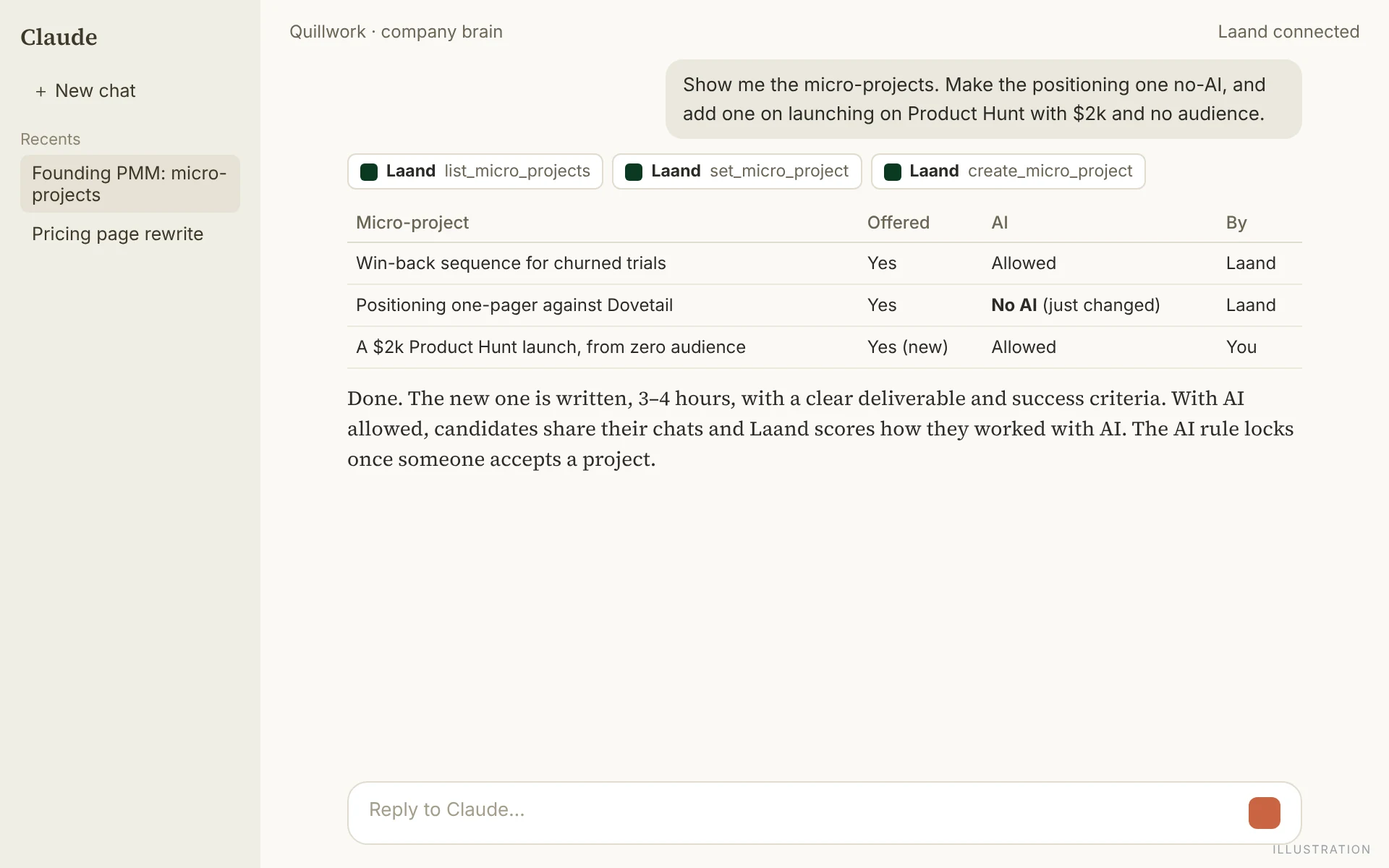
The paid work is AI-visible. Micro-projects are scoped from your core problems, with a planted mistake in every brief. Talent share the public links to their AI chats (or say they didn't use AI), and Laand scores how they worked with AI as well as the work.
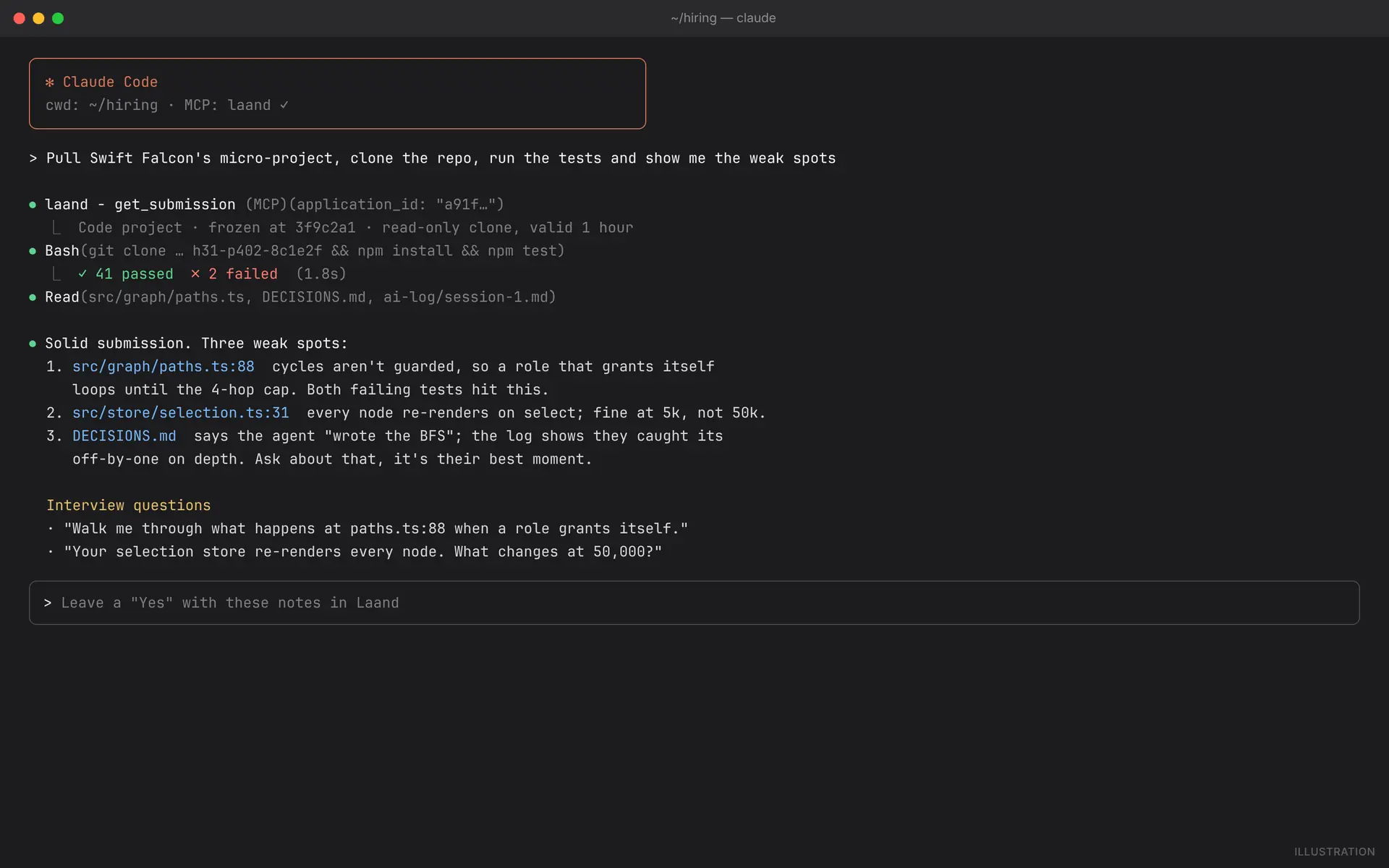
Your own agents can check the work. With Laand connected, Claude Code, Codex or Cursor can run a finalist's submission and find its weak spots.
People make the calls that matter. Candidates stay anonymous until a person unlocks them, at $750 per talent unlocked; agents never spend money. Publishing is free.
A founder who works this way
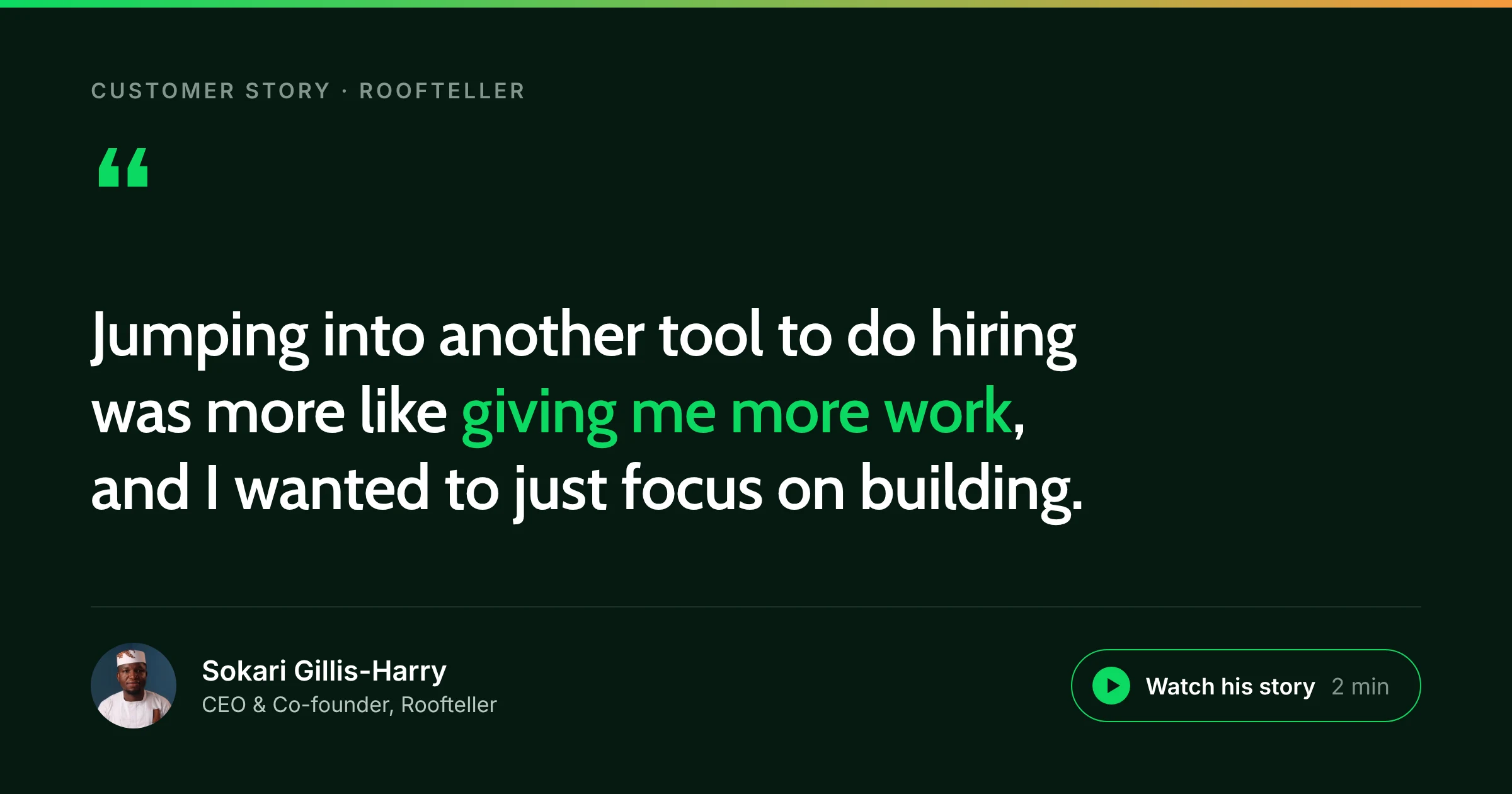
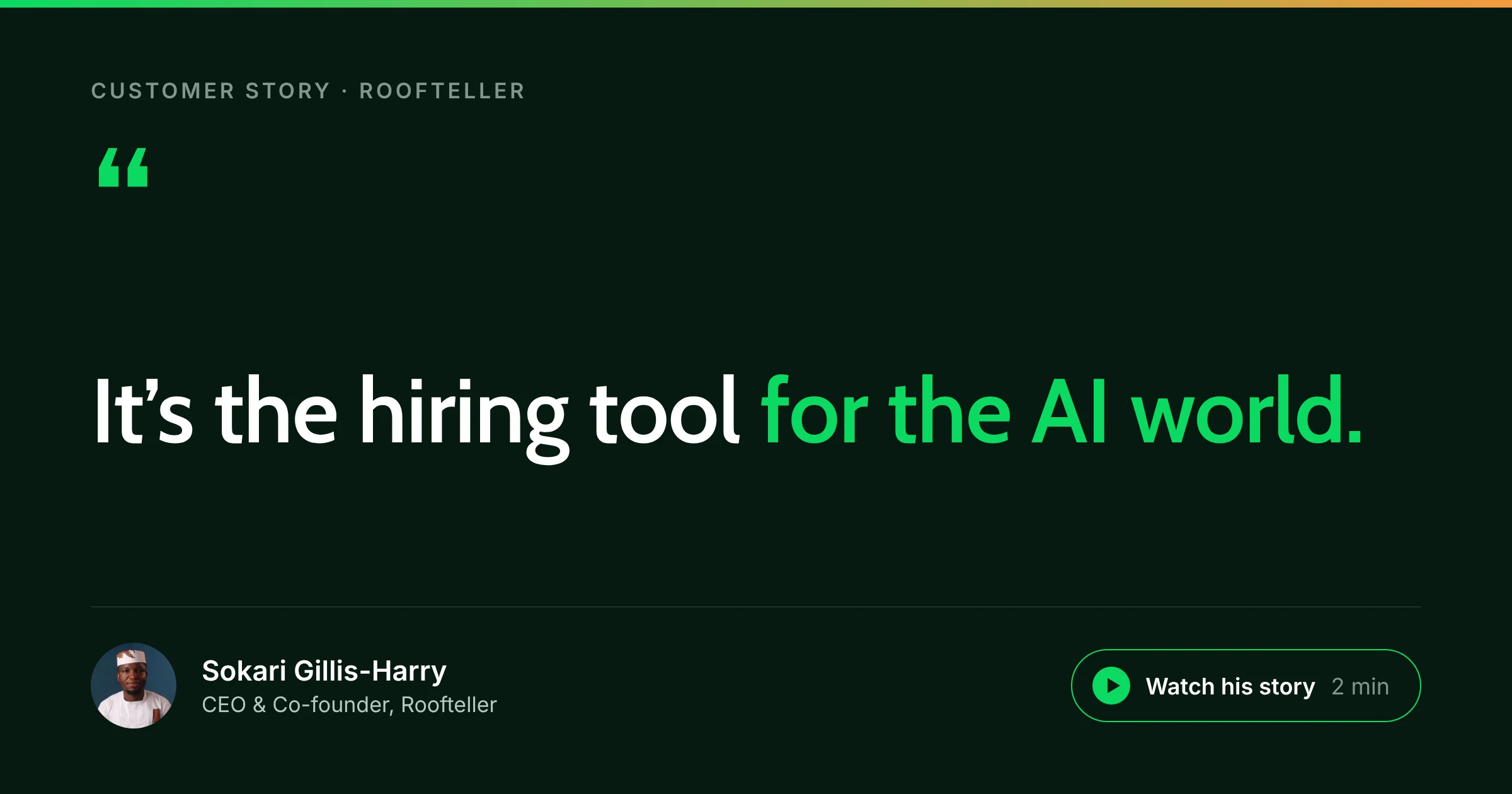
Sokari Gillis-Harry, founder of Roofteller, runs his company through AI agents, and hires that way too:
What this means for your next hire
Ask yourself one question about the role you're about to open: if an agent did everything it could in this job, what would be left?
Whatever's left (deciding, noticing, catching, owning) is the job. Hire the person who's best at that, and see them do it before you hire them.
Five questions to ask about every role you open
- If agents did everything they can in this role, what would be left?
- Who on our team is already doing the leftover part, and how well?
- What would go wrong if the person in this role followed agents instead of steering them?
- Where in our hiring process would we see whether someone steers or follows?
- What's the one decision in this role we'd never want an agent to make alone?
The answers usually shrink the role, sharpen it, or both, and they tell you exactly what to test for.
Key takeaways
- AI made output cheap and made judgment scarce.
- Agents remove the friction that forced people to think, so people who still notice and own stand out more.
- AI amplifies agency in whatever direction it points; without taste, that's more of the wrong thing, faster.
- Steering AI means giving context, pushing back, keeping one of forty, catching wrong assumptions and owning the result.
- Experience can't show whether someone steers or follows AI; paid, AI-visible work on your real problems can.
Frequently asked questions
Why does AI make high agency more valuable?
Because agents produce output on demand but don't decide what's worth doing, notice what nobody assigned, or catch what's wrong in an instruction. Those are exactly the things high-agency people do.
Will AI replace high-agency employees?
AI replaces execution that follows instructions. High-agency people provide the judgment and ownership that decide which instructions to give, so their role grows as agents take on more execution.
What does it mean to steer AI?
Giving agents the right context and constraints, questioning their output, keeping only what serves the goal, catching wrong assumptions and owning the result.
How do you test whether someone can steer AI?
Give them paid work from your real problems with AI allowed, ask for the chat links, plant a mistake in the brief, and look at what they accepted, rejected and caught.
Is high agency enough on its own?
Not in the age of AI. Agency without taste ships more of the wrong thing, faster. Hire for both.
Which roles need high agency most in the age of AI?
Roles closest to customers and outcomes, where judgment can't be delegated. In the October 2026 Laand Hiring Index, forward-deployed, product marketing, product management and design roles were most likely to describe high-agency work.
What should I ask about a role before hiring for it?
If agents did everything they can in this role, what would be left? Hire for whatever's left, and test for it directly.
Keep reading
- High agency and taste
- Hiring for taste
- How to identify high-agency candidates
- Today's high-agency jobs
Or start a Talent Hunt and begin with "hire or agent?".
Stop applying blind.
Laand scores your fit for any role, then builds the application kit that proves you can do the job.
Join LaandHire people who steer AI, not follow it
Laand shows you how candidates worked with AI on your real problems, planted mistake and all, before you meet them. Free to publish; $750 per talent you unlock.
Start a Talent Hunt