AI fluency hiring: how to tell who steers AI from who just uses it
Everyone lists "proficient in AI tools". Almost nobody can show you what that means. Here's you can.

Two engineers submit a solution to the same problem. Both used Claude. Both solutions pass the tests. The code is about the same length.
The first engineer's chat history is three messages long: the brief, pasted in; "make the tests pass"; "thanks".
The second's is twenty-two messages. She asks the agent to explain the existing retry logic before touching it. She rejects its first approach because it would hammer a rate-limited API. She catches that it invented a config option that doesn't exist. She asks it to write three extra tests for the edge case she's worried about. Then she rewrites the README herself, because the agent's version oversold what the code does.
Both of them would tick "proficient with AI tools" on an application. Only one of them is AI fluent.
What AI fluency actually means
AI fluency is the ability to produce better work, faster, by directing AI systems, while keeping responsibility for quality and judgment.
It is not:
- Knowing tool names. Tools change every quarter.
- Prompt tricks. Clever phrasing matters far less than context and checking.
- Using AI a lot. Volume of use says nothing about quality of judgment.
It is a combination of four things:
- Delegation: knowing what to hand to an agent and what to keep.
- Direction: giving the agent the context, constraints and examples it needs.
- Verification: checking the output, catching errors and hallucinations, testing assumptions.
- Ownership: taking responsibility for the result, including what the agent got wrong.
The four levels of AI fluency
| Level | Name | What it looks like | Hire for it? |
|---|---|---|---|
| 1 | Avoider | Doesn't use AI, or only for trivial tasks | Rarely, on an AI-native team |
| 2 | User | Pastes tasks in, ships the output | Risky: fast, but errors ship too |
| 3 | Collaborator | Iterates with AI, checks major outputs | Good for most roles |
| 4 | Steerer | Designs the work around AI, verifies rigorously, catches subtle errors, owns the outcome | The people who move milestones |
Level 2 is the dangerous one. It looks productive, and in a demo it can look like level 4. The difference only shows when something's subtly wrong.
Why AI fluency is now the core hiring question
On an AI-native team, agents do the first draft of almost everything. That changes the shape of every role. The scarce skill isn't producing output; it's judgment over output.
You can see the market shifting. In October 2026, the Laand Hiring Index found AI & ML Engineering roles growing 28% month on month, second only to Product Marketing.

But AI fluency matters far beyond AI roles. A growth marketer who can't tell good AI copy from generic AI copy will flood your channels with sameness. An operations lead who trusts an agent's spreadsheet without checking will make decisions on invented numbers.
How to test for AI fluency
Don't: ban AI in your assessment
A no-AI test measures a level-1 skill. Unless you specifically need to see an unassisted skill, banning AI tests a job nobody on your team does.
Don't: ask "which AI tools do you use?"
The answer tells you their tool list, not their judgment.
Do: let them use AI on real work, and ask for the chats
Give a short, paid piece of your real work. Ask candidates to share the public links to the AI chats they used, or to say they didn't use AI. Then read the chats.
What to look for:
| Signal | Level 2 (User) | Level 4 (Steerer) |
|---|---|---|
| First message | Brief pasted in | Context, constraints, what good looks like |
| When the agent is wrong | Doesn't notice | Catches it, says why, redirects |
| Verification | None | Asks for tests, checks sources, sanity-checks numbers |
| Edits | Ships first output | Rewrites the parts that matter |
| Ownership | "The AI did this" | "I chose this, and here's why" |
Do: plant a mistake
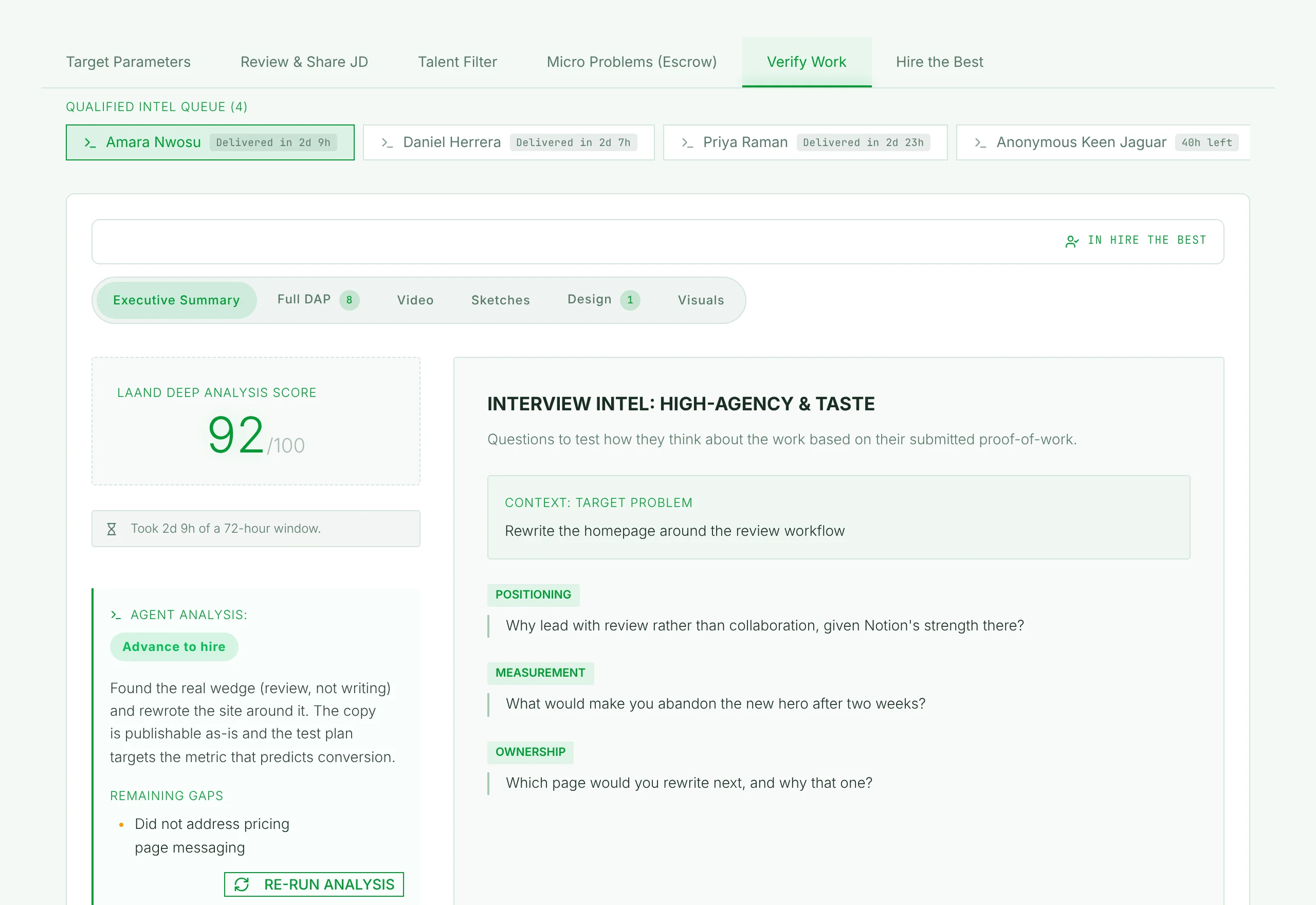
Put one wrong number or broken assumption in the brief. A level-2 user feeds it to the agent and ships it. A level-4 steerer catches it, often before the agent sees it.
Do: ask about the chats in the interview
"At message eight, you rejected the agent's approach. Why? What would have happened if you'd accepted it?" Fluent people light up. Others get vague.
AI fluency interview questions
- Walk me through a time an AI tool gave you something that looked right and wasn't. How did you catch it?
- What do you never delegate to an agent? Why?
- How do you decide when AI output is good enough?
- Show me a chat where you changed the agent's mind. What was the turning point?
- "Here's an AI-generated analysis of our churn. What would you check first?"
- Which parts of this role would you hand to agents in week one?
How Laand tests AI fluency
Laand treats AI fluency as a first-class signal in every Talent Hunt.
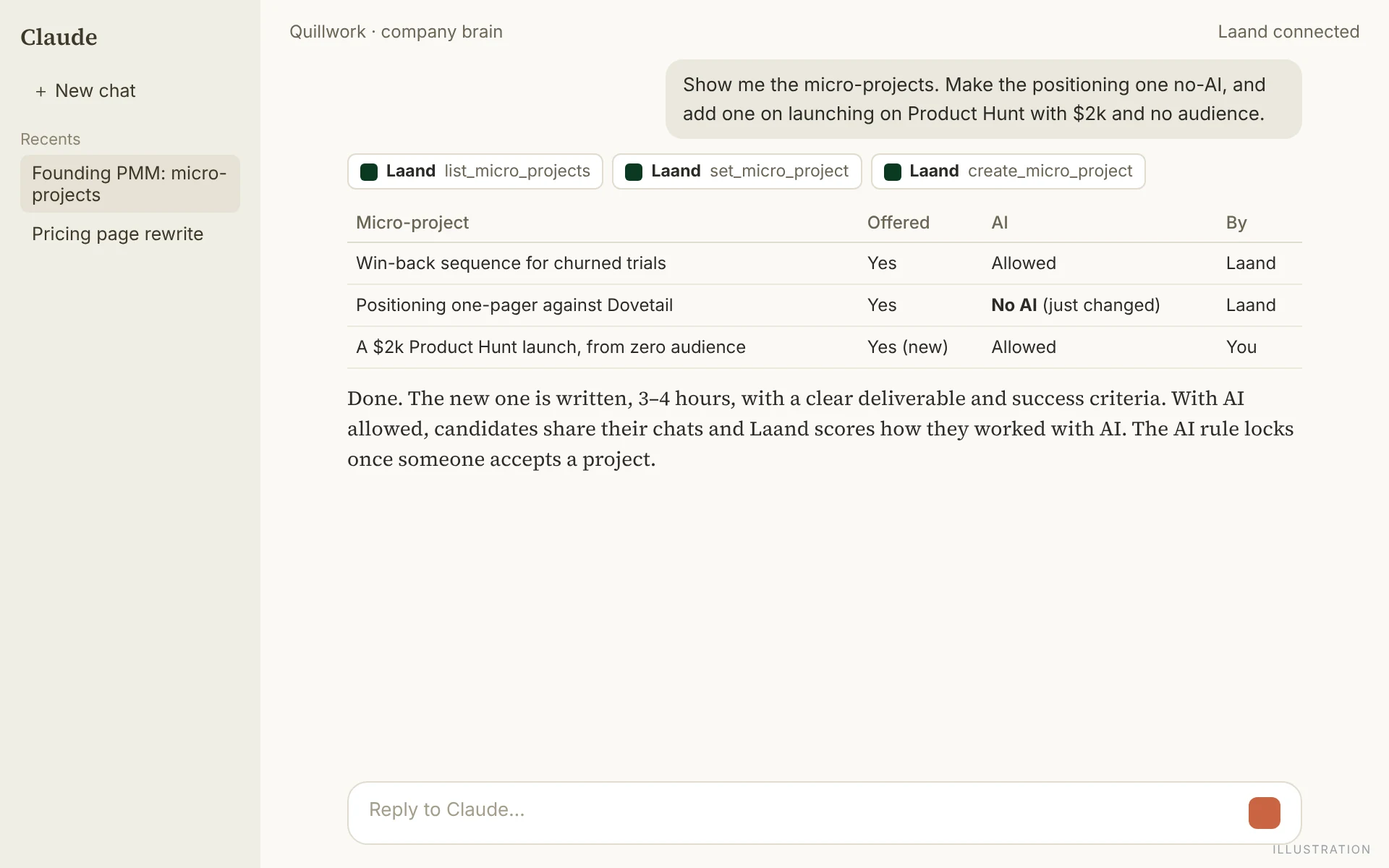
AI is allowed, per project, and visible. In each paid micro-project, candidates share the public links to the chats they used, or state they didn't use AI. You can switch AI off for a specific project when you need to see a skill unassisted.
Every brief has a planted mistake. It's the cleanest test of verification there is.
Laand scores how they worked with AI, not just the work. Each review includes an AI-collaboration score alongside the work score, so you can tell a steerer from a user even when the outputs look similar.
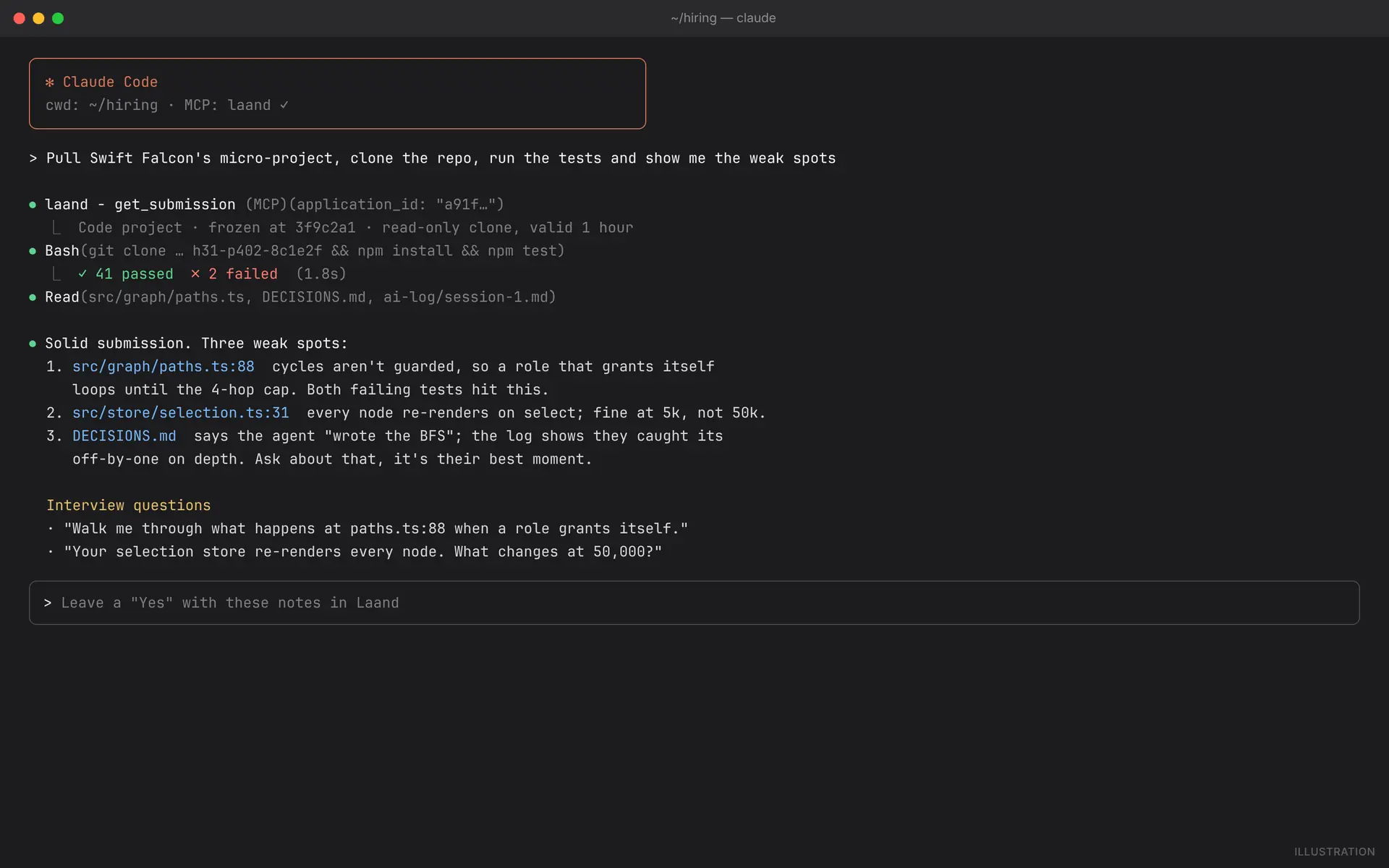
Your own agents can dig in. Ask Claude Code or Codex to run a finalist's submission and find its weak spots, or ask Claude which candidates' work is strongest.
And the whole hire runs through your own AI. Start the hunt in Claude or Slack, review in your agent, decide in a Slack channel, unlock at $750 per talent unlocked. Publishing is free.
Before you hire for AI fluency, check your own
The best way to evaluate AI fluency is to have it. If your team doesn't use agents seriously, you'll struggle to tell level 2 from level 4.
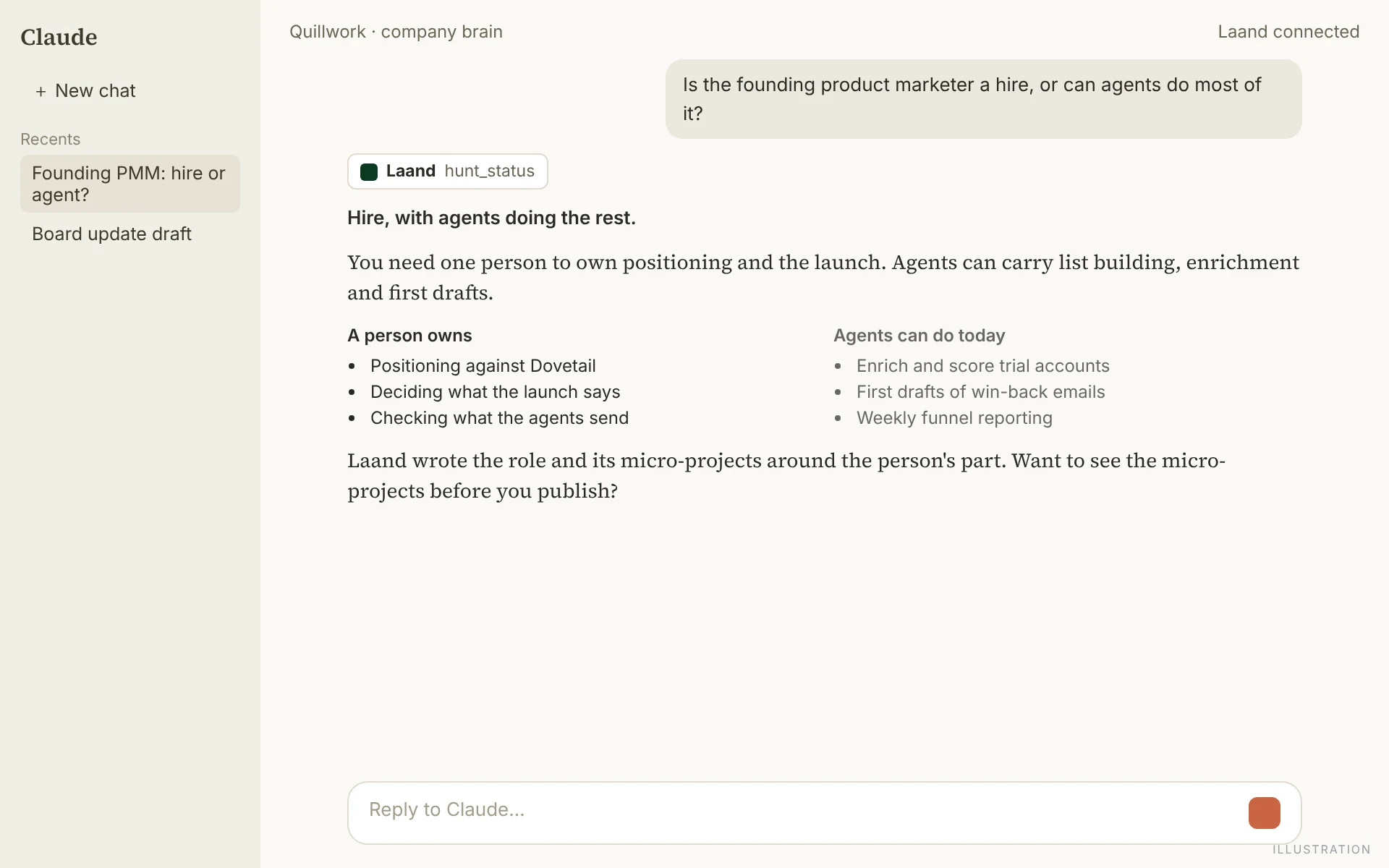
Laand starts every hunt with hire or agent?: which parts of the role agents can already do, and which a person must own. If you find most of the role is agent work, the fluency you need might be a level-4 steerer to run those agents, not three level-2 users.
A founder who works this way
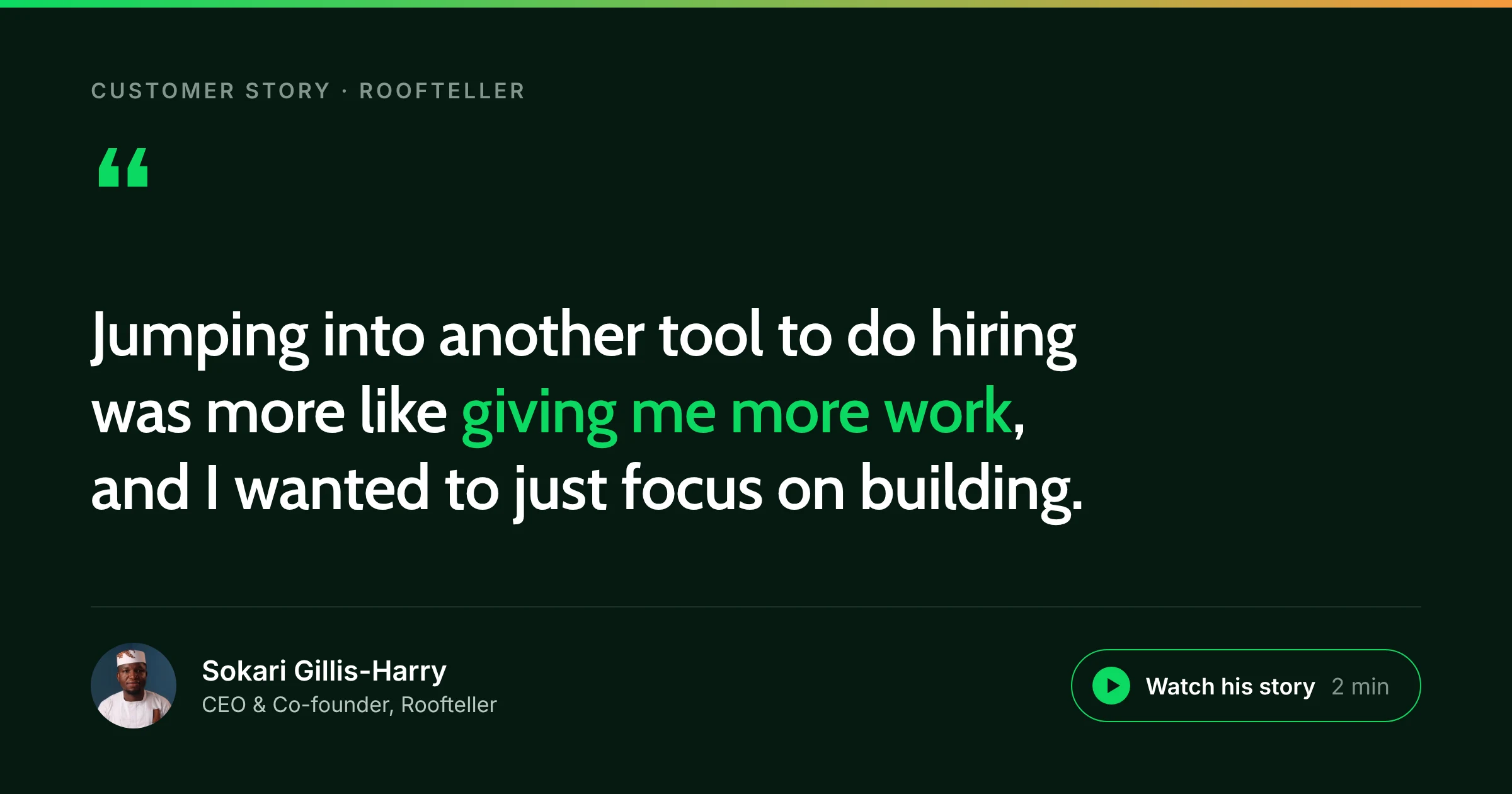
Sokari Gillis-Harry, founder of Roofteller, runs his company through AI:
AI fluency by role
AI fluency looks different in each function. Here's what level 4 (the steerer) looks like across the roles startups hire most.
| Role | Level 2: User | Level 4: Steerer |
|---|---|---|
| Software engineer | Accepts the agent's code if the tests pass | Reads the diff, rejects invented APIs, adds tests for edge cases the agent missed |
| Forward-deployed engineer | Uses AI to write integration code | Uses AI to map the customer's system, then decides what to build and what to push back on |
| Growth marketer | Ships AI copy with light edits | Uses AI for variants and research, throws away the generic ones, writes the line only your company could say |
| Product marketer | Generates positioning docs | Uses AI to synthesise call notes, then makes the positioning call and defends it |
| Operations lead | Trusts the agent's spreadsheet | Sanity-checks totals, traces odd numbers to source, sets up agents to monitor and escalate |
| Designer | Generates mockups | Uses AI to explore widely, then cuts to one direction with clear reasons |
| Founder's associate | Summarises everything with AI | Decides what's worth summarising, and spots what the summary left out |
The pattern is the same everywhere: the steerer uses AI to go wider and faster, then applies judgment to go narrower and better.
A worked example: scoring two submissions
Picture a growth marketer micro-project: diagnose the biggest drop-off in the trial funnel and draft three emails to fix it. The brief claims most trials come from paid search. The data says most come from a partner integration.
Candidate A pastes the brief and the CSV into an AI chat, asks for an analysis and three emails, asks for the emails to be "punchier", and submits. The emails are well written and aimed at paid-search trials. The planted mistake ships.
Candidate B asks the AI to summarise trial sources before anything else, notices the mismatch, and writes in her submission: "The brief says paid search; the data says 61% of trials come from the integration. I've built the sequence for integration-led trials." Her chat shows her rejecting two of the AI's email drafts as "could be any SaaS company" and rewriting the subject lines herself.
| Criterion | Candidate A | Candidate B |
|---|---|---|
| Solves the problem | 2 | 4 |
| Judgment and trade-offs | 2 | 4 |
| Caught the planted mistake | 1 | 4 |
| AI collaboration | 2 | 4 |
Both "used AI". Only one is AI fluent. You'd never have seen the difference on their CVs.
Common mistakes when hiring for AI fluency
- Asking about tools instead of judgment. Tool lists go stale; judgment doesn't.
- Rewarding speed alone. The fastest submission is often the least checked.
- Ignoring the chat links. The process is the evidence.
- Testing fluency only for technical roles. Your marketers and operators use AI as much as your engineers.
- Hiring fluency your team can't recognise. If nobody on your team works this way, start by using agents seriously yourself.
Key takeaways
- AI fluency is judgment through AI: delegation, direction, verification and ownership.
- Level 2 users and level 4 steerers can produce similar output; only their process differs.
- Allow AI in assessments, ask for the chat links and plant a mistake.
- AI fluency matters in every function, not just engineering.
- Laand scores how candidates worked with AI alongside the work itself.
Frequently asked questions
What is AI fluency?
The judgment to get excellent results through AI: deciding what to delegate, giving agents the right context, checking and correcting their output, and owning the outcome.
How do you assess AI fluency in candidates?
Let them use AI on a short, paid piece of real work, ask for the public links to their AI chats, plant a mistake in the brief, and score how they directed and checked the AI, not just the final output.
Should AI be allowed in job assessments?
For most roles on an AI-native team, yes. Allowing it, and making it visible, is the only way to see AI fluency. Turn it off only for a specific skill you need to see unassisted.
What's the difference between using AI and being AI fluent?
Using AI is producing output with it. AI fluency is the judgment around it: knowing what to ask for, catching what's wrong and taking responsibility for the result.
Is AI fluency only important for technical roles?
No. Marketers, operators, salespeople and analysts all work through AI now. Fluency decides whether their output is distinctive or generic.
Keep reading
Or start a Talent Hunt and see how candidates steer AI before you meet them.
Stop applying blind.
Laand scores your fit for any role, then builds the application kit that proves you can do the job.
Join LaandSee how candidates steer AI
Laand's paid micro-projects let candidates use AI and share their chats, then score how they worked with it. Free to publish; $750 per talent you unlock.
Start a Talent Hunt