AI recruiting agency vs ATS: which one a startup actually needs (and the third option most miss)
One finds people for you. One organises the people who find you. Neither shows you who can do the work.

You're the COO of a fourteen-person AI startup, and you've got three roles to fill this quarter: a forward-deployed engineer, a growth lead and an operations generalist. Your CEO forwards you two emails on the same morning.
The first is from an AI recruiting agency. "Our AI recruiter will send you interview-ready candidates in Slack within a week. You only pay when you hire."
The second is from an applicant tracking system. "Now with AI: screen every applicant automatically, write job descriptions in seconds, and never lose a candidate again."
Your CEO's note: "Which one?"
It's a fair question with a misleading framing. An AI recruiting agency and an ATS aren't two versions of the same thing. They solve different problems, cost money in different ways, and leave you with very different amounts of control. And for a founder-led AI-native team, neither of them answers the question that decides whether a hire works out: can this person actually do the work, with AI, on our problems?
This article lays out the honest comparison, then shows you the third option.
What is an AI recruiting agency?
An AI recruiting agency is a recruiting service that uses AI agents to do most of a recruiter's work: searching for candidates, reaching out, running first screens and sending you a shortlist. Some have human recruiters in the loop; some are mostly agent-driven. YC-backed Perfectly, for example, describes itself as an AI-native recruiting agency that delivers interview-ready candidates into your Slack.
Most charge like traditional agencies: a fee when you hire, usually a share of the person's first-year salary. You trade money for time.
What is an ATS?
An applicant tracking system (ATS) is the software that holds your hiring pipeline: job posts, applications, stages, interview scheduling, feedback, offers and reporting. Ashby, Greenhouse, Workable and Lever are the names startups meet most. All of them have added AI, typically to draft job descriptions, summarise applications, screen or rank candidates and take interview notes.
An ATS charges a subscription. It doesn't find anyone for you; it organises the people who find you, and makes your recruiter more efficient.
AI recruiting agency vs ATS: the side-by-side
| AI recruiting agency | ATS with AI | |
|---|---|---|
| Main job | Find and screen candidates for you | Organise everyone who applies |
| Who does the work | The agency's AI (and sometimes recruiters) | Your team, with AI assistance |
| How you pay | Fee on hire, often a % of first-year salary | Subscription, often per seat or company size |
| Cost of one hire | High, but only when you hire | Low per hire, but you pay every month |
| Your control over the funnel | Low: you see who they send | High: you see everything |
| What you see before interviewing | Their shortlist and screen notes | CVs, plus AI summaries and scores |
| Best for | No time, few roles, budget for fees | Volume, a recruiter, compliance needs |
| Main risk | Paying a lot for profile matches | Drowning in AI-written applications |
Where the AI recruiting agency wins
You get your time back. For a founder, the most expensive part of hiring is the sourcing hours. An agency removes them.
You only pay on success. No subscription to justify in a quiet quarter.
It's fast to start. You describe the role in a call or a doc, and candidates start arriving.
Where the AI recruiting agency hurts
Fees scale with salary, not with value. A percentage of first-year salary on a senior engineer is a lot of money for the introduction, and it's due before you know whether the hire works out.
You see their judgment, not the candidate's work. The agency decides who's "interview-ready". That's usually a profile match plus a screening call. It tells you who looks right, not who can do the job.
You still run the interviews. The founder hours come back at the end of the funnel instead of the start.
Where the ATS wins
It's the system of record. Once you hire at volume, you need one place for every candidate, stage and decision, with an audit trail.
It's cheap per hire at scale. Fifty hires a year spread the subscription thin.
AI makes your recruiter faster. Summaries, drafted emails and scheduling save real hours if you have someone whose job is recruiting.
Where the ATS hurts
It organises the old signal. An ATS is built around the CV. In 2026 the CV is written with AI, so the AI screening it is mostly reading other AI.
It needs someone to run it. On a team under twenty, there's no recruiter. The founders become the ATS admins.
It lives in its own tab. Every decision your team makes in Slack has to be copied back in, or it's lost.
The question neither one answers
Here's the gap. Both models are optimised to get you to the interview. Neither shows you, before the interview, whether a person can do your work.
And the market agrees that's the gap. In October 2026, Laand read 411,000 new job descriptions for the Laand Hiring Index. Of the roles that explicitly ask for high agency, 79% give candidates no way to show it beyond a résumé.

Brian Chesky, CEO of Airbnb, put the fix in one line:
"Start with the results and work backwards to the people. Most [startups] start with resumes."
An agency starts with résumés and sends you the best-looking ones. An ATS starts with résumés and sorts them. A work-first platform starts with the result.
The third option: a work-first hiring platform
A work-first hiring platform asks candidates to prove they can do the job, on your real problems, before you spend time on them. For AI-native teams, that work is done with AI, and how someone steers AI is part of what's scored.
That's what Laand is.
Here's how it plays out for that COO's three roles.
1. Start from the problem, where it's already written down
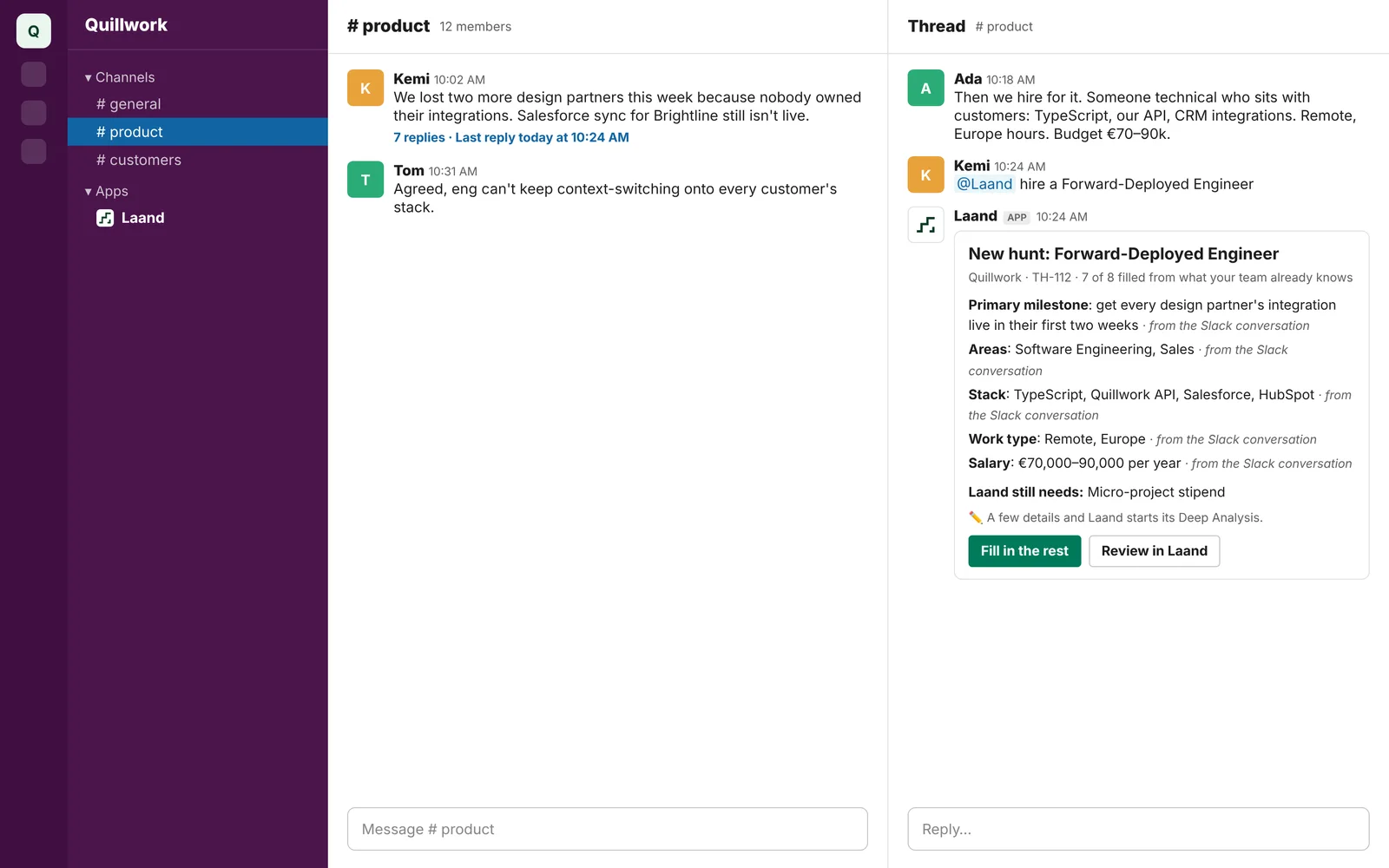
The forward-deployed engineer role was already described in a Slack thread about losing design partners. So the COO types @Laand hire a Forward-Deployed Engineer in that thread, and Laand fills the role from the conversation.
2. Decide what a person must own
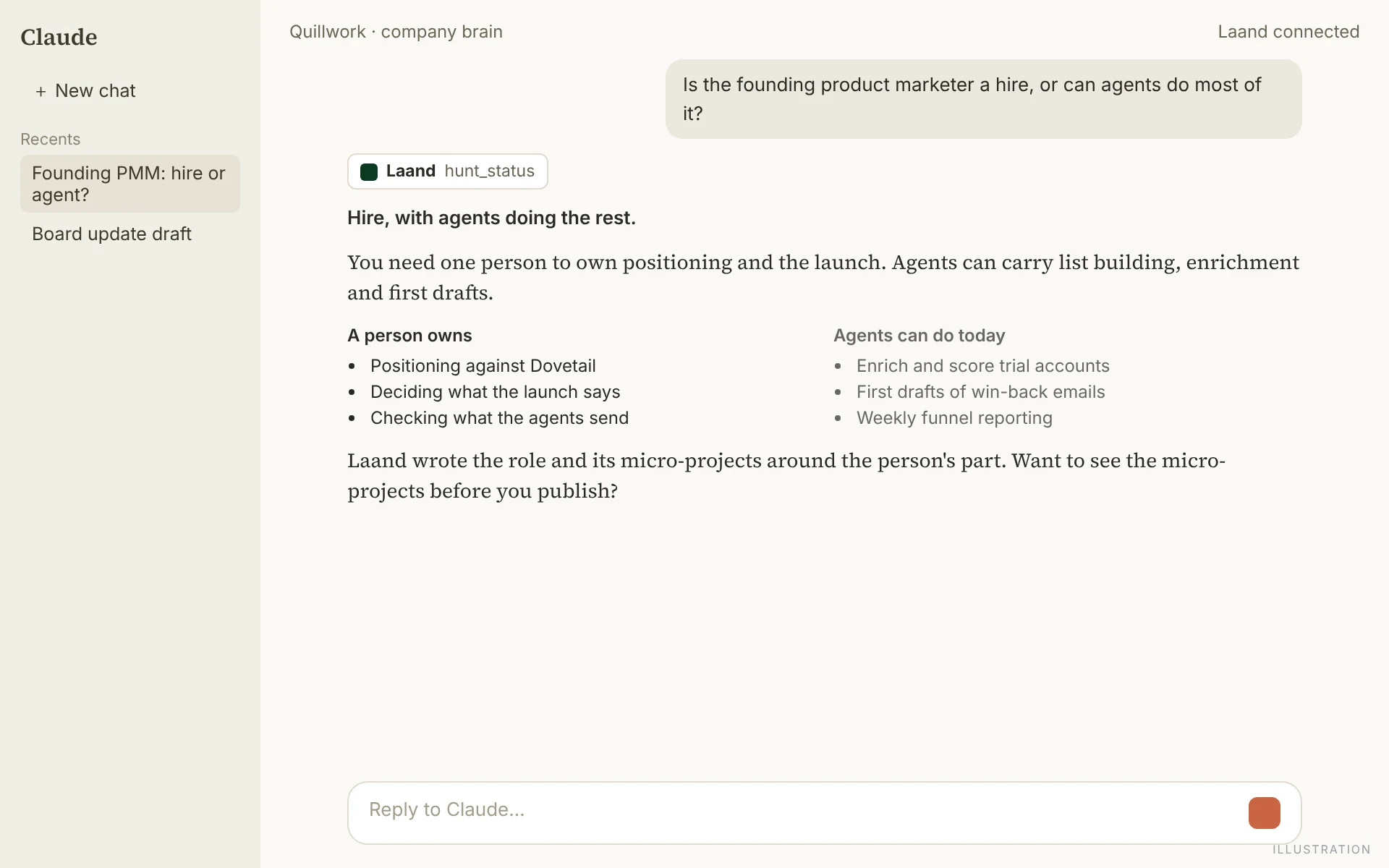
Before the role opens, Laand's Deep Analysis answers hire or agent?: which parts of the role agents can already do, and which a person must own. The growth lead role shrinks a little; the operations generalist turns out to be two-thirds agent work and one-third judgment, which changes who you look for.
3. See real work before you meet anyone
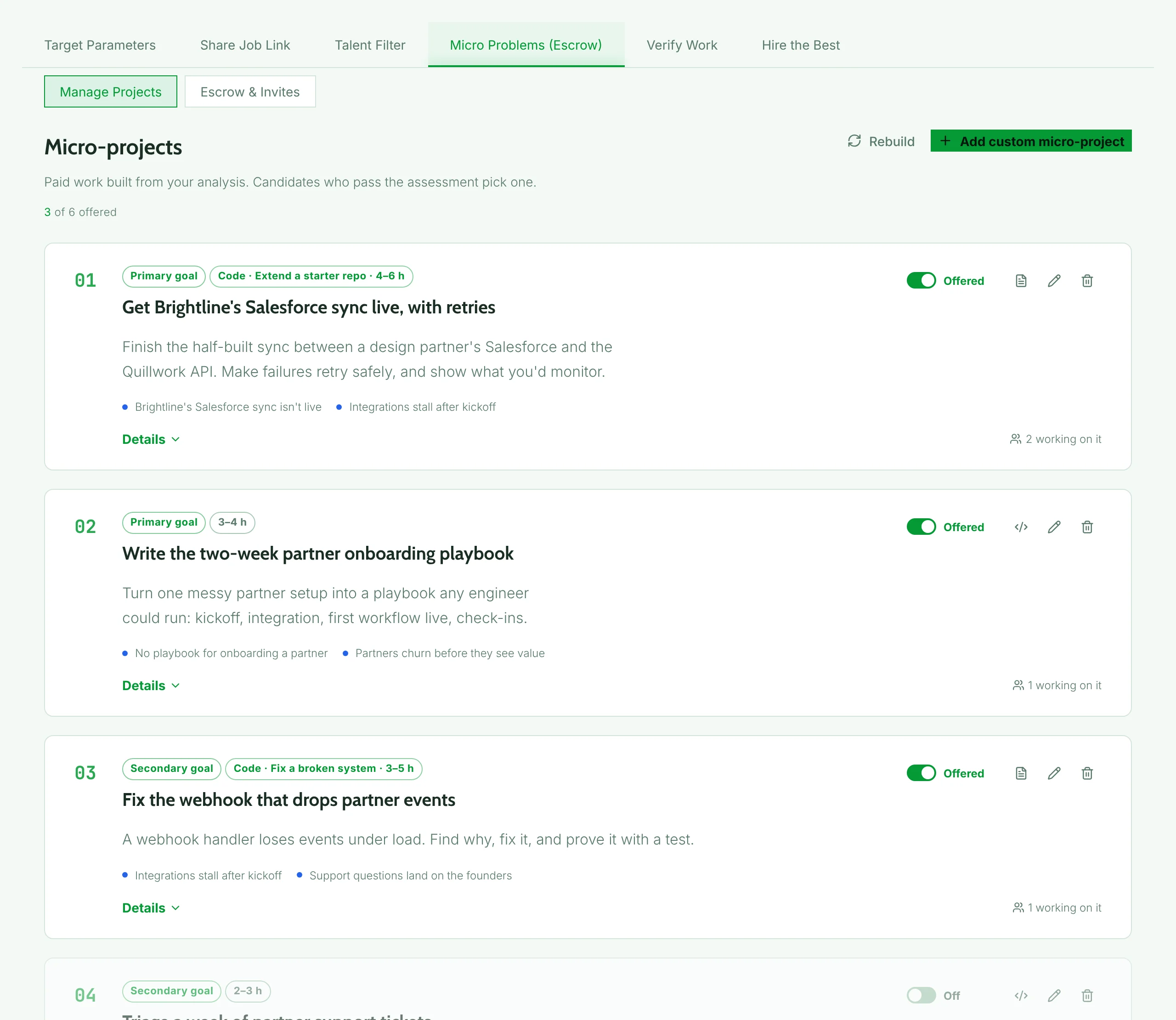
Candidates pass an honest Fit Score, then a High-Agency Assessment, then do a paid micro-project: about six hours of real work on one of your problems, with AI allowed and visible unless you turn it off. Every brief has a planted mistake to catch.
4. Decide as a team, and pay only for who you want
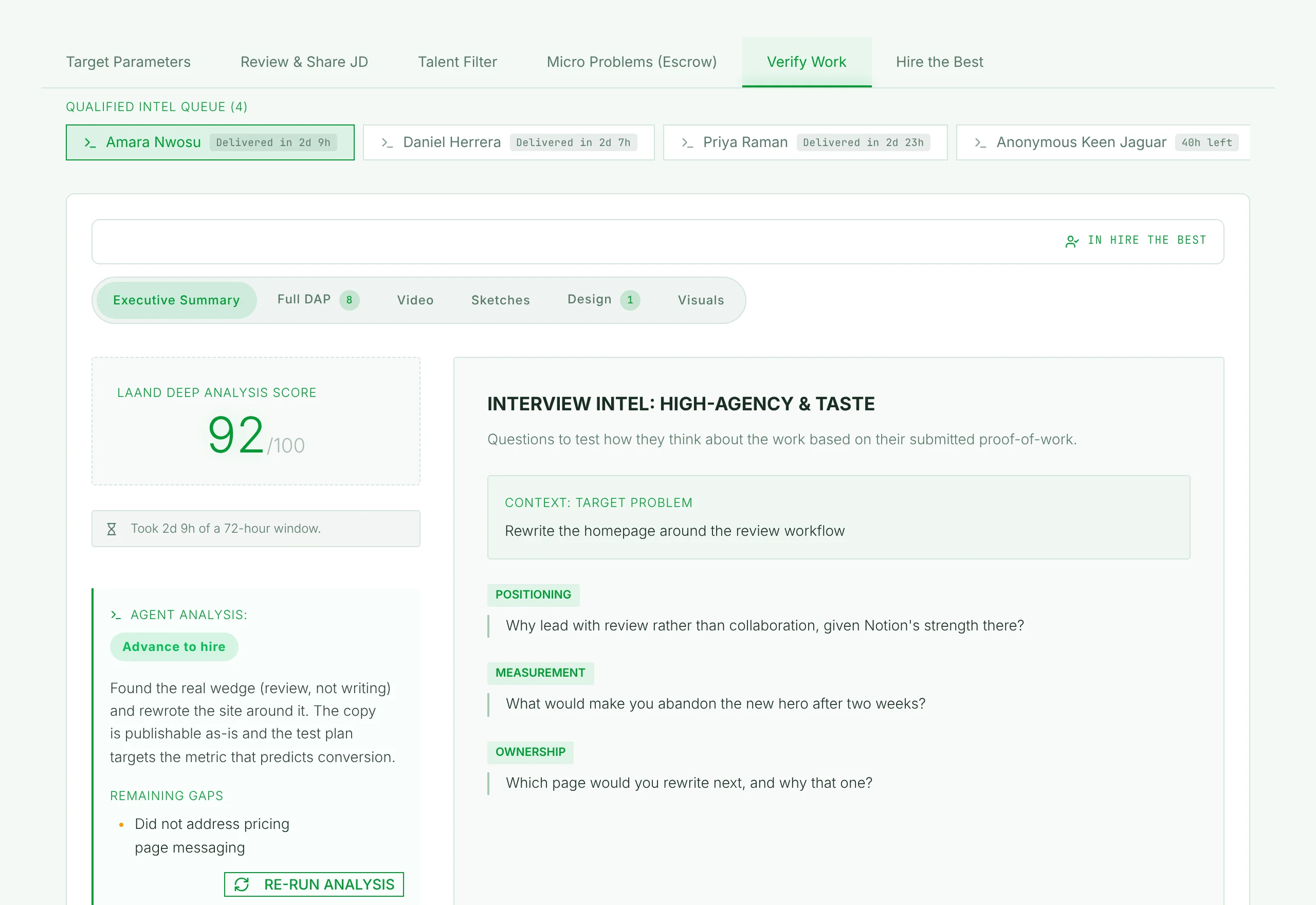
Candidates stay anonymous until you unlock them. Your team decides in a private Slack channel per hunt. You pay $750 per talent unlocked, a flat fee whatever the salary. Publishing is free.
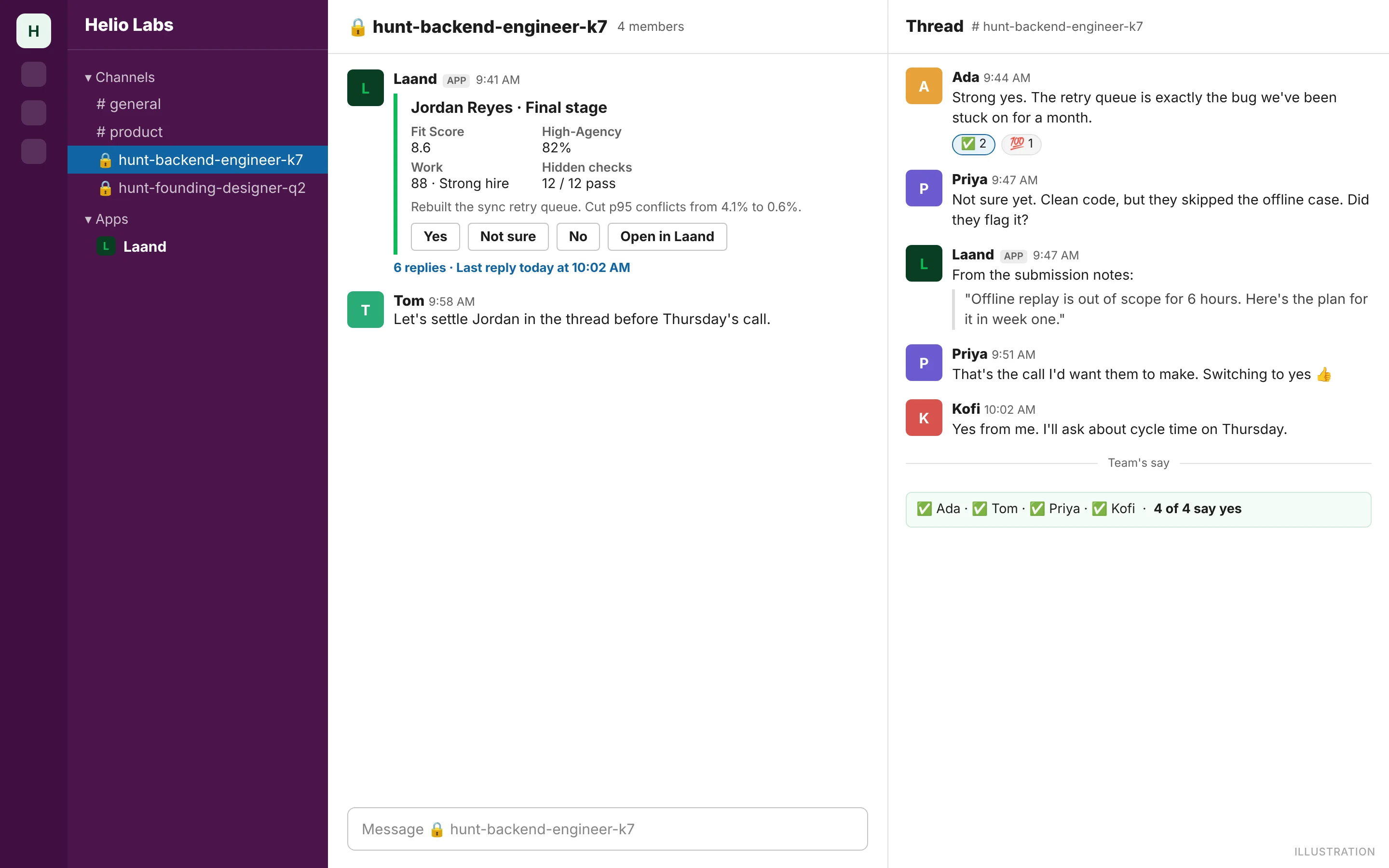
All three, side by side
| AI recruiting agency | ATS with AI | Laand (work-first) | |
|---|---|---|---|
| Starts from | Your brief | A job post | The result you need, plus hire or agent |
| Who sources | The agency | You (and job boards) | Laand's sourcing plus your Job Link |
| Signal before the interview | Their screen | CV plus AI summary | Paid work on your problem, AI use scored |
| Where your team decides | Email or Slack | The ATS | Slack, Claude or your dashboard |
| Candidate identity | Visible | Visible | Anonymous until you unlock |
| How you pay | % of salary on hire | Subscription | Free to publish; $750 per talent unlocked |
| Founder hours per hire | Low to start, high at interviews | High throughout | Low: you meet only people who've done the work |
Which should you choose?
- Choose an AI recruiting agency if you have budget for fees, very little time, and roles where a strong profile is a good enough signal.
- Choose an ATS if you're past roughly fifty people, hiring at volume, and have a recruiter to run it.
- Choose Laand if you're a founder-led AI-native team, the people you need must own outcomes and steer AI, and you'd rather see the work than read about it.
They're not exclusive. Plenty of teams use Laand to decide who's worth hiring and an ATS to keep the records once they're bigger.
What it looks like from the founder's chair
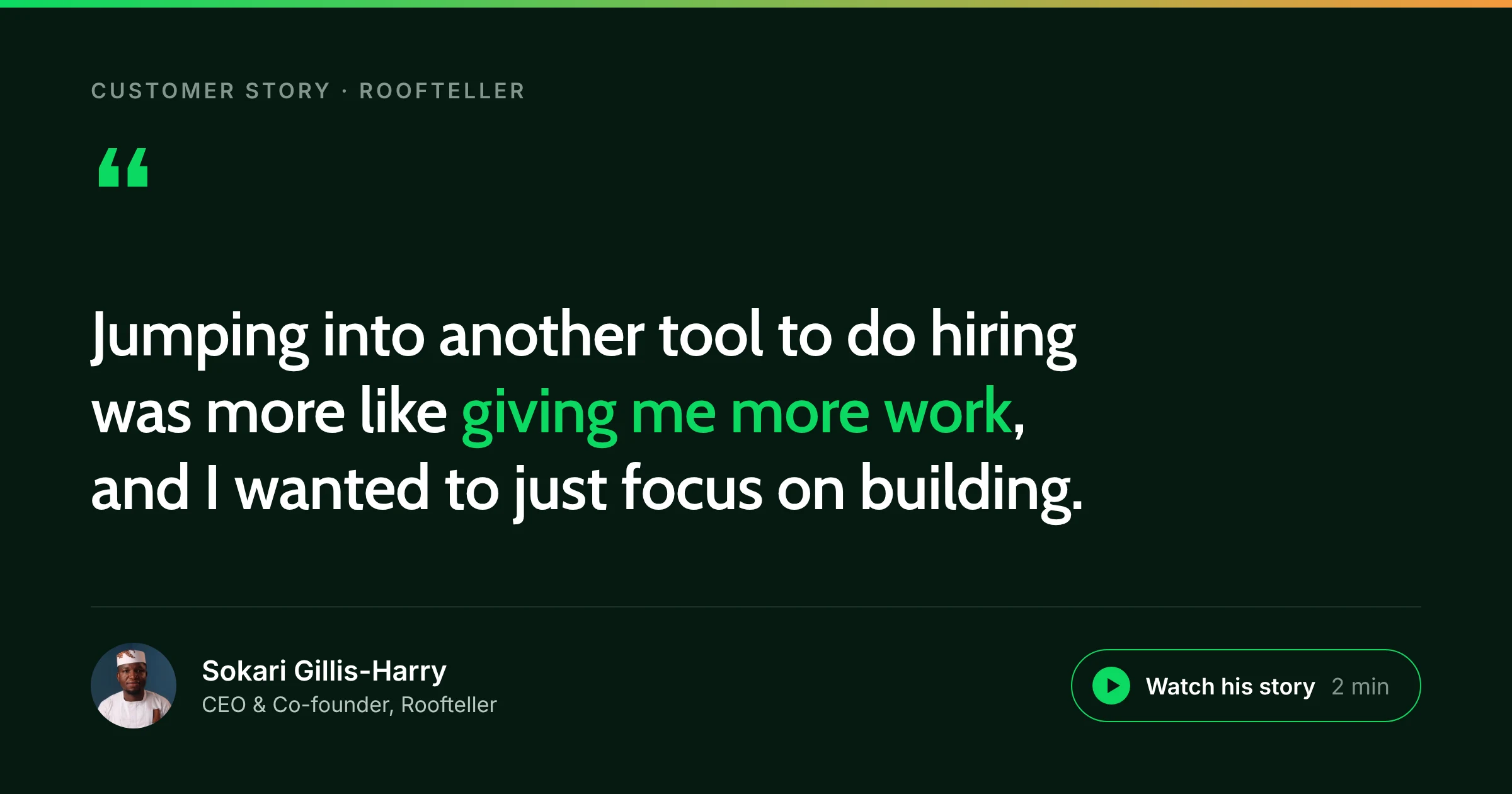
Sokari Gillis-Harry, founder of Roofteller, didn't want either a new tab or an agency. He wanted to hire from the tools he already worked in:
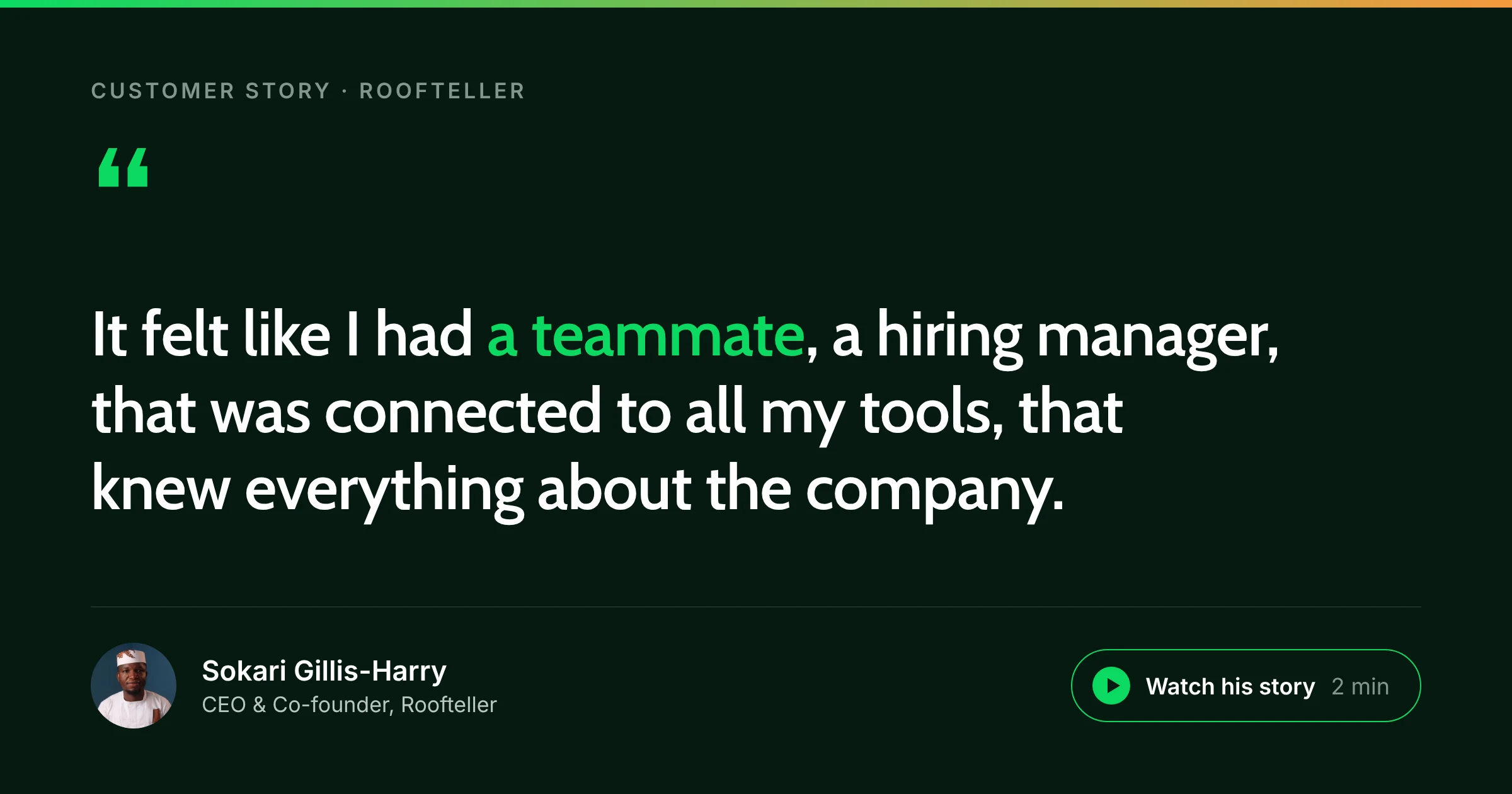
What he got instead:
The real cost of one hire, three ways
Fees are only part of the cost. For a founder-led team, the bigger cost is founder hours and the weeks a role sits open. Here's an illustrative comparison for one senior hire at a $150,000 base salary. Your numbers will differ; the shape usually doesn't.
| AI recruiting agency | ATS with AI | Laand | |
|---|---|---|---|
| Direct fee | A placement fee, often quoted at 15–25% of first-year salary: roughly $22,500–$37,500 here | Your subscription, whether or not you hire that month | $750 for the person you unlock |
| Paid work for candidates | Usually none | Usually none | Stipends for your 3–5 finalists, about six hours each at the role's rate |
| Founder hours before the first good interview | Low | High: reading applications | Low: reviewing a few pieces of work |
| Founder hours in interviews | High: several rounds to verify the shortlist | High | Low: one interview about the work |
| Risk if the hire doesn't work out | The fee is usually already paid | Sunk time | You saw the work first, so the risk is lower to begin with |
The agency is the most expensive in cash and the cheapest in early founder time. The ATS is cheapest in cash per hire at scale and most expensive in founder time when there's no recruiter. A work-first platform tries to be cheap in both, by spending the effort on the one thing that predicts the hire: real work.
Questions to ask before you sign anything
Ask an AI recruiting agency:
- What exactly do you screen for, and can I see the screen?
- What's the fee, when is it due, and what happens if the hire leaves in the first 90 days?
- Do candidates know they're being represented by you, and to how many companies?
- Can I see any work from candidates before I interview them?
Ask an ATS vendor:
- Who on my team will run this day to day?
- What does your AI read, and what does it decide on its own?
- How do decisions made in Slack get back into the system?
- What does it cost in a month when we don't hire anyone?
Ask Laand (we'd ask ourselves the same):
- What will candidates actually do, and how long will it take them?
- How is AI use judged, and can we switch it off for a project?
- Who sees candidates' identities, and when?
- What happens if nobody good applies? (You pay nothing to unlock; publishing is free.)
Frequently asked questions
What's the difference between an AI recruiting agency and an ATS?
An AI recruiting agency finds and screens candidates for you and charges a fee when you hire. An ATS organises the candidates who apply to you and charges a subscription. The agency does the sourcing; the ATS helps your team manage it.
Is an AI recruiting agency cheaper than an ATS?
Per hire, usually not: agencies often charge a share of first-year salary, while an ATS spreads a subscription across many hires. For a startup making only a few hires a year, an agency can cost less in total, but the fee per hire is much higher.
Do startups need an ATS?
Most teams under twenty people don't need one yet. They need a reliable way to find people who can do the work and a place for the team to decide. An ATS becomes valuable at volume, when you have a recruiter and need records and reporting.
What's a work-first hiring platform?
A hiring platform that judges candidates on real work for your company, usually paid and short, instead of on CVs and screening calls. Laand is a work-first platform built for AI-native teams: AI is allowed in the work, and how candidates use it is scored.
How much does Laand cost?
Publishing a Talent Hunt is free. You pay $750 per talent you unlock, only after you've seen their work. Micro-projects pay candidates a stipend you set.
Keep reading
- AI-native hiring platforms, and how to choose one
- The best AI recruiting tools for startups in 2026
- Paid work trial vs take-home assignment
Or skip the comparison and start a Talent Hunt from the thread where you decided to hire. The first people you meet will have already done the work.
Stop applying blind.
Laand scores your fit for any role, then builds the application kit that proves you can do the job.
Join LaandSee the work before you choose the person
Start a Talent Hunt from Slack, Claude or your dashboard. Laand brings back people who've done paid, real work on your problem. Free to publish; $750 per talent you unlock.
Start a Talent Hunt