How to hire high-agency people: a founder's field guide
Everyone puts "high agency" in the job ad. Almost nobody hires for it. Here's how.

Imagine two candidates applying for the same operations role at a ten-person startup.
The first had the better CV: four years at a well-known scale-up, "owned vendor management", "drove process improvements". In the interview, every answer started with "what we did was…".
The second had a thinner CV and one odd line: "Rebuilt my previous company's onboarding after noticing churn in month two. Nobody asked." In the interview, asked how she'd handle a supplier who kept missing deadlines, she asked three questions about the contract, then said she'd already have a backup supplier quoted by Friday, and that she'd use an agent to monitor the delivery dates so it never surprised anyone again.
Most founders hire the first one. Six months later, it's often the most expensive mistake of their year.
The second candidate had what every startup job ad now asks for and almost no hiring process finds: high agency.
What high agency actually means
High agency is the tendency to own an outcome and find a way to it without waiting for permission, instructions or perfect conditions. A high-agency person treats "nobody's doing this" as an invitation, not an excuse.
It isn't the same as:
- Hard work. Plenty of people work hard on what they're told.
- Confidence. Agency shows in what someone does, not how they talk.
- Seniority. Some juniors have more agency than some executives.
On an AI-native team, high agency has a sharper edge. When agents can write the code, the copy and the analysis, the scarce part is deciding what to build, spotting what the agent got subtly wrong, and driving the work to done. High-agency people steer AI; others follow it.
Why everybody asks for it and nobody finds it
The Laand Hiring Index reads hundreds of thousands of job descriptions a month. In October 2026, job ads asked for agency in four main ways: proactiveness (19%), autonomy (16%), craft (4%) and comfort with ambiguity (3%).

But of the roles that explicitly ask for high agency, 79% gave candidates no way to show it beyond a résumé.

That's the gap. You can't see agency on a CV, because a CV is a description of the past in the candidate's words, and in 2026 it's often written with AI. You need to see the person act.
The four signals of high agency
When I hired at VEC Studio, for my own team and for clients, the people who turned out to have real agency shared four signals. You can look for all of them.
| Signal | What it looks like | How to see it |
|---|---|---|
| Unasked-for ownership | They fixed something that wasn't their job | Ask: "What's something you fixed that nobody asked you to?" |
| Speed to specifics | Ambiguity makes them ask sharp questions, then commit | Give an ambiguous scenario with a deadline |
| Resourcefulness under constraint | They find a way with no budget, no team, no time | Add a hard constraint and watch what they do |
| Judgment over tools | They check, correct and push back on AI | Let them use AI on real work and look at how |
Notice what's missing: years of experience, brand-name employers, degrees. None of them predict agency well.
Step 1: Define the outcome they'll own
You can't hire for agency in the abstract. Agency is always about something. Start with the result you need, not the role.
Brian Chesky, CEO of Airbnb, put it simply:
"Start with the results and work backwards to the people. Most [startups] start with resumes."
Write one paragraph: the problem, how you'll measure it, the deadline, and the constraint. "Supplier delays are costing us two weeks per order. We need on-time delivery above 95% by March, with no new headcount beyond this hire."
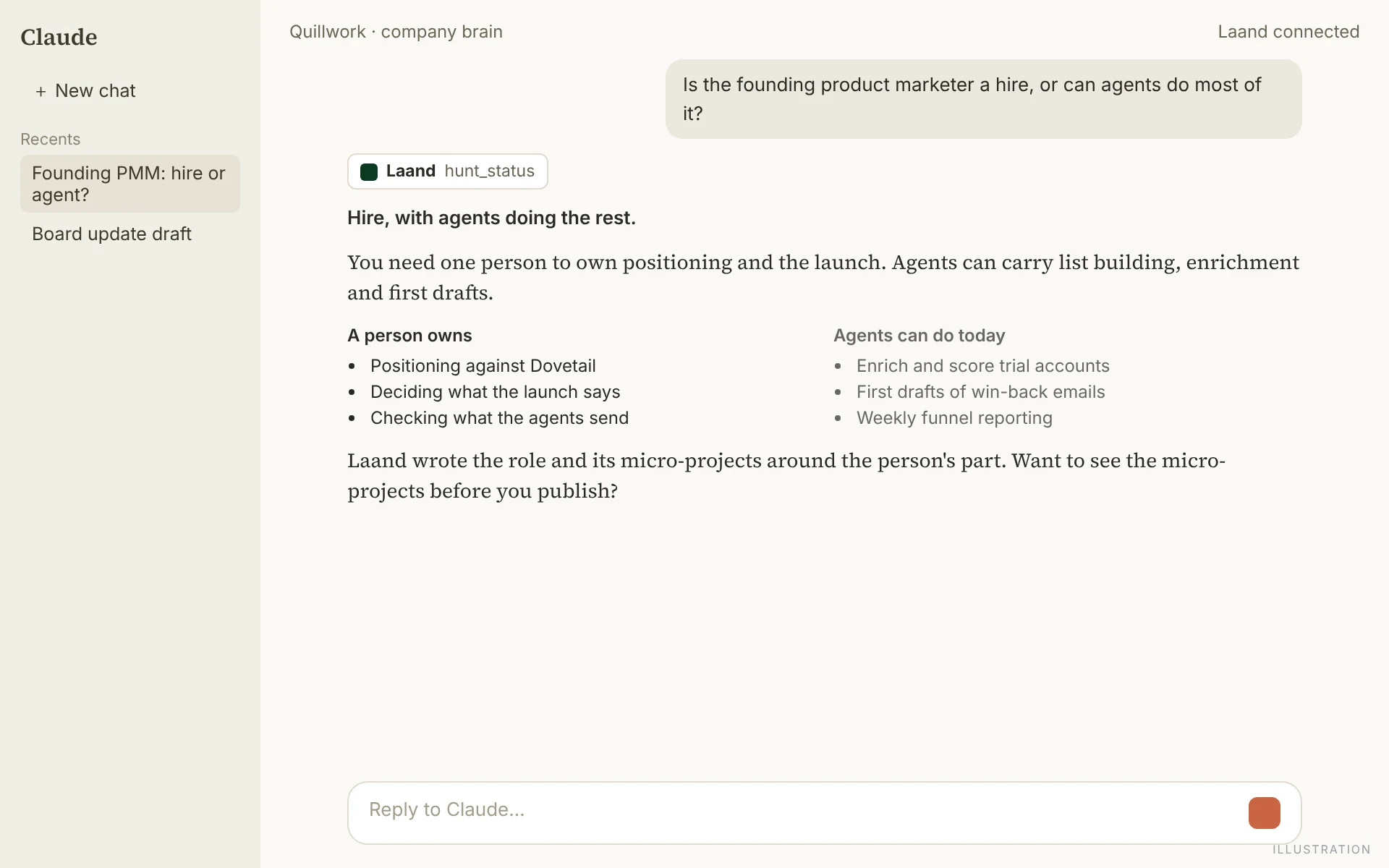
Then split it: what can AI agents already do, and what must a person own? The person's part is where agency matters.
With Laand, this is the start of every Talent Hunt. You describe the problem in Slack, Claude or the dashboard, and Laand's Deep Analysis returns a straight answer to hire or agent?, then writes the role around what a person must own.
Step 2: Go where high-agency people are (they're rarely job hunting)
High-agency people are usually employed, busy and not reading job boards. That's the point: someone good at owning outcomes tends to have outcomes to own.
Three things help reach them:
- Make the problem the headline. "Fix our supplier delays by March" attracts owners. "Operations Manager" attracts title-matchers.
- Pay for their time. An employed person won't do free work on the chance of a job. They will do six hours of interesting, paid work.
- Show the stakes. What changes if they succeed, and what it costs if nobody does.
With Laand, your hunt's public Job Link leads with the milestone and the paid micro-projects, and Laand invites people whose saved work matches what you're hiring for.
Step 3: Filter for fit before anyone spends effort
Let candidates check honestly whether they fit before they invest time. Ask five specific questions that only someone who understands your problem could answer well.
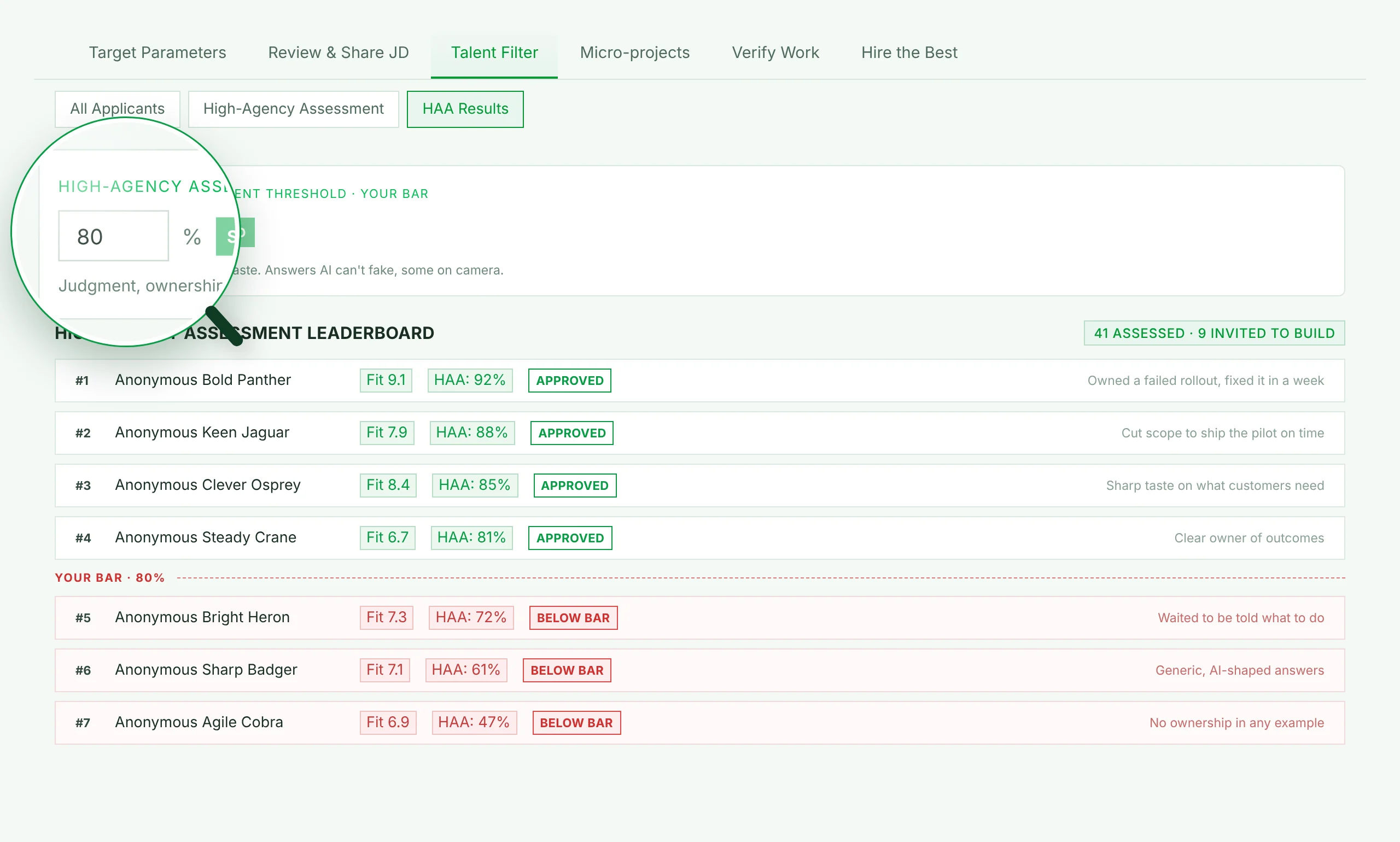
With Laand, every candidate gets a Fit Score first. Laand reads your role and their background and tells them, honestly, where they're strong and where they're thin. Below the bar you set, they don't move on.
Step 4: Test agency with ambiguity and a constraint
The most revealing question format I know:
An ambiguous situation from your real work + a hard constraint + no right answer.
Example for an operations role: "Our biggest supplier just missed two deliveries. You have no budget for a second supplier and the founder's on a plane for 48 hours. What do you do in the next two days?"
High-agency answers get specific fast and include a first action. Low-agency answers describe a process or wait for more information. (More examples in how to test for high agency in interviews.)
With Laand, candidates who pass the Fit Score take the High-Agency Assessment: short questions drawn from your hunt's core problems, some answered on camera or by screen share, scored against your bar.
Step 5: See them act on real, paid work
Nothing beats watching someone do a slice of the job. Give your top three to five candidates a paid micro-project: about six hours on one of your real problems.
Two details make it work for agency:
- Allow AI, and make it visible. Ask for the links to the AI chats they used. High-agency people steer, check and correct the agent; others paste its output.
- Plant a mistake in the brief. A wrong figure, a broken assumption. People with agency question the brief. Others execute it, mistake and all.
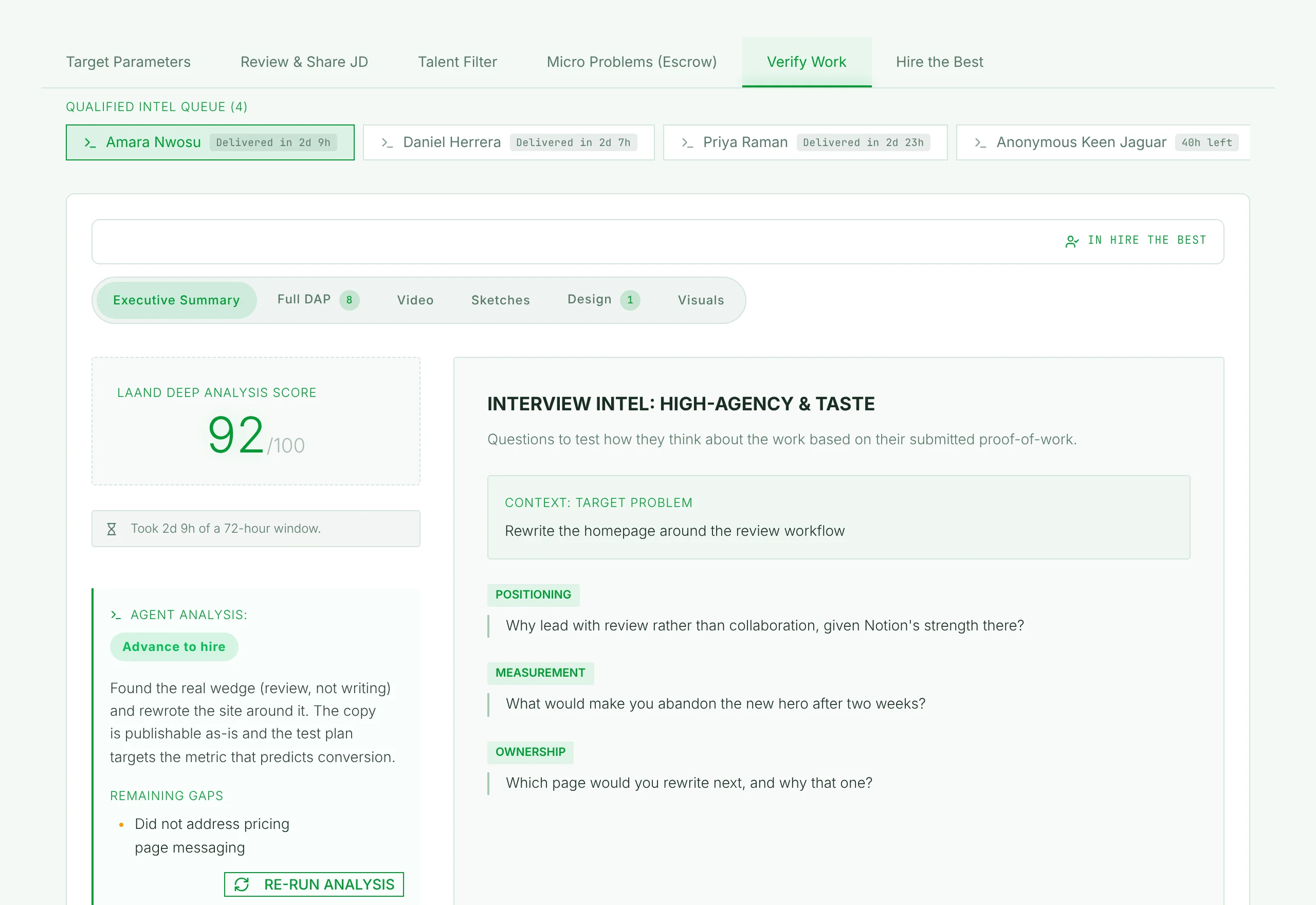
With Laand, micro-projects are scoped from your core problems, every brief carries a planted mistake, and Laand scores the work and how the person worked with AI.
Step 6: Interview about the work, then decide as a team
Now the interview is short and specific: "Walk me through why you cut this. Where did the agent get it wrong? What would you do in week two?" Agency is obvious in the answers, because they're about something real.
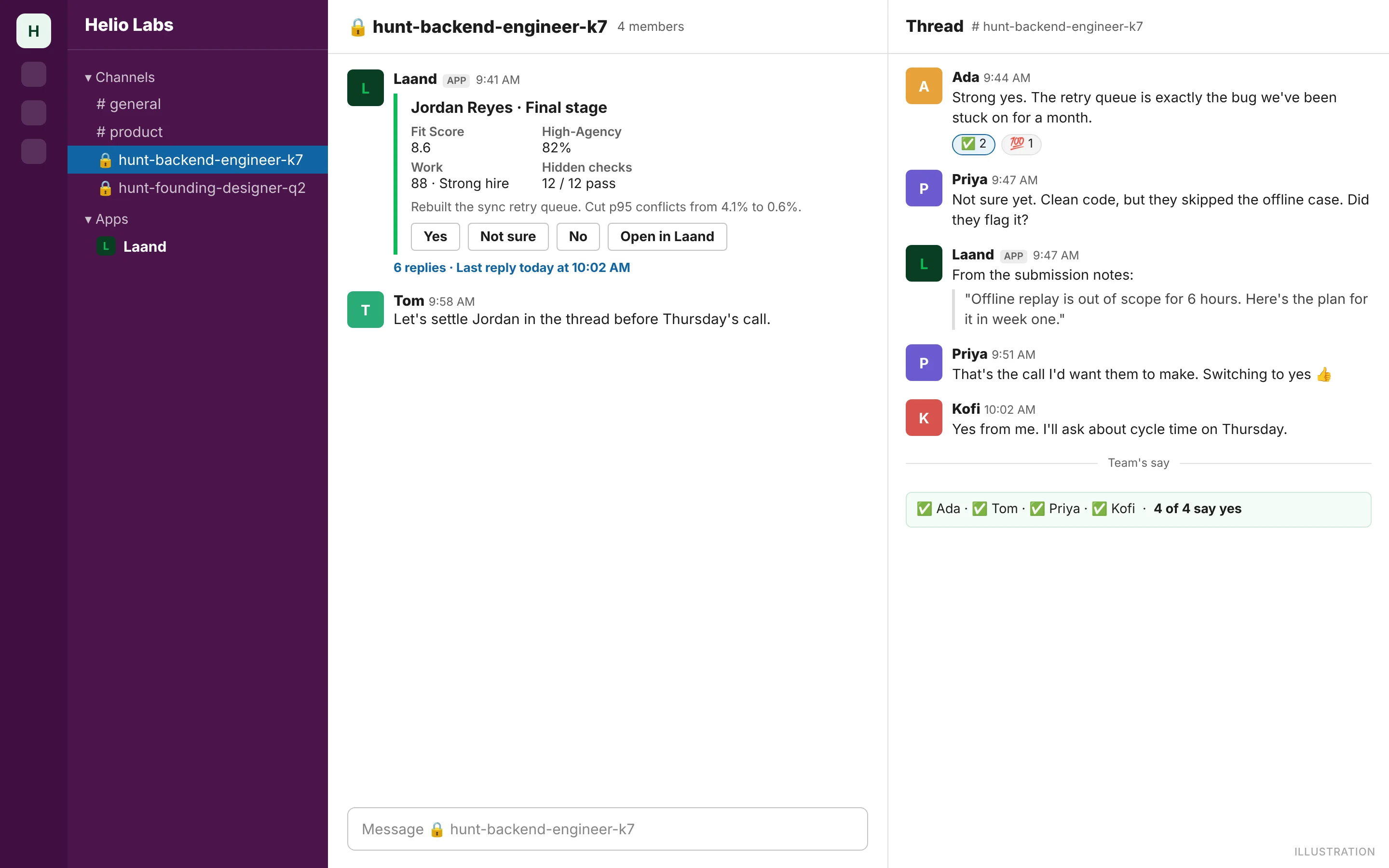
With Laand, your team decides in a private Slack channel, on anonymous cards. When you're ready, you unlock the person for $750. Publishing is free.
Red flags and green flags
| Green flags | Red flags |
|---|---|
| "I noticed… so I…" | "I was responsible for…" |
| Asks sharp questions, then commits | Waits for complete information |
| Caught the planted mistake | Executed the brief as written |
| AI chats show pushback and checking | AI output pasted without changes |
| Describes trade-offs and what they cut | Lists every tool they've used |
| Asks about the outcome and the deadline | Asks mostly about process and title |
What it looks like when you get it right
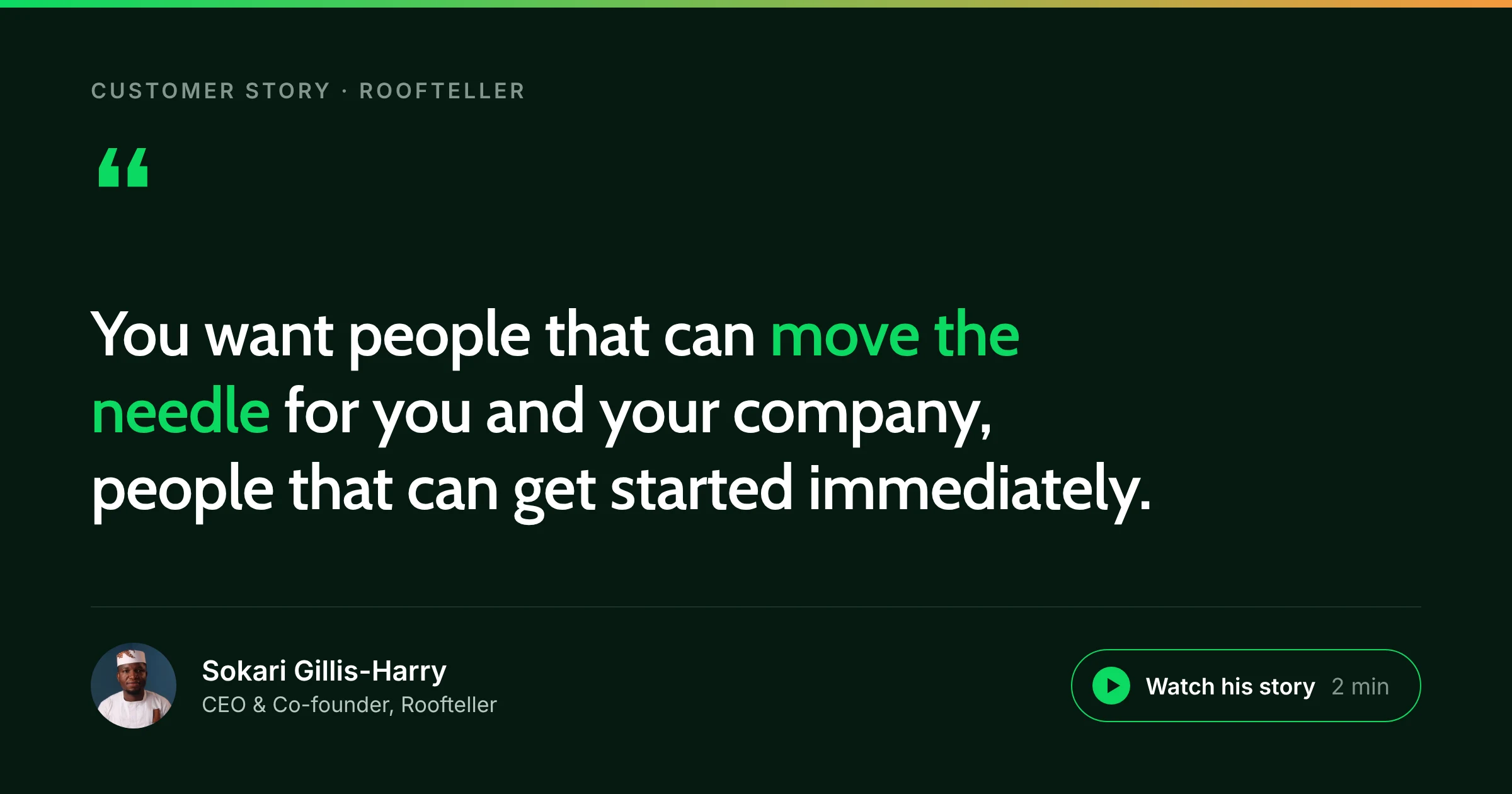
Sokari Gillis-Harry, founder of Roofteller, put the goal better than any framework:
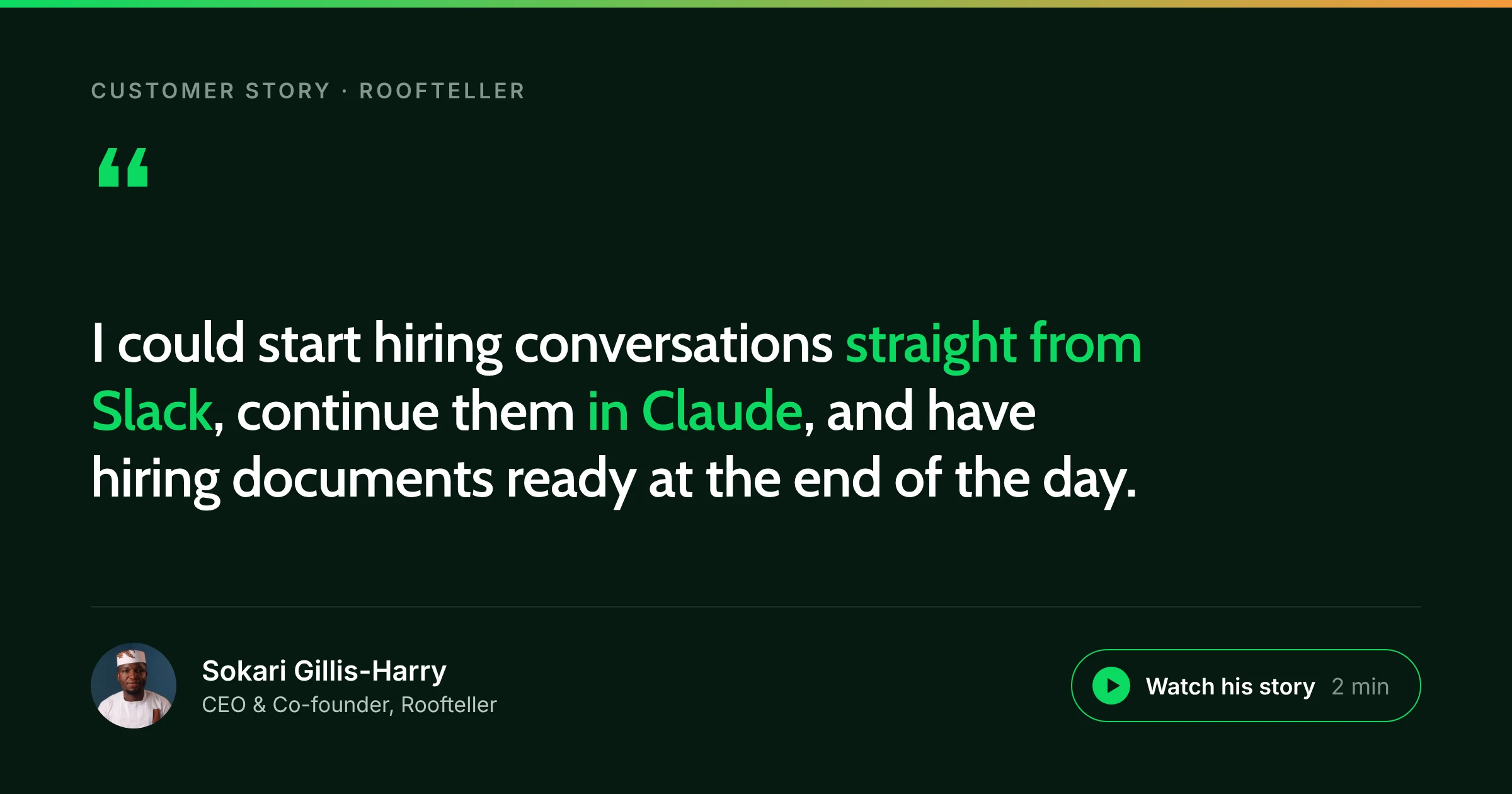
He found those people without leaving the tools he already worked in:
Where high-agency people actually are
They're rarely on job boards. Look where agency leaves traces:
| Where | What to look for |
|---|---|
| Public repos and issue trackers | People who fixed things in projects they don't own |
| Newsletters, blogs and launch posts | People who shipped something nobody asked for |
| Your own customers and community | Users who sent you a workaround, a bug fix or a better onboarding doc |
| Adjacent startups that just shut down | Operators who kept things running to the last day |
| Unglamorous industries | People who modernised a process with no budget and no mandate |
| Laand's Career Vault | Projects described with the problem, the AI chats behind them and the outcome |
Then make it easy for them to say yes: lead with the problem, show the paid work and the stipend, and don't ask for a cover letter.
The first 30 days: don't smother the agency you hired
A common, painful pattern: you hire a high-agency person, then onboard them like everyone else. Long ramp-up, approval for everything, a backlog of small tasks. Within a month they're either frustrated or gone.
Instead:
- Give them the result on day one. The same one you hired them for.
- Give them access, not a reading list. Systems, data, customers.
- Agree the guardrails, not the steps. Budget limits, what needs a second opinion, what's off-limits.
- Ask for a 30-day plan by the end of week one, then get out of the way.
- Review outcomes weekly, not activity daily.
With Google Drive connected, Laand drafts a 90-day onboarding guide for each hire, tied to the result and the core problems from their hunt, so they start on the work you hired them for.
Frequently asked questions
What is a high-agency person?
Someone who owns outcomes and finds a way to them without waiting to be told how. On AI-native teams, it also means steering AI agents to results, checking their work, and driving it to done.
How do you identify high agency in a candidate?
Look for unasked-for ownership in their past, speed to specifics in ambiguous scenarios, resourcefulness under hard constraints, and judgment when using AI on real work. Paid work samples reveal it far better than CVs.
What interview questions reveal high agency?
Ask about something they fixed that nobody asked them to, and give an ambiguous scenario from your own work with a hard constraint. See how to test for high agency in interviews for a full question bank.
Is high agency the same as being proactive?
Proactiveness is part of it. High agency also includes owning the outcome, being resourceful under constraints, and, on AI-native teams, exercising judgment over AI.
Can high agency be taught?
It can grow with the right environment, but it's much easier to hire for than to train. That's why it's worth testing for directly.
Keep reading
- How to test for high agency in interviews
- How to run a paid trial project
- Hiring for AI-native teams
Or start a Talent Hunt. The High-Agency Assessment and paid micro-projects are built in.
Stop applying blind.
Laand scores your fit for any role, then builds the application kit that proves you can do the job.
Join LaandHire for agency, on real work
Start a Talent Hunt from Slack, Claude or your dashboard. Laand's High-Agency Assessment and paid micro-projects show you who owns outcomes before you meet anyone.
Start a Talent Hunt