How to attract high-agency candidates: lead with the problem and a paid project
High-agency people don't respond to job titles. They respond to problems worth owning, and to companies that respect their time.

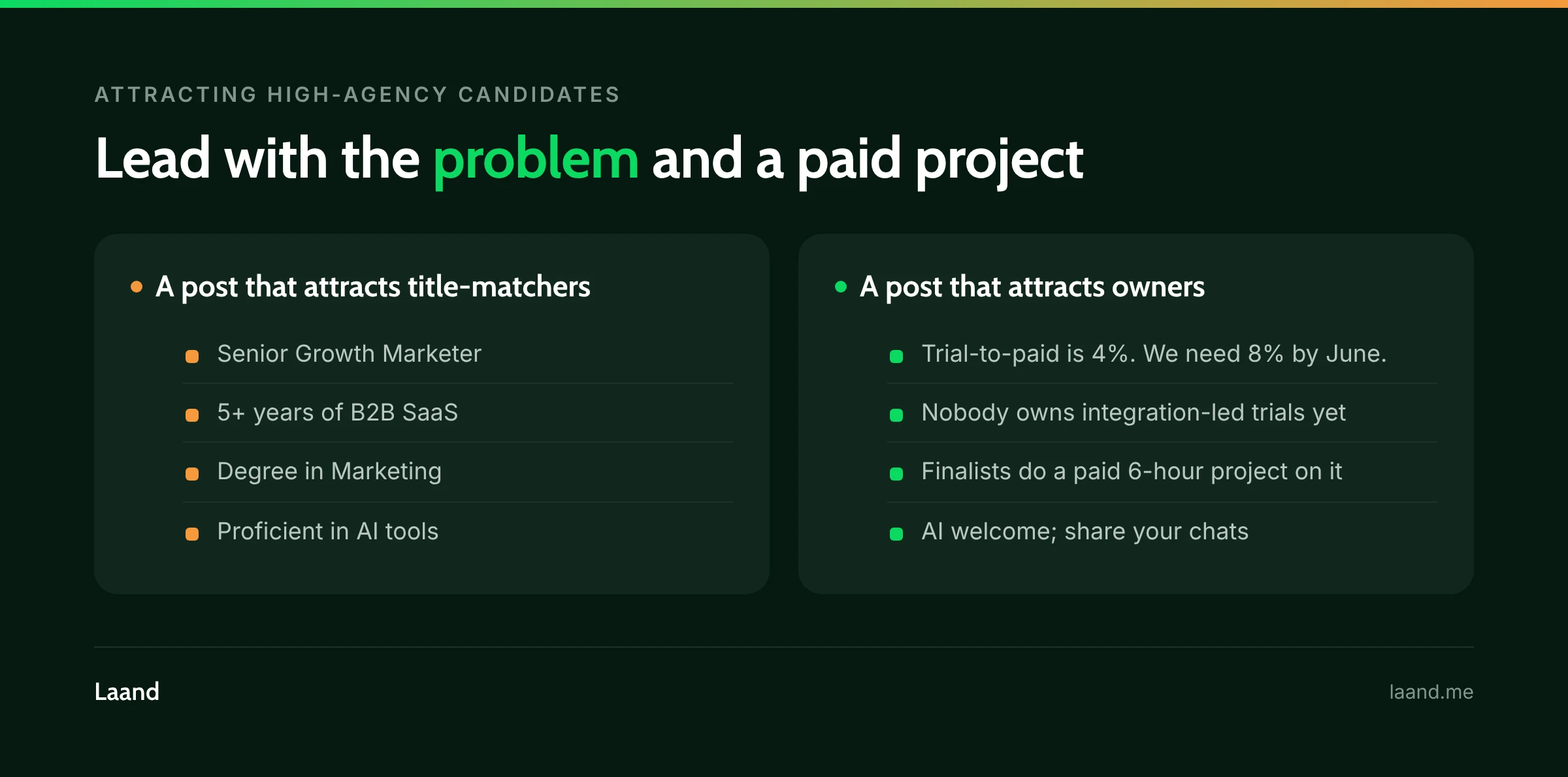
Read these two job post openings and ask yourself which one a high-agency person would finish reading.
Post A: "We're a fast-growing, venture-backed startup looking for a rockstar Senior Growth Marketer to join our world-class team! You'll own the growth function end-to-end in a fast-paced environment. Requirements: 5+ years of B2B SaaS experience, a degree in Marketing or a related field, proficiency in HubSpot, Google Ads and AI tools. You thrive in ambiguity and have a bias for action."
Post B: "Our trial-to-paid conversion is 4%. We need it at 8% by June. Most of our best trials now come from a partner integration that nobody owns yet, and our onboarding still assumes paid search. This hire owns that number. Agents already draft our emails and reports; we need a person who decides what to say, to whom, and what to stop. Finalists do a paid six-hour project on our real (anonymised) funnel data. AI is welcome; share your chats. No degree or years required."
Post A describes a title. Every high-agency person has read it a thousand times, and it tells them nothing they can act on. Post B describes a problem worth owning, the stakes, what agents already do, and a fair, paid way to prove themselves. It also quietly tells the wrong people to keep scrolling.
What high-agency people are actually looking for
Ask people who own outcomes what makes them consider a move, and the answers rarely include perks or titles. They're looking for:
- A problem worth owning. Something hard, important and theirs.
- Room to act. Clear outcomes, few approvals.
- People with taste. A team that knows what good looks like.
- Respect for their time. They're employed and busy; a five-round loop is a deal-breaker.
- A fair test. They'd rather show what they can do than talk about it.
Everything in your post and your process should speak to those five.
Why most job posts repel the people they want
| Common phrase | What a high-agency person reads |
|---|---|
| "Rockstar / ninja / world-class" | No specifics, so no real problem |
| "Fast-paced environment" | Chaotic, without a clear outcome |
| "Thrives in ambiguity" | Copied from every other ad |
| "5+ years required" | They hire on time served, not ability |
| "Proficient in AI tools" | They don't know what the job is |
| A long list of responsibilities | No priorities, so no taste |
| "Apply with CV and cover letter" | They'll judge me on documents, not work |
The Laand Hiring Index tracks this across hundreds of thousands of ads. In October 2026, ads asked for agency mostly as "proactiveness" and "autonomy", and only 4% mentioned craft.

And among roles that explicitly ask for high agency, 79% give candidates no way to show it beyond a résumé.

That's the opening for you: ask for agency and show candidates how they'll prove it.
The anatomy of a post that attracts owners
1. The result, in the first line
"Our trial-to-paid is 4%; we need 8% by June." A high-agency person decides in one sentence whether this is worth their time. Give them the sentence. Brian Chesky's principle applies to the post itself: "Start with the results and work backwards to the people. Most [startups] start with resumes."
2. Why now, and what it costs if nobody owns it
Stakes create urgency. "We've lost two design partners this quarter because nobody owns their integrations."
3. What agents already do, and what's left for the person
This is new, and it works. It shows you've thought about the role, and it tells candidates exactly which part needs their judgment. "Agents draft our emails and pull our reports. We need someone to decide what we say, to whom, and what we stop doing."
4. Real ambiguity, described honestly
Instead of "thrives in ambiguity", show the ambiguity: "We don't yet know whether the partner channel or self-serve is the bigger lever. Figuring that out is part of the job."
5. A paid project, not an interview gauntlet
"Finalists do a paid, six-hour project on our real (anonymised) data. Stipend: [amount]. AI welcome; share your chats. Then one conversation about your work." This is the most powerful sentence in a post for high-agency people. It says: we'll judge you on what you can do, and we value your time.
6. Fewer requirements
Cut every requirement you'd waive for the right person. Degrees and years usually go first.
7. Short
Taste attracts taste. A post that's a page long, specific and honest says something about the people who wrote it.
Outreach for people who aren't looking
The same rules apply in a direct message, compressed:
Hi [name]. Your [specific work] is why I'm writing. We're [N] people building [product], and we're stuck on [specific problem], which is costing us [stakes]. We pay people to take a real swing at it before anyone interviews: about six hours, [stipend], AI welcome. Brief here: [link]. No CV needed.
(For finding these people in the first place, see where to find high-agency talent.)
How Laand attracts high-agency candidates for you
Laand builds these principles into every Talent Hunt.
The hunt is written from your result. Start from a Slack thread, a Claude conversation or your dashboard. Laand fills the Target Parameters from what's already been said, then its Deep Analysis splits the role into what agents can do and what a person must own, and writes the job description around the person's part, including what the milestone changes and what it costs if it's missed.
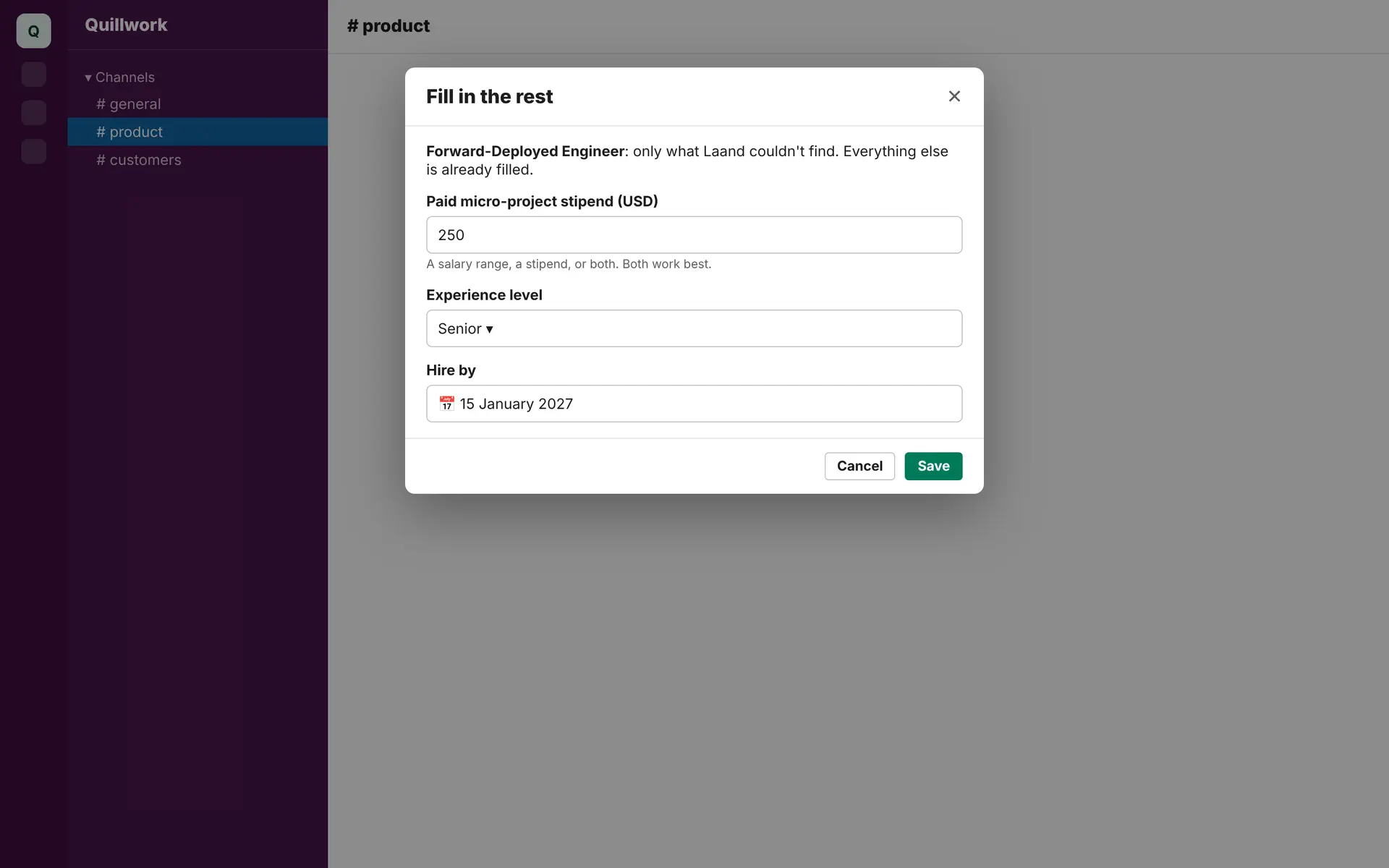
The paid project is on the posting. Laand asks for the stipend while the role is being set up, suggests one from the role's own pay (about six hours at that rate), and shows it on the public posting, because a number nobody sees motivates nobody.
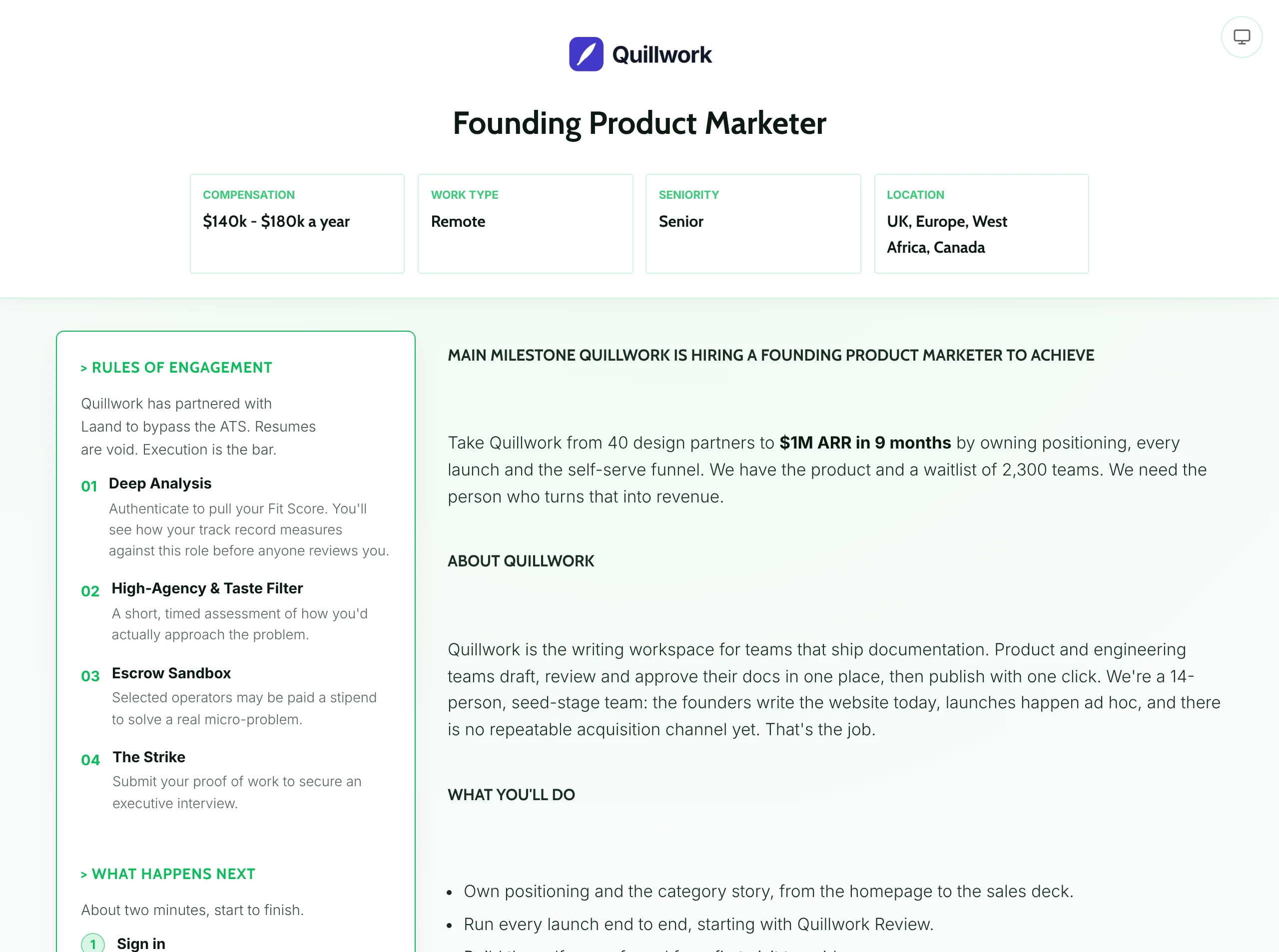
The right people are invited. Publishing puts your hunt on Laand's job board and alerts matching talent the day it opens. People whose saved Career Vault work matches your hunt may be invited by email, naming the project.
Candidates know where they stand. Before applying, candidates get an honest Fit Score: what you're really trying to fix, and where their background is strong or thin. High-agency people appreciate that; it respects their time.
The process respects them. Fit Score, a short High-Agency Assessment, then paid work, then one conversation. Candidates are anonymous until you unlock them, at $750 per talent unlocked. Publishing is free.
Before and after: three roles
| Role | Before | After |
|---|---|---|
| Founding engineer | "Senior full-stack engineer, 7+ years, React/Node, startup experience" | "Take us from 12 design partners to self-serve: first 100 paying teams by Q3. Paid 6-hour project in our real codebase." |
| Forward-deployed engineer | "Customer-facing engineer, strong communication skills, integrations experience" | "Every new customer's integration is live in 6 weeks; we need 14 days. Paid project: make a real (anonymised) sync reliable." |
| Chief of staff | "Chief of Staff to CEO, MBA preferred, consulting background, thrives in ambiguity" | "Free 10 of the CEO's hours a week by owning our operating rhythm. Paid project: turn last month's notes into next month's one-page plan." |
A founder's view
Sokari Gillis-Harry, founder of Roofteller, described what he was looking for in plain words:
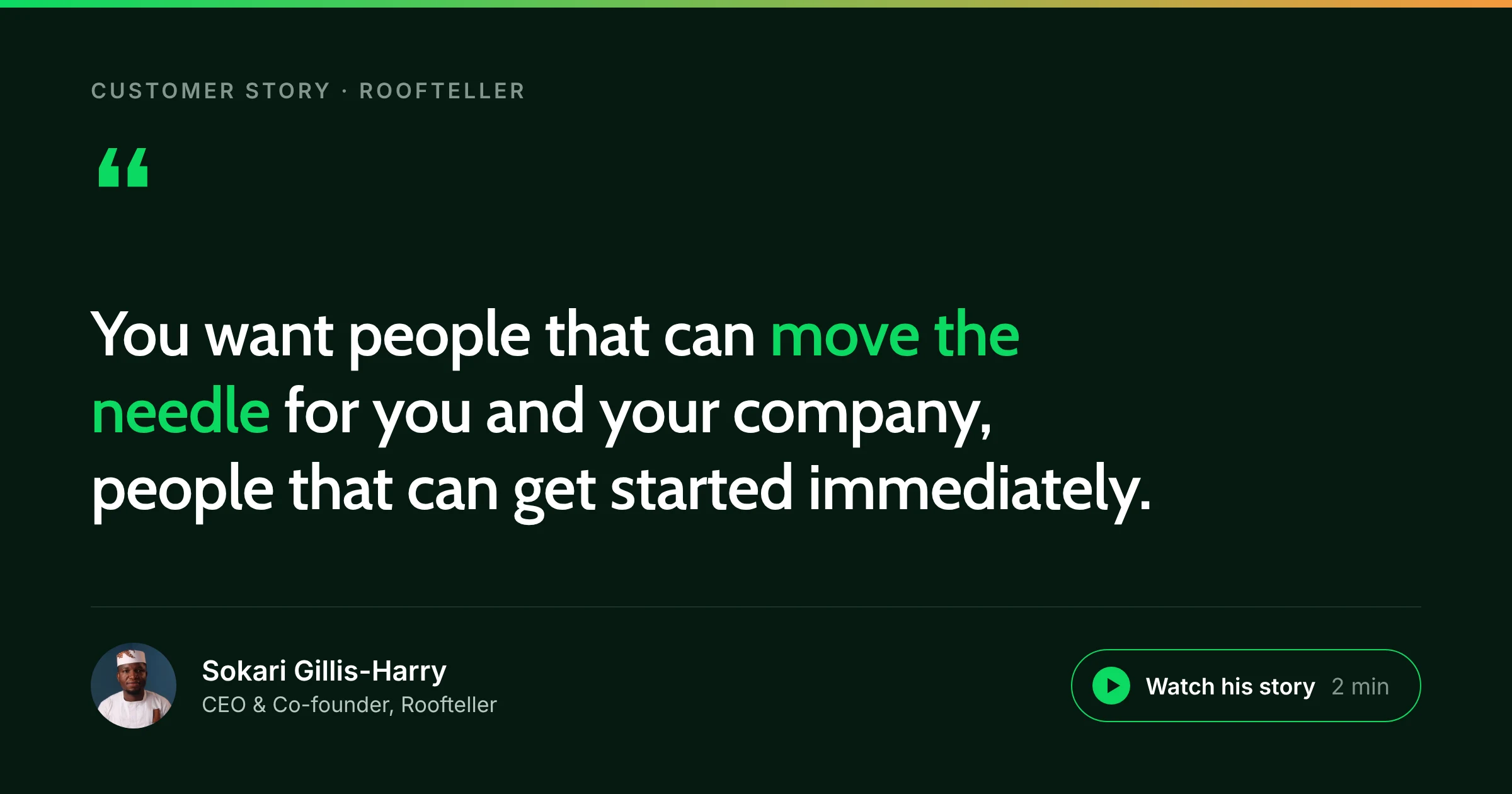
Write your post for exactly that person.
The candidate experience that keeps them
Attracting high-agency people is half the job. The other half is not losing them in the process. They have options, so every slow or disrespectful step is a reason to drop out.
| Step | What loses them | What keeps them |
|---|---|---|
| First contact | A generic reply, or none | A reply within two working days |
| Screening | A long form and a CV upload | A short, honest fit check on your problem |
| Assessment | Five interview rounds | One short assessment, then paid work |
| The paid project | Vague brief, unclear pay | One-page brief, stated stipend, clear deadline window |
| After submission | Silence | Feedback on their work within a week, hired or not |
| The decision | Weeks of "we'll be in touch" | One conversation about their work, then a decision |
Your careers page is a job post too
High-agency candidates read your careers page before they apply. Make it do the same work as your posts:
- Say what the company is trying to achieve this year, in one paragraph.
- List open problems, not just open roles.
- Explain how you hire: the fit check, the paid project, the one conversation.
- Show the work people do, not the snacks in the kitchen.
Signals in your process that repel the best
- Asking for a cover letter.
- Asking for unpaid take-homes longer than an hour.
- Rejecting by silence.
- Interviews that don't mention the result the role exists for.
- A degree requirement for a role that doesn't need one.
Each of these tells a high-agency person that you value documents and process over outcomes and their time.
Key takeaways
- High-agency people respond to problems worth owning, room to act, taste, respect for their time and a fair test.
- Lead with the result, the stakes and what agents already do.
- Replace buzzwords with real, honestly described ambiguity.
- Offer a paid project scoped from your work instead of an interview gauntlet.
- Keep it short; taste attracts taste.
- Keep them once they're interested: reply within two days, give feedback on their work, and decide after one conversation.
Frequently asked questions
How do you attract high-agency candidates?
Lead with a real problem and the result you need, show the stakes and what agents already handle, describe real ambiguity honestly, and offer a paid project scoped from your work instead of a long interview loop.
What should a job description for high-agency people include?
The result and deadline, why it matters now, what agents do versus what the person owns, honest ambiguity, the paid project and stipend, and only the requirements you truly wouldn't waive.
Why do high-agency candidates avoid some companies?
Because generic posts signal no real problem, long interview loops signal no respect for their time, and credential requirements signal that ability won't be judged fairly.
Should I pay candidates for a work trial?
Yes. Paying is what makes busy, employed high-agency people say yes, and it signals respect for their time.
Does "thrives in ambiguity" attract high-agency people?
Not on its own; it's in almost every ad. Describing the actual open questions in the role does.
What should I write on my careers page to attract high-agency people?
What the company is trying to achieve this year, the open problems (not just roles), how you hire (a fit check, a paid project and one conversation) and examples of the work people actually do.
How fast should I reply to high-agency candidates?
Within two working days at every step. People with options read slow replies as a signal of how the company works.
Keep reading
- Where to find high-agency talent
- How to source high-agency engineers
- How to onboard high-agency employees
- Today's high-agency jobs
Or start a Talent Hunt and publish a problem worth owning.
Stop applying blind.
Laand scores your fit for any role, then builds the application kit that proves you can do the job.
Join LaandPublish a problem worth owning
Laand writes your hunt around the result you need, shows the paid micro-projects and stipend on the posting, and invites people whose saved work fits. Free to publish.
Start a Talent Hunt