The 30-60-90 day plan for a high-agency hire at a startup (with templates by role)
Not a learning plan. An ownership plan: one core problem, then the main lever, then the result.

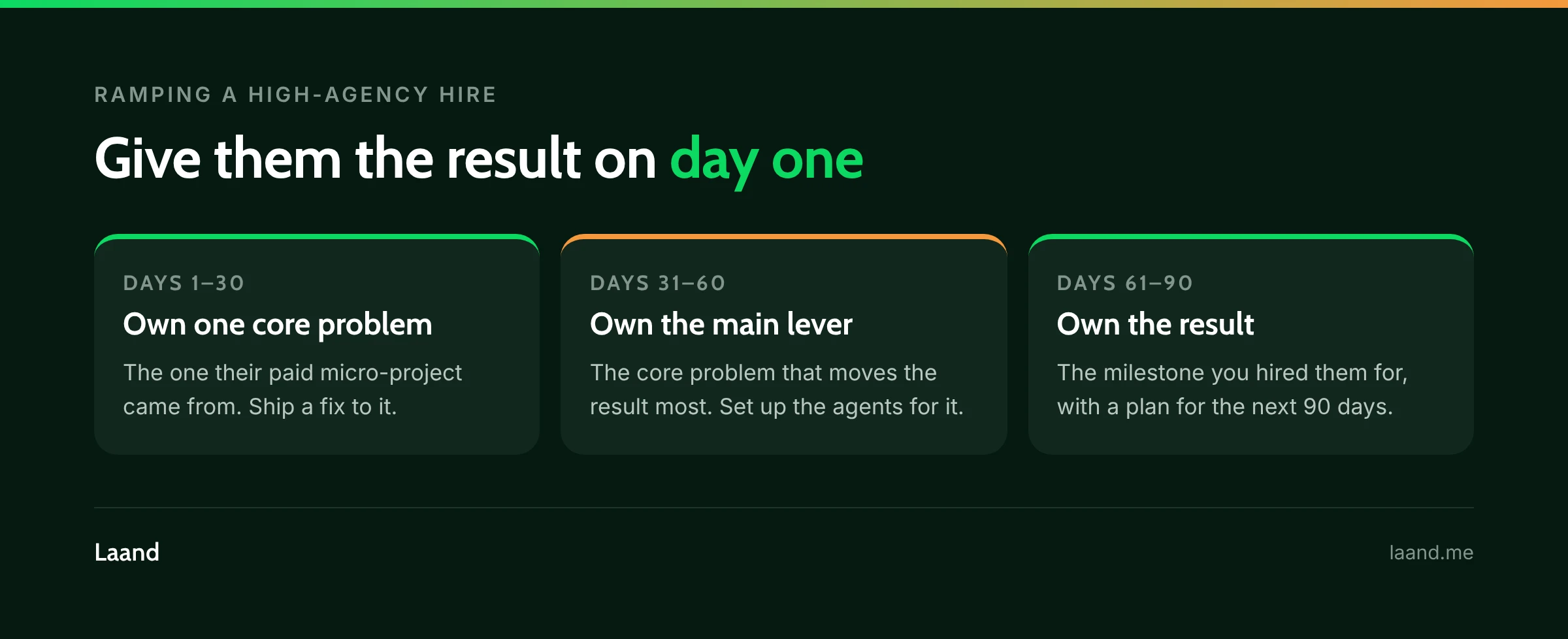
Search for "30-60-90 day plan" and you'll find hundreds of templates that look like this:
- First 30 days: Learn. Meet the team. Understand the product. Shadow customer calls.
- Days 31–60: Contribute. Take on small projects. Identify opportunities.
- Days 61–90: Own. Lead an initiative. Set goals for the next quarter.
It's a reasonable plan for someone who needs to be shown the way. For a high-agency hire, it's backwards. It spends a third of the quarter on learning someone would do anyway while working, and it delays ownership until the moment they're starting to get bored.
Picture a high-agency product marketer on day 29 of that plan. She's "completed her learning". She also noticed on day three that your onboarding emails contradict your pricing page, on day nine that your best customers all came through one partner, and on day sixteen that two of your competitors changed positioning. She's done nothing about any of it, because it's not day 61 yet.
Here's a plan built the other way round.
Before day one: three things to write down
A good plan needs inputs. Write these before the hire starts:
- The result. What this person was hired to change, with a measure and a deadline. "Trial-to-paid from 4% to 8% by end of Q2."
- The core problems. The three to seven specific problems in the way of that result.
- The split. Which parts of the role agents already handle, and which the person owns.
If you hired through work scoped from your real problems, you already have all three, plus a fourth input most companies never get: a piece of work the hire already did on one of those problems.
Days 1–30: own one core problem
Goal: ship a real fix to one core problem, ideally the one their hiring project came from.
Week 1
- Read the result, the core problems and the guardrails.
- Pick up the problem from their hiring project; talk to the people and customers it affects.
- Write a one-page "what I'd do in 30 days" by Friday.
- Ship something small and real.
Weeks 2–3
- Ship the fix to the core problem, properly: tested, documented, adopted.
- Map the agents and tools that touch this problem; improve one.
Week 4
- Show the outcome, not the activity: what changed, how you know, what's next.
- Propose which core problem is the main lever for days 31–60.
What success looks like: a measurable improvement on one core problem, and a clear view of where the biggest lever is.
Days 31–60: own the main lever
Goal: own the core problem that moves the result most.
- Agree the lever and the measure in week 5.
- Set up or redesign the agents that handle the routine parts of it; own the judgment calls.
- Run at least one experiment with a stop rule.
- Cut one thing that isn't working, and say why.
What success looks like: the main lever is moving, the agents around it are running, and something low-value has been stopped.
Days 61–90: own the result
Goal: own the milestone you hired them for.
- Report on the result weekly, in one paragraph.
- Write the plan for the next 90 days: what to do, what to stop, what to ask for.
- Identify one thing that would make the next hire's first 30 days faster.
What success looks like: the result is on track (or there's a clear, honest plan for why it isn't), and they're setting priorities, not receiving them.
Templates by role
| Founding engineer | Forward-deployed engineer | Growth / product marketer | Operations lead | Chief of staff | |
|---|---|---|---|---|---|
| The result | First 100 paying teams self-serve by Q3 | Every new customer live in 14 days | Trial-to-paid 4% → 8% by Q2 | On-time delivery above 95% by March | Free 10 founder hours a week |
| Days 1–30: one core problem | Ship self-serve team invites | Make one customer's sync reliable | Fix onboarding for integration-led trials | Find and fix the main cause of late deliveries | Run the weekly operating rhythm |
| Days 31–60: the main lever | Self-serve onboarding end to end | A repeatable integration playbook | The partner-integration channel | Supplier monitoring, agent-watched | Own two cross-team projects |
| Days 61–90: the result | Self-serve funnel and its metrics | Time-to-live across all new customers | Trial-to-paid, weekly | Delivery performance, weekly | The founder's calendar and priorities |
| Agents handle | Boilerplate, tests, migrations | API mapping, integration code, monitoring | Variants, research, reports | Reconciliation, tracking, alerts | Notes, summaries, first drafts |
Five rules that keep the plan high-agency
- Outcomes, not activities. "Shipped invites; 12 teams used them" beats "completed onboarding modules".
- Their plan, not yours. You set the result and the guardrails; they write the steps.
- One weekly check-in. Thirty minutes on outcomes. Not a daily status meeting.
- Cut something every phase. Taste is part of the job, so practise it from week one.
- Write down what was confusing. It becomes the next hire's onboarding.
Why tie the plan to the hiring work
Research consistently finds that past experience predicts performance in a new organisation only weakly, while work samples predict much better. (See does past experience predict job performance?) The same logic applies after the hire: the best predictor of how someone will ramp is how they already worked on your problem.
So the strongest 30-60-90 plans start with that work: the problem it came from, what it got right, and what it left open.
How Laand drafts the plan for you
When you hire through Laand with Google Drive connected, the plan comes with the hire.
It's built from the hunt. Every Talent Hunt starts from your milestone and breaks the person's part of the role into core problems, with Laand's answer to hire or agent?.
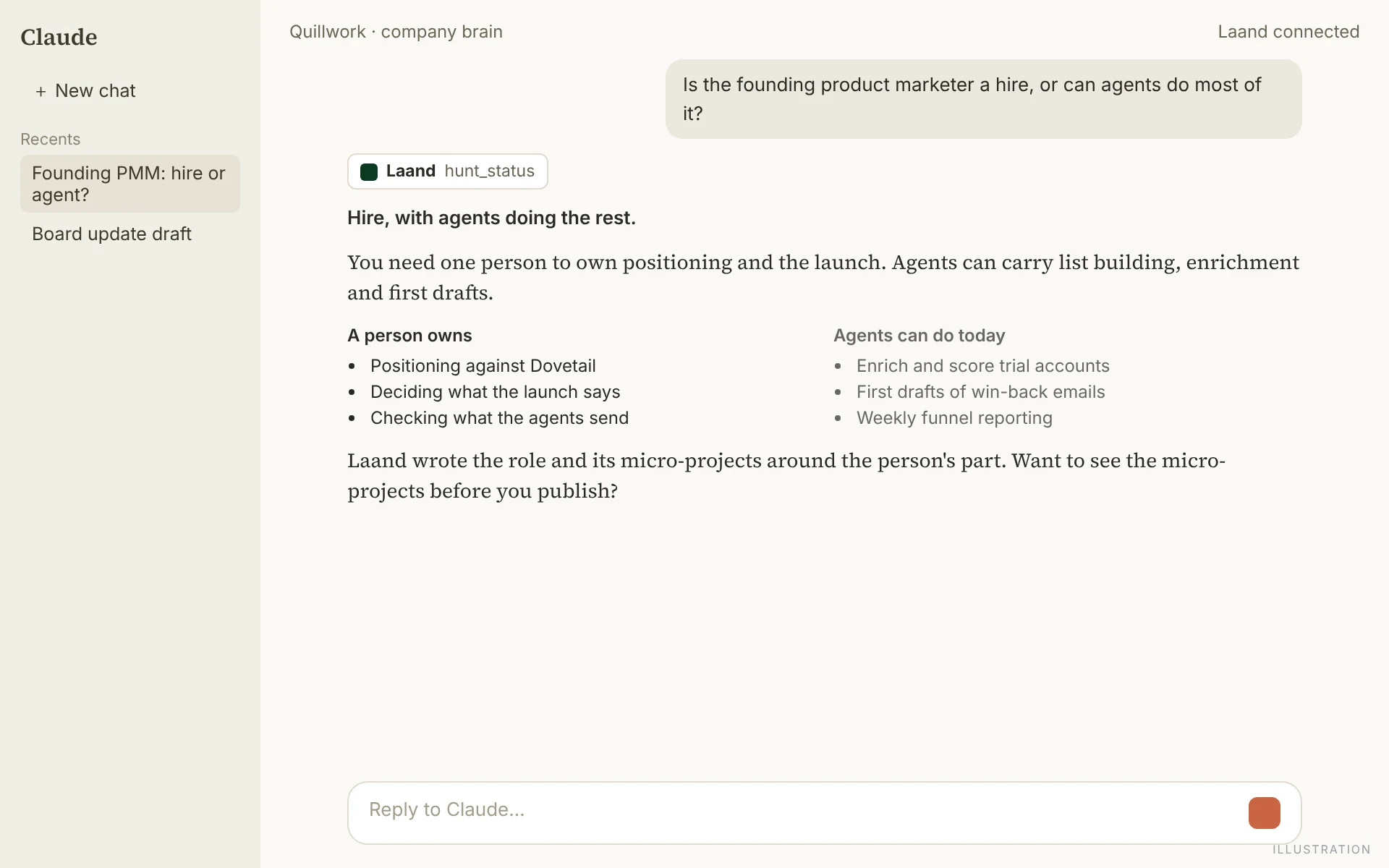
It's built from their work. Your hire completed a paid micro-project from one of your core problems, and Laand reviewed it.
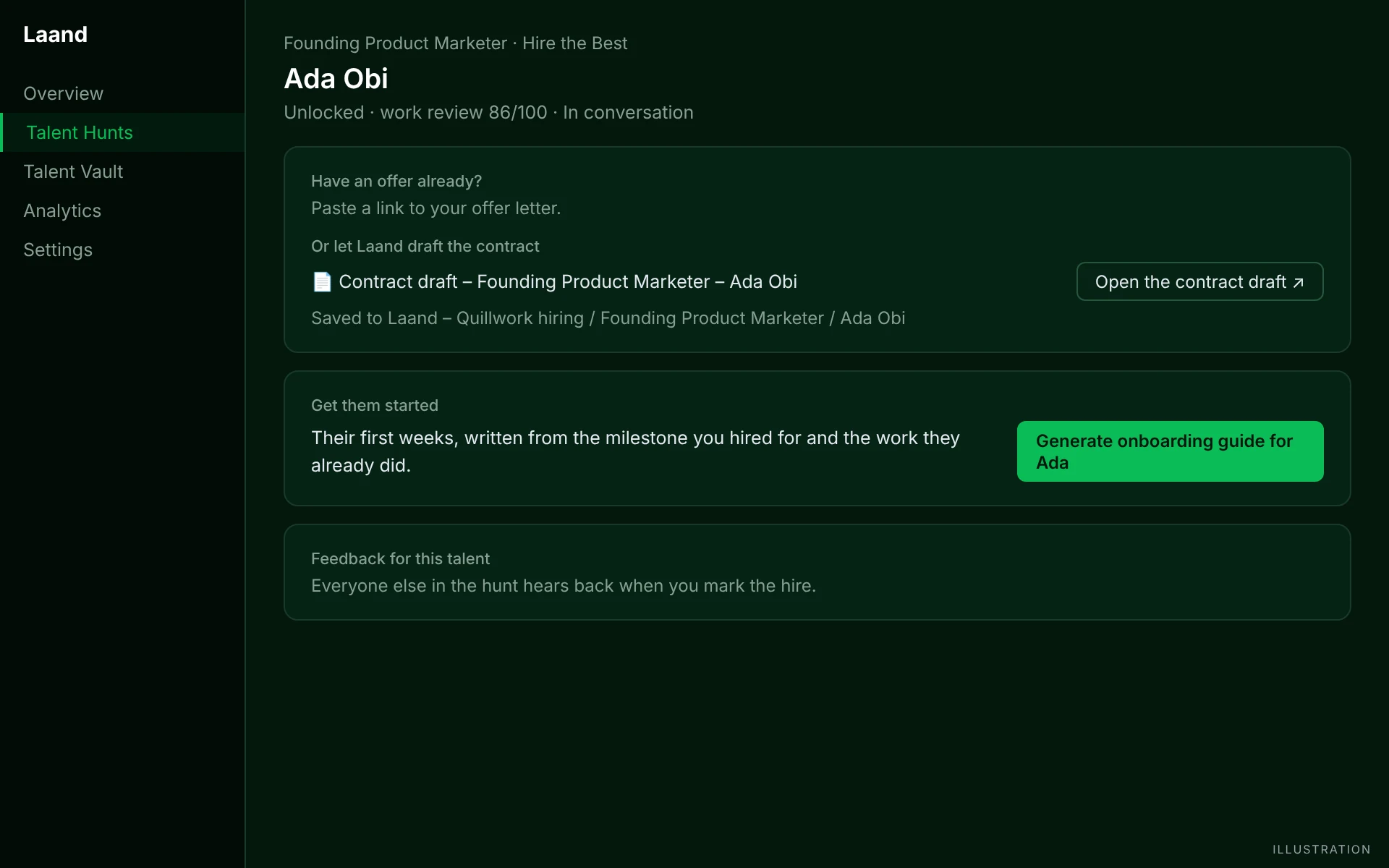
It lands in your Drive. In Hire the Best, Laand drafts a contract and an onboarding guide for the person you're hiring, saved to your team's hiring folder. The guide is written to the new hire. It covers why the role exists, their first week, and a 30/60/90 plan that moves from context, to first contribution, to owning a measurable part of the milestone, built on the micro-project they shipped. It also turns the gaps from their review into constructive focus areas, never quoted as weaknesses, and lists people to meet early, tools and access, and what a great first 90 days looks like. Anything only you know is left as a bracketed slot to fill in; nothing is invented.
A founder's view
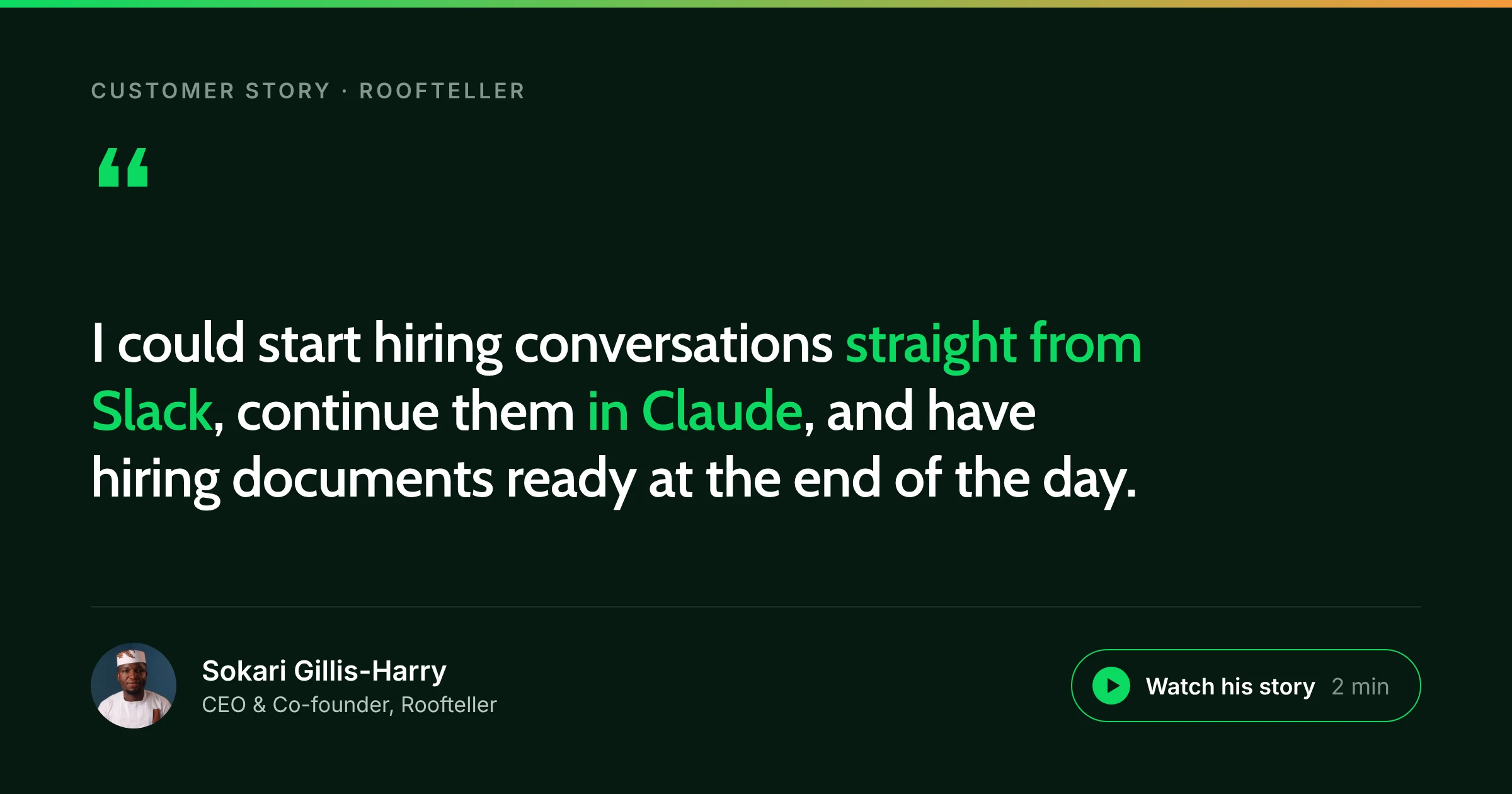
Sokari Gillis-Harry, founder of Roofteller, described having hiring documents ready without extra work:
The manager's side of the plan
A high-agency hire writes their own steps. Your job is different, and just as specific:
| When | What you do |
|---|---|
| Before day 1 | Write the result, the core problems, the agent/person split and the guardrails. Set up access to everything. |
| Day 1 | One hour together: the result, the guardrails, why this role exists now. Nothing else. |
| End of week 1 | Read their one-page 30-day plan. Change one thing at most, and cut one thing. |
| Every week | Thirty minutes on outcomes: what moved, what's stuck, what they're dropping. |
| Day 30 | Agree the main lever for days 31–60, based on what they've learned. |
| Day 60 | Hand over the result formally. Say it out loud to the team. |
| Day 90 | Read their plan for the next 90 days. Ask what they'd want the next hire's first month to look like. |
Notice what isn't on the list: daily stand-ups, approvals for routine decisions, a learning curriculum.
Signs the plan is going off track
| Signal | What it usually means | What to do |
|---|---|---|
| Lots of activity, the result isn't moving | Agency without direction | Re-anchor on the result; ask what they'd cut |
| A beautiful plan, nothing shipped by week 3 | Taste without agency, or fear of the guardrails | Ask what's blocking them; remove one approval |
| They're doing everything themselves | Agents aren't set up, or they don't trust them | Make "what can agents do here?" part of the check-in |
| They've stopped raising problems | They don't think you want to hear them | Thank them for the last bad news they brought |
| They're working every weekend | Over-ownership, heading for burnout | Ask what they're dropping this week |
Adapting the plan by seniority
An earlier-career hire (a founder's associate, a first marketer) needs the same ownership arc with tighter guardrails and a shorter first problem: own a small slice by day 15, a core problem by day 45, a measurable part of the result by day 90.
A senior hire (a head of something) should move faster to the result, and add a fourth thread from the start: the agents and, later, the people they'll need. Their day-90 plan should include the next hire's result, written the same way yours was.
Key takeaways
- A high-agency 30-60-90 plan is an ownership plan, not a learning plan.
- Days 1–30: own one core problem; days 31–60: own the main lever; days 61–90: own the result.
- Write the result, the core problems and the agent/person split before day one.
- Start from the work they already did for you in hiring.
- Outcomes not activities, their plan not yours, one weekly check-in, cut something every phase.
Frequently asked questions
What is a 30-60-90 day plan?
A plan for a new hire's first three months, split into three phases with goals for each. For high-agency hires, it should focus on owning outcomes rather than on learning.
What should a high-agency hire do in their first 30 days?
Own and ship a real fix to one core problem, ideally the one from their hiring work sample, and identify the biggest lever on the result.
Who should write the 30-60-90 day plan?
The company sets the result, the core problems and the guardrails; the hire writes the steps, usually by the end of their first week, and agrees them with their manager.
How is a 30-60-90 plan different for a startup?
Startups have less structure and more urgency, so the plan should move to real ownership faster and be tied directly to the company's next milestone.
Can I get a 30-60-90 plan generated automatically?
When you hire through Laand with Google Drive connected, it drafts an onboarding guide with a 30/60/90 plan built from the milestone, the core problems and the micro-project your hire completed.
What does the manager do in a 30-60-90 day plan?
Write the result, core problems and guardrails before day one; spend an hour on them on day one; read and lightly edit the hire's plan at the end of week one; check in weekly on outcomes; and formally hand over the result around day 60.
What if the hire is behind plan at day 30?
Look at the signals first: lots of activity with no movement means direction is missing; no shipping means a blocker or fear of the guardrails. Fix the cause together, and adjust the plan rather than adding supervision.
Keep reading
- How to onboard high-agency employees
- How to manage high-agency people
- Hiring a high-agency product marketer
Or start a Talent Hunt, so the plan writes itself from real work.
Stop applying blind.
Laand scores your fit for any role, then builds the application kit that proves you can do the job.
Join LaandGet the plan drafted from their own work
Hire through Laand and the 30/60/90 plan is built from your milestone, its core problems and the micro-project your hire already shipped, in your Google Drive.
Start a Talent Hunt