How to manage high-agency people without micromanaging them: guardrails, not steps
High-agency people don't need less management. They need a different kind: clear results, firm guardrails, and freedom inside them.

Picture a founder with two high-agency hires and two very different problems.
The first, an engineer, is drowning in Slack messages from the founder: "Can you check with me before changing the schema?" "Why did you pick that library?" "Let's sync on this tomorrow." Each message is reasonable. Together, they say: I hired you to own this, and I don't trust you to. She's polite about it. She's also started updating her portfolio.
The second, a growth marketer, gets no messages at all. The founder is relieved to have someone who "just gets on with it". Six weeks in, the marketer has launched seven campaigns, rebuilt the website's homepage, signed an agency contract and committed a large share of next quarter's budget. Every decision was defensible on its own. Together, they're a direction the company never agreed to.
Same founder, same instinct, opposite failures. One got too many steps. The other got no guardrails.
Why high-agency people are hard to manage
High agency is the disposition to own an outcome and find a way to it without waiting to be told. That's exactly what you want, and it creates three management problems:
- They resist steps. Telling a high-agency person how to do something feels like a vote of no confidence.
- They move fast, in their own direction. Without a shared result, their energy can point somewhere you didn't intend.
- They take on too much. People who see what needs doing tend to do it, even when they shouldn't, and burn out.
The fix for all three is the same: a small number of firm boundaries, and real freedom inside them.
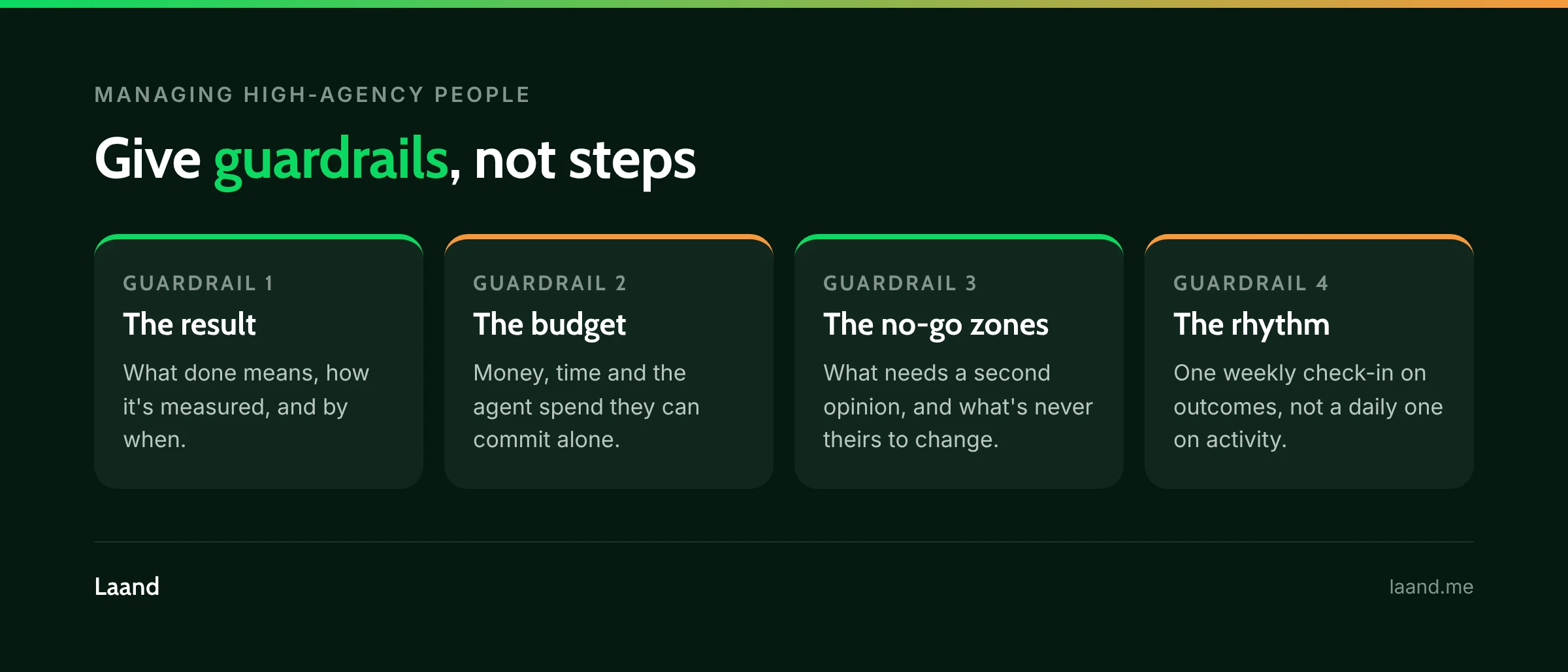
The four guardrails
Guardrail 1: The result
What done means, how it's measured, and by when. "Trial-to-paid from 4% to 8% by end of Q2." This is the most important guardrail, because it tells them what not to do: anything that doesn't serve it. Brian Chesky's principle for hiring applies to managing too: "Start with the results and work backwards to the people."
Guardrail 2: The budget
The money, time and agent spend they can commit alone, and above what amount they need a second opinion. "Up to $2,000 a month in tools and agents without asking; above that, a two-line note."
Guardrail 3: The no-go zones
What's never theirs to change alone: pricing, brand, contracts above a size, anything legal, production data. Keep the list short. Every item is a place where they'll ask permission, so every item costs some agency.
Guardrail 4: The rhythm
When and how you check in. One weekly, 30-minute conversation on outcomes, plus a shared, written update. No daily status meetings.
Everything inside the four guardrails is theirs: the approach, the tools, the agents, the order.
Steps vs guardrails, in practice
| Situation | Managing with steps | Managing with guardrails |
|---|---|---|
| A new project | "Here's the plan; follow it" | "Here's the result and the budget; what's your plan?" |
| A technical choice | "Check with me first" | "Your call, unless it touches a no-go zone" |
| A disagreement | "Let's do it my way" | "Here's my concern about the result; you decide" |
| A mistake | "From now on, run it by me" | "What would you do differently? Do we need a new guardrail?" |
| Status | Daily stand-up | A weekly paragraph on the result |
Feedback that doesn't feel like micromanagement
High-agency people want feedback; they just don't want instructions. The difference:
- Instructions say what to do: "Change the headline to X."
- Feedback says what you see, against the result: "The headline is clear, but it's written for us, not the customer. Our best customers talk about time saved."
Give feedback on taste as well as output: what they cut, what they kept, what they chose. That's how you teach your company's standards without dictating the work.
The downsides of high agency, and how to handle them
High-agency people bring real risks. Pretending otherwise is how founders get surprised.
| Downside | What it looks like | How to handle it |
|---|---|---|
| Misdirected energy | Lots of shipping, little impact | Re-anchor on the result; ask what they'd cut |
| Burnout | They take on everything they notice | Ask what they're dropping this week; protect time off |
| Friction with process | Clashes with the few approvals you do need | Explain why each no-go zone exists; remove the ones that can't be explained |
| Agency without taste | Fast, confident, slightly wrong | Feedback on choices; this is why taste matters in hiring |
| Over-ownership | Hard to collaborate with | Share outcomes across people; reward helping others ship |
A note on fairness: people from under-represented groups are sometimes labelled "difficult" for the same behaviour that earns others "high agency". Judge the action against the result, not the style.
Keeping high-agency people
High-agency people rarely leave over pay alone. More often they leave because:
- The autonomy they were promised turned out to be fake.
- The problems stopped being interesting.
- They're surrounded by people with less agency or less taste.
- Nobody noticed what they did.
So: keep the guardrails real, give them bigger results as they deliver, hire people who match them, and say out loud what they changed. Reward intelligent attempts that didn't work, not just wins, or they'll stop trying hard things.
Managing high-agency people on an AI-native team
Agents add a new dimension. A high-agency person with agents can commit a lot of work, and a lot of spend, very quickly. Two adjustments help:
- Put agent spend inside the budget guardrail. Agents are tools with costs; treat them like any other spend.
- Make "what did the agent get wrong?" part of the weekly check-in. It keeps judgment, not volume, at the centre.
It starts with hiring
You can't manage taste into someone. If you hire high agency without taste, you'll spend your time steering. If you hire taste without agency, you'll spend it pushing. The easiest high-agency person to manage is one you saw, before you hired them, making good choices on your real problems.
That's what Laand is built to show you.
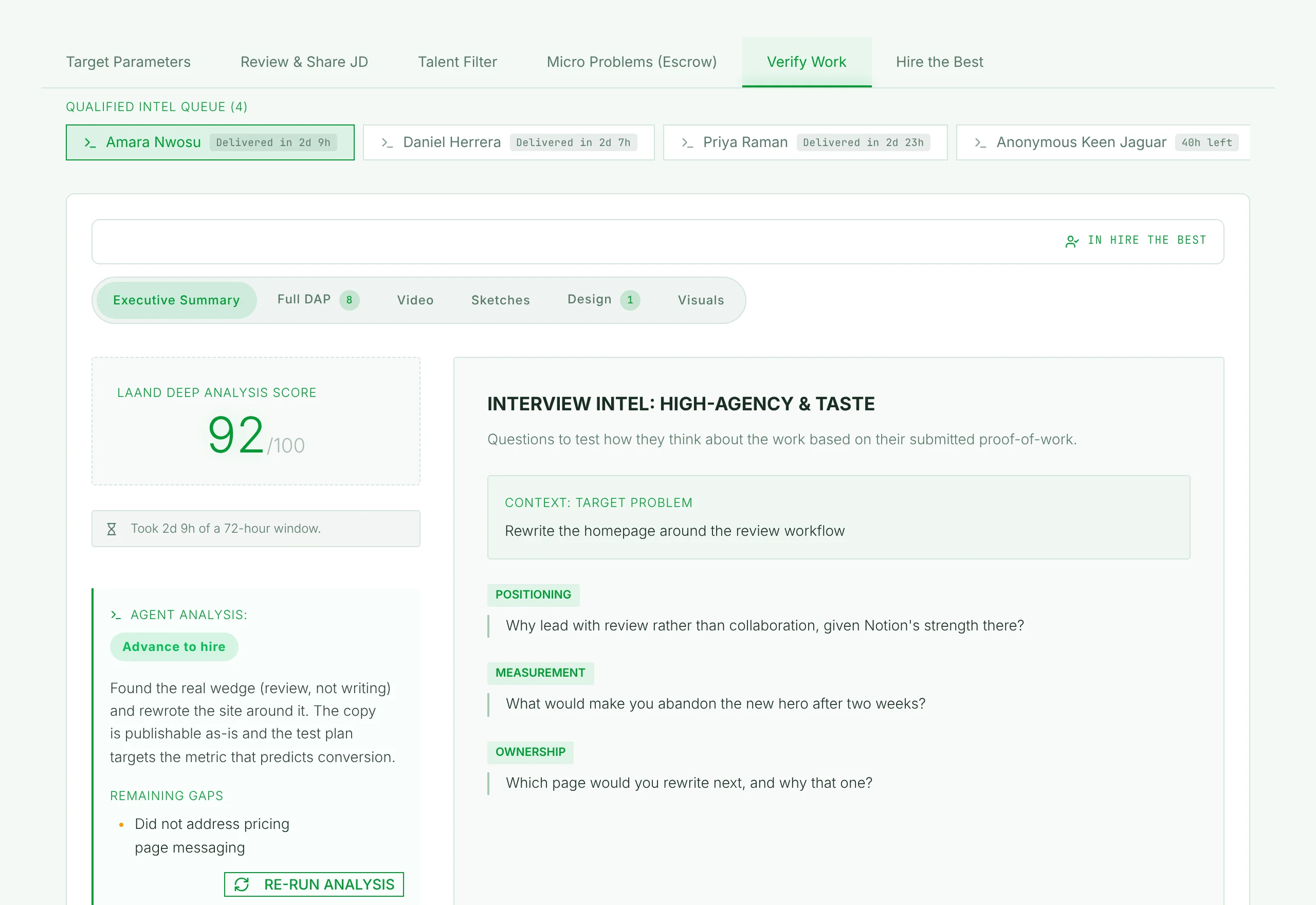
Every hunt starts from the result. That's your first guardrail, written before the person is hired. Laand's Deep Analysis also answers hire or agent?, so you know which parts of the role need human judgment at all.
Candidates do paid work scoped from your real problems. Every brief has a planted mistake, and AI is allowed and visible. You see how they handle ambiguity, what they question and what they cut: a preview of how they'll work inside your guardrails.
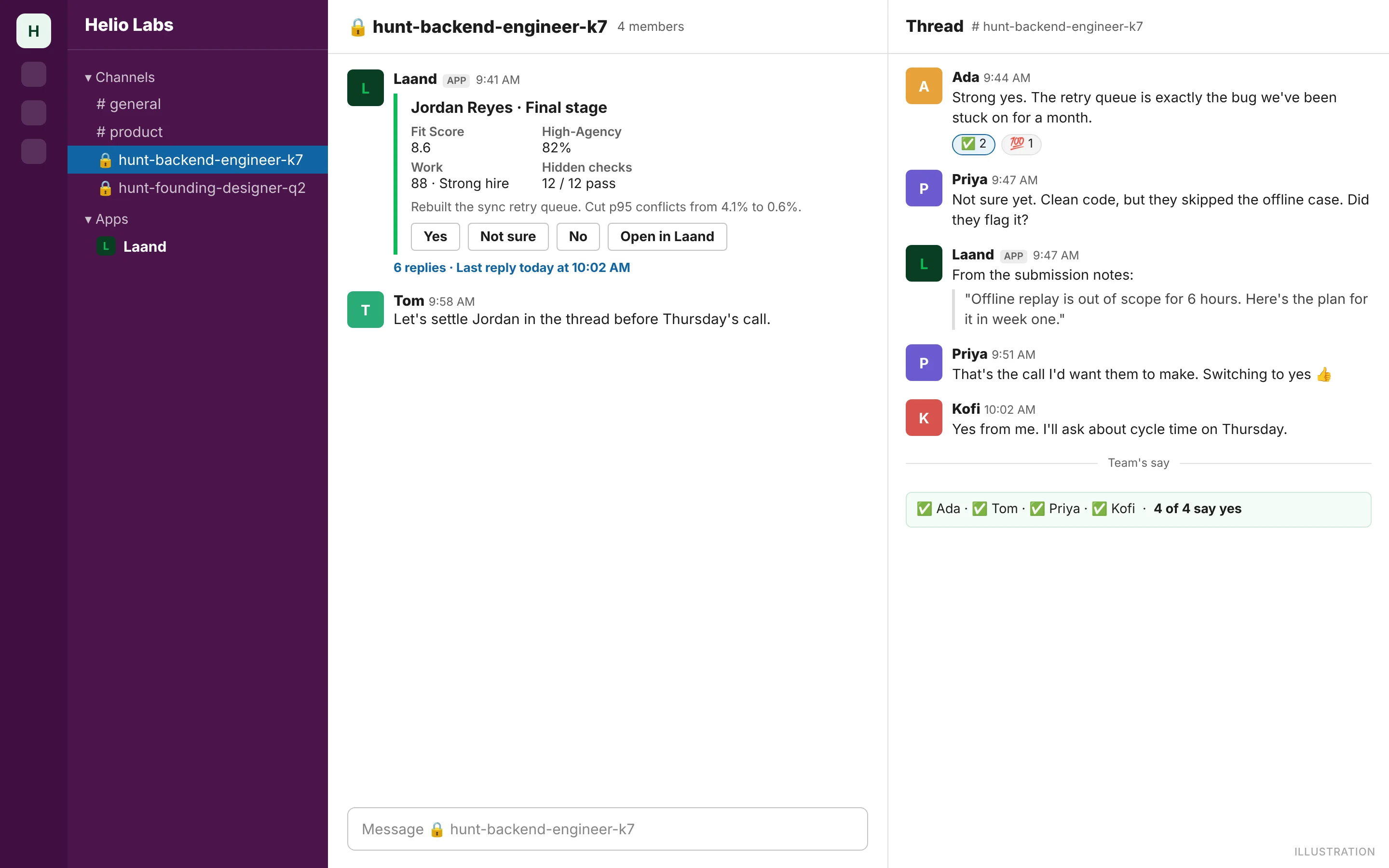
Your team decides together. Each hunt has a private Slack channel where teammates weigh in on anonymous candidate cards.
The plan comes with the hire. With Google Drive connected, Laand drafts an onboarding guide built from the milestone and the work your hire already did, so the guardrails are written down on day one.
Publishing is free; you pay $750 per talent you unlock.
A founder's view
Sokari Gillis-Harry, founder of Roofteller, described what it felt like to work with a tool that knew his company and got on with it:
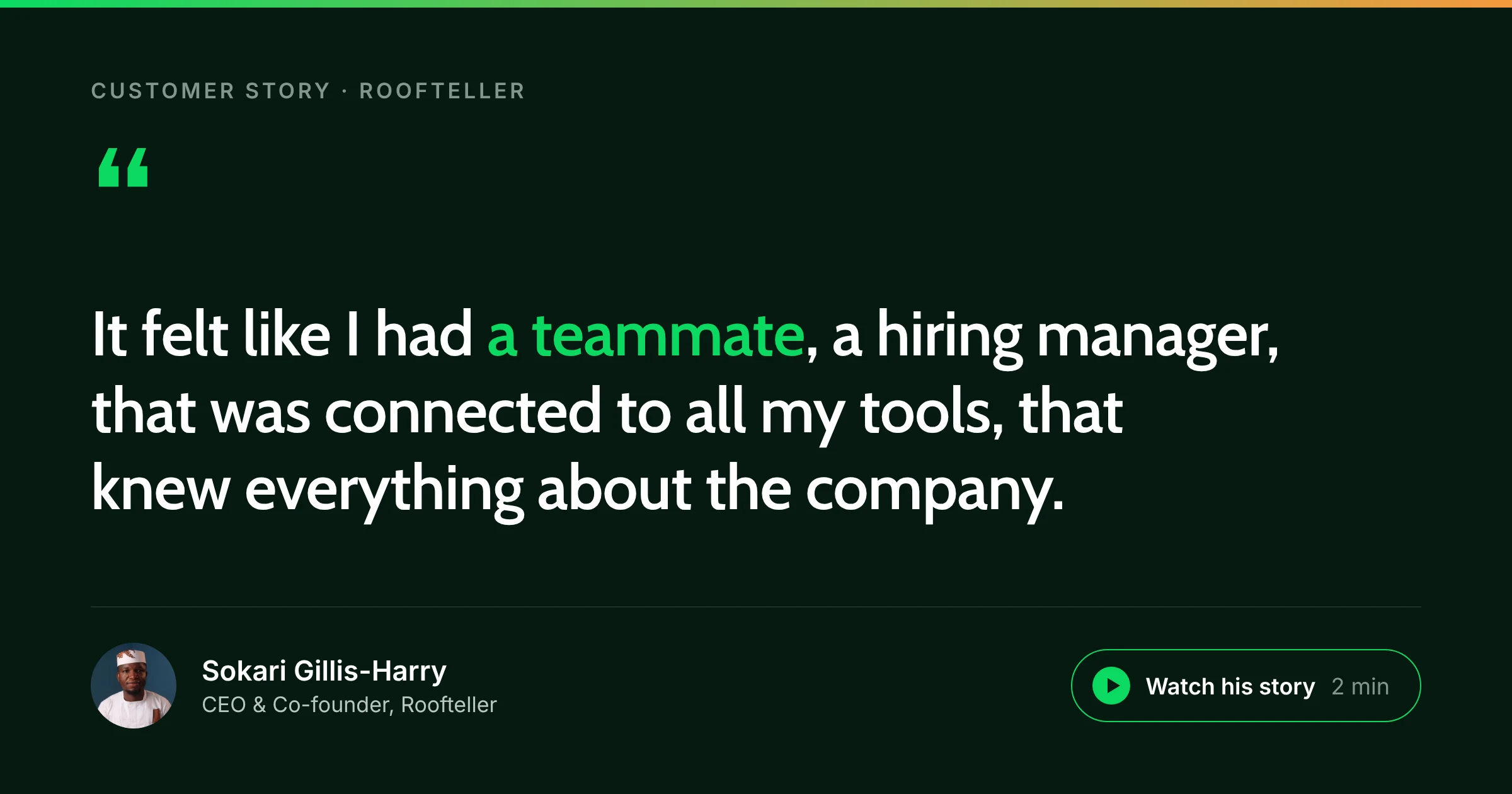
That's the feeling you want from a high-agency hire too: someone who knows the goal and just gets on with it.
The 30-minute weekly check-in
Use the same agenda every week, and keep it to 30 minutes:
- The result (5 min). Where is it, in one number or one sentence?
- What moved (5 min). The one or two things that changed it.
- What's stuck (10 min). Where they need a decision, an introduction or a guardrail changed.
- What they're dropping (5 min). This is how you protect them from over-ownership, and how you see their taste.
- One piece of feedback (5 min), in each direction.
Ask them to send a short written update the day before: three sentences, not a report. If you find yourself wanting a daily one, the guardrails aren't clear enough.
When to step in
High-agency people should be left alone most of the time. But not all of the time.
| Step in when… | Don't step in when… |
|---|---|
| They're heading into a no-go zone | They chose a different approach from yours |
| The result has been flat for three weeks with no plan | Something failed and they already know why |
| They're visibly burning out | They're moving faster than you'd like |
| Someone else's work is being damaged | They made a call you'd have made differently but can live with |
| They've stopped raising problems | They disagree with you in the check-in |
How to disagree without taking the work back
The hardest moment in managing a high-agency person is when you think they're wrong. Three moves help:
- Say what you see against the result, not what you'd do. "I'm worried this pricing test confuses our biggest segment" rather than "Don't run the pricing test."
- Say how sure you are. "I'm 60% on this" invites a conversation; "I don't like it" ends one.
- Let them decide, unless it's a no-go zone. If it isn't, it's theirs. If you keep overruling them, either the guardrails are wrong or the hire was.
Key takeaways
- Manage high-agency people with four guardrails (the result, the budget, the no-go zones, the rhythm) and freedom inside them.
- Check in weekly on outcomes, not daily on activity.
- Give feedback on taste, not instructions on steps.
- Handle the downsides openly: misdirected energy, burnout, friction, over-ownership.
- Keep them with real autonomy, bigger problems, good peers and recognition; and hire for taste, because taste makes autonomy safe.
- Run the same 30-minute weekly check-in: the result, what moved, what's stuck, what they're dropping, and one piece of feedback each way.
Frequently asked questions
How do you manage high-agency people?
Agree the result, the budget, the no-go zones and the check-in rhythm, then let them decide how. Check in weekly on outcomes and give feedback on their choices, not instructions.
How do you avoid micromanaging a high-agency employee?
Replace steps with guardrails. If you feel the urge to approve something, ask whether it's in a no-go zone; if not, it's their call.
What are the downsides of high-agency employees?
Misdirected energy, burnout, friction with process and over-ownership. Most are handled by a clear result, honest feedback on taste, and checking what they're dropping.
Why do high-agency employees quit?
Usually because autonomy turns out to be fake, the problems stop being interesting, or they're surrounded by people with less agency or taste.
How do I know a candidate will thrive with autonomy?
Watch them make choices on paid work scoped from your real problems before you hire: what they question, what they cut and how they handle a planted mistake.
How often should I check in with a high-agency employee?
Once a week, for about 30 minutes, focused on the result: what moved, what's stuck and what they're dropping. Add a short written update the day before. Daily check-ins usually signal that the guardrails aren't clear.
What if a high-agency person keeps making decisions I disagree with?
First check whether the decisions serve the agreed result. If they do, it's their call. If they don't, re-anchor on the result. If you keep overruling them, either the guardrails are wrong, or the hire lacks the taste the role needs.
Keep reading
- How to onboard high-agency employees
- The 30-60-90 day plan for a high-agency hire
- High agency and taste
Or start a Talent Hunt and hire people you won't need to steer.
Stop applying blind.
Laand scores your fit for any role, then builds the application kit that proves you can do the job.
Join LaandHire people you won't need to micromanage
Laand shows you each candidate's agency and taste on paid work scoped from your real problems, before you hire. Free to publish; $750 per talent you unlock.
Start a Talent Hunt