Hiring with AI agents: the agentic hiring workflow for AI-native teams
Your company already runs on agents.
Claude holds the roadmap. Codex and Cursor ship half the code. ChatGPT drafts the board update. Slack is where all of it gets argued about. Six people, doing the work of thirty, because every one of them knows how to steer an agent.
So when you need person number seven, it's natural to ask: what does hiring look like when agents do the work?
The industry's answer, so far, has been to automate the old pipeline. Agents that write job posts, source profiles, send InMails, screen résumés and book calls, so you can process more applicants, faster. It's impressive. It's also aimed at the wrong problem.
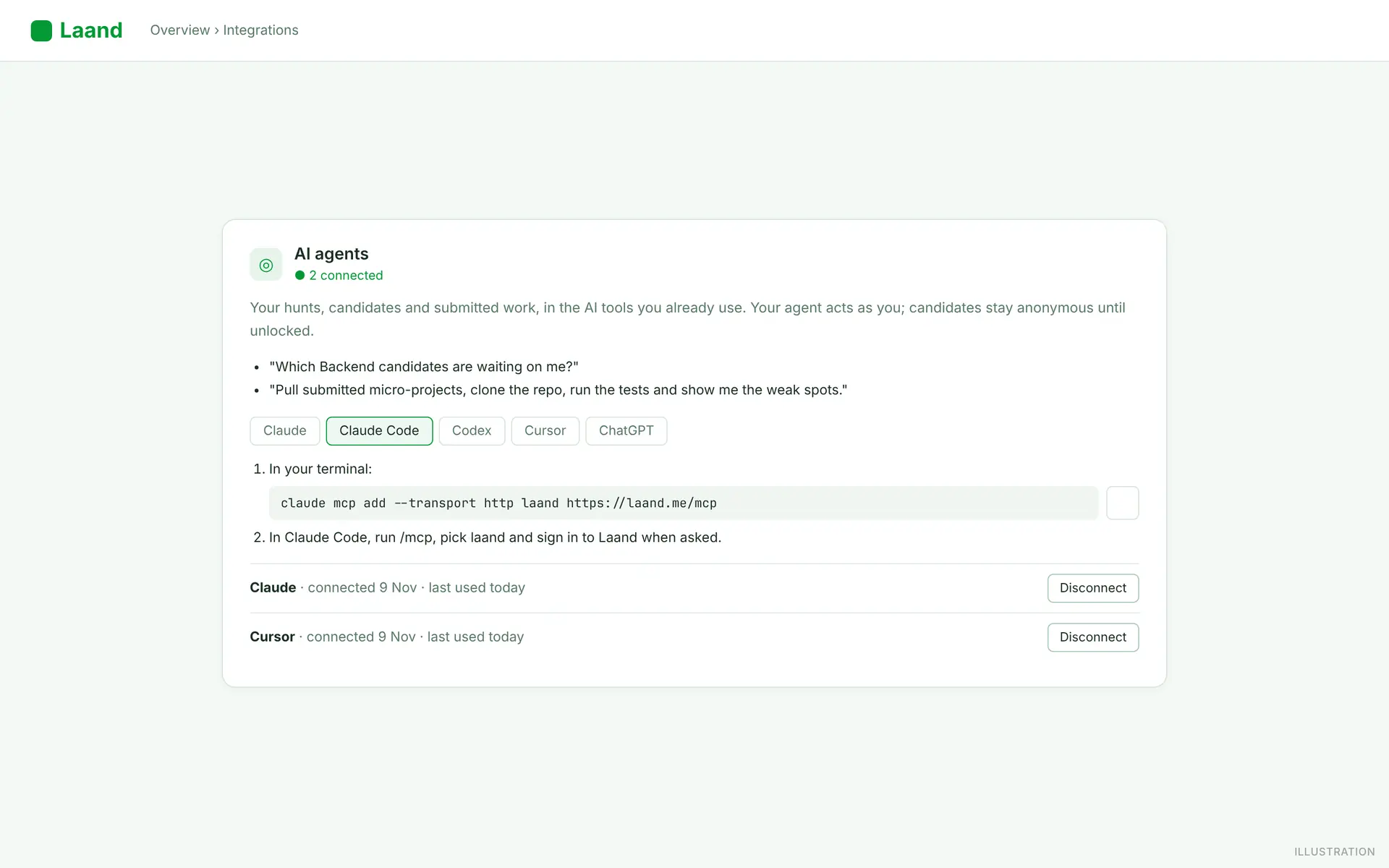
This guide is a different answer. It lays out an agentic hiring workflow built for AI-native teams: five layers, what agents should and shouldn't do in each, how to connect them safely, and what it all costs. It links to a deep guide for every tool your team uses. And it shows how we built Laand to run that workflow by default, from whichever agent you're already in.
Why I don't believe in résumé-forwarding agents
I've hired from both sides of the desk.
At VEC Studio, which I grew from my home office in Nigeria into a $350K-a-year content agency, I hired a lot, for my own team and for the companies we served. A stack of résumés was always waiting, and I mostly ignored it. The people I hired gave me a reason to look. Tamilore Sonaike emailed me her work samples; when I missed the email, she found me on LinkedIn and sent them again:

She got the job because she showed me what she could do, and that she wouldn't wait to be asked.
Years later, on the other side, I applied for GTM engineering and sales roles. Crickets. So I did what Tamilore did and attached a micro-solution, a small piece of real work on each company's actual problem, to every application. The replies started coming.
Two sides, one lesson: companies want proof someone can do the work, and good people want a way to show it. A résumé can't do either.
So when I look at recruiting's big AI idea (agents and bots that forward more résumés, faster), I see the wrong thing being automated. They miss the two things that matter most now: High-Agency, spotting a problem worth solving and solving it unprompted, and Taste, solving it in a way that stands out. Only the work shows both.
Real numbers behind the shift
From the market:
- LinkedIn receives about 11,000 applications a minute, up 45% in a year (The New York Times, via eWeek). LinkedIn's answer is Hiring Assistant, an AI agent for recruiters that went globally available in English in 2025.
- 70% of hiring managers trust AI to help them make faster, better hiring decisions. Only 8% of job seekers think AI makes hiring fairer, and 41% of US job seekers admit to using prompt injection to get past AI filters (Greenhouse).
- Gartner expects 1 in 4 candidate profiles worldwide could be fake by 2028 (HR Dive).
- 84% of developers use or plan to use AI tools, and their top frustration (66%) is output that's "almost right, but not quite" (Stack Overflow). Catching the "almost" is the job now.
From Laand's own data. We track 678,125 open roles at 12,317 companies across 15,085 job boards, and have read 896,475 job descriptions sentence by sentence. The Laand Hiring Index shows:
- AI companies ask for high agency three times as often as everyone else (7.8% of roles against 2.5%).
- Within the same function, roles that ask for it advertise 89% more at the top of the range.
- 79% of ads that ask for high agency ask for nothing but a résumé to prove it. Only 11.4% of all ads ask to see any work at all.
- Only 7.2% mention AI fluency, even though it's how most of these teams work.
Put together: the scarcest, best-paid skill in AI-native companies is the one almost nobody checks, and the AI tools being built for hiring make the checking harder, not easier.
Two kinds of hiring agents
| Pipeline agents | Evidence agents | |
|---|---|---|
| What they automate | Sourcing, outreach, screening, scheduling | Scoping the work, verifying it, reading it |
| What they read | Résumés, profiles, AI-written applications | Real work on your problem, with the AI log |
| What they optimise | Volume and speed through the funnel | Signal per candidate |
| What fools them | Polish, keywords, prompt injection | Very little: the work runs or it doesn't |
| What you end up with | More interviews | Fewer, better ones, about real work |
Pipeline agents are great when your problem is volume. An AI-native team of six doesn't have a volume problem. It has a signal problem: finding the one person in 300 who can steer agents with taste. That needs evidence agents.
The agentic hiring workflow: five layers
Here's how to design hiring around agents, layer by layer, with what to automate and what to keep human.
Layer 1: Context, where the hire starts
What happens: the reason to hire already exists in your tools: a Slack thread about lost design partners, a TODO in the onboarding code, an ADR about throughput, a roadmap in a Claude project. Agents should: read that context and draft the role from it, citing where each part came from. Keep human: the budget, the bar, and whether to hire at all.
Layer 2: Scope, defining the work
What happens: the role becomes an outcome (what this person must achieve in 90 days), its core problems, and a short, paid piece of real work built from them. Agents should: find the core problems, write success criteria, and recreate them as a fictional work sample, never your real code or data. Keep human: approving the work sample before anyone sees it.
Layer 3: Work, where candidates show it
What happens: candidates clear a fit bar and an agency check, then do the paid micro-project, using AI however they like and logging it. Agents should: handle the logistics: repos, access, timeboxes, freezing submissions. Keep human: nothing here needs your time. That's the point.
Layer 4: Verify, turning work into evidence
What happens: the submission becomes facts: hidden tests passed, claims checked, decisions compared with the AI log, test tampering flagged. Agents should: run everything that can be run, and quote the work for every judgment. Keep human: nothing yet; verification should be mechanical and explainable.
Layer 5: Decide, as a team
What happens: the team reads the evidence, debates, and decides. Agents should: compare finalists, find weak spots, write interview questions that only the author could answer, and record everyone's say. Keep human: the decision, always. Hiring is one of the most regulated uses of AI: the EU AI Act lists AI used for recruitment as high-risk, and New York City requires bias audits of automated hiring tools.
Which tool for which layer
| Your team lives in… | Best at | Deep guide |
|---|---|---|
| Claude | Context (projects), scoping, reading work, Claude Code for running it | Hiring with Claude |
| ChatGPT | Scoping and judging non-engineering work: growth, sales, ops, design | Hiring with ChatGPT |
| Codex | Engineering work samples with hidden tests, comparing submissions at scale | Hiring with Codex |
| Cursor | Reviewing candidates like pull requests, against success criteria | Hiring with Cursor |
| Slack | Starting from the thread, and deciding as a team | Hiring from Slack with AI |
Most teams use three or four of these at once, which is exactly why the workflow can't live inside any one of them.
The agentic hiring workflow, running end to end
Here's one hire at a six-person AI startup, across the tools its people actually use. Every screen is Laand, connected through MCP.
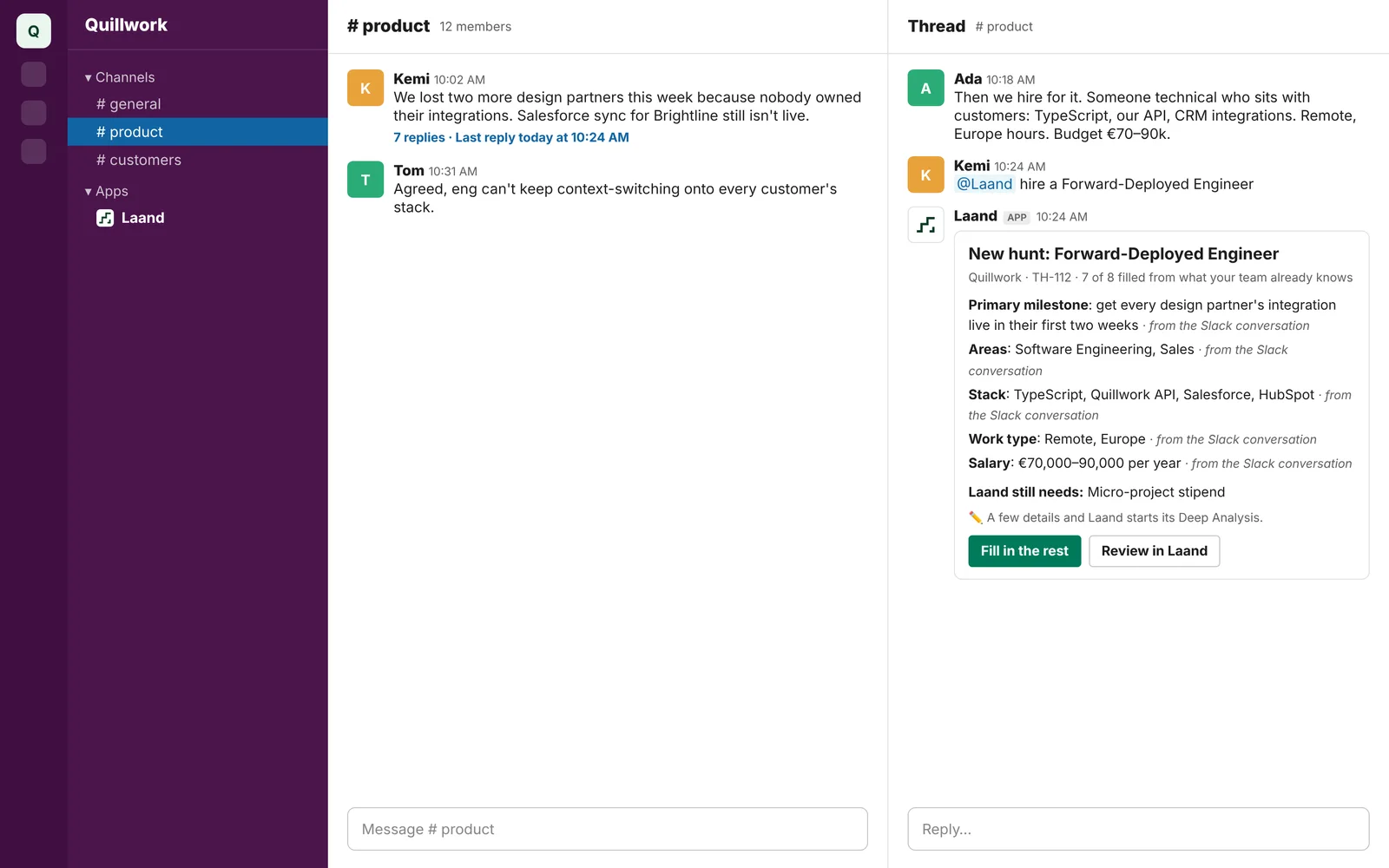
Monday, in Slack. The decision to hire happens in #product. Kemi mentions @Laand hire a Forward-Deployed Engineer, and Laand drafts the hunt from the thread, with sources. (Layer 1.)
Monday, nothing extra. The team connected GitHub to Laand once, read-only. So Laand reads a summary of the codebase into the same hunt, and the micro-projects reflect the real problems in the code, recreated in a fictional setting. (Layers 1–2.) Engineers who'd rather start from the repo can do it from Codex or Cursor instead.
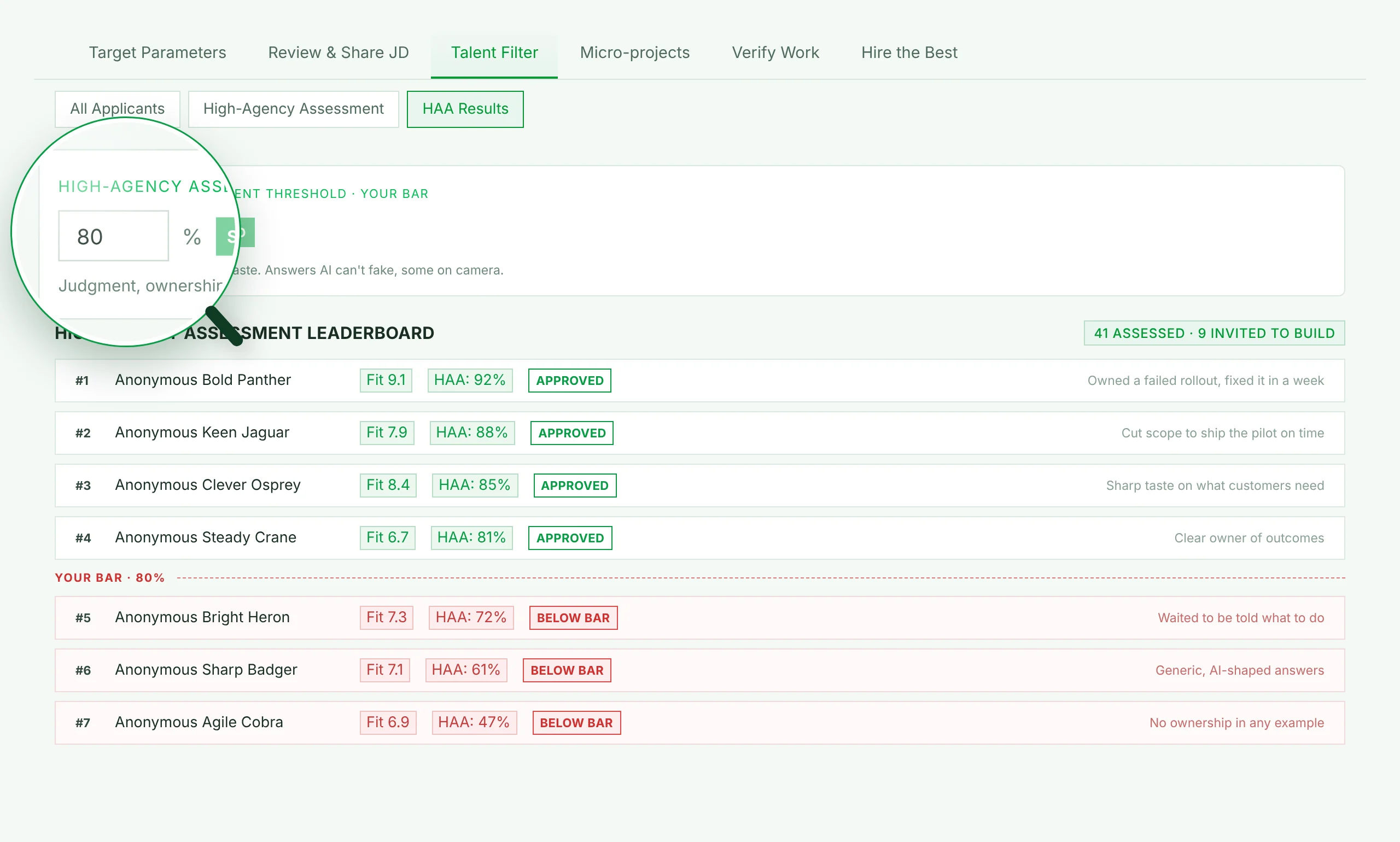
Monday to Thursday, nobody. Laand sources, scores, tests for agency, and builds verified micro-projects: hidden tests proven against a solution, reviewed by a second model for leaks and fairness. Candidates do the work in private repos with fair clocks, DECISIONS.md and AI logs. (Layers 2–4.) The team ships.
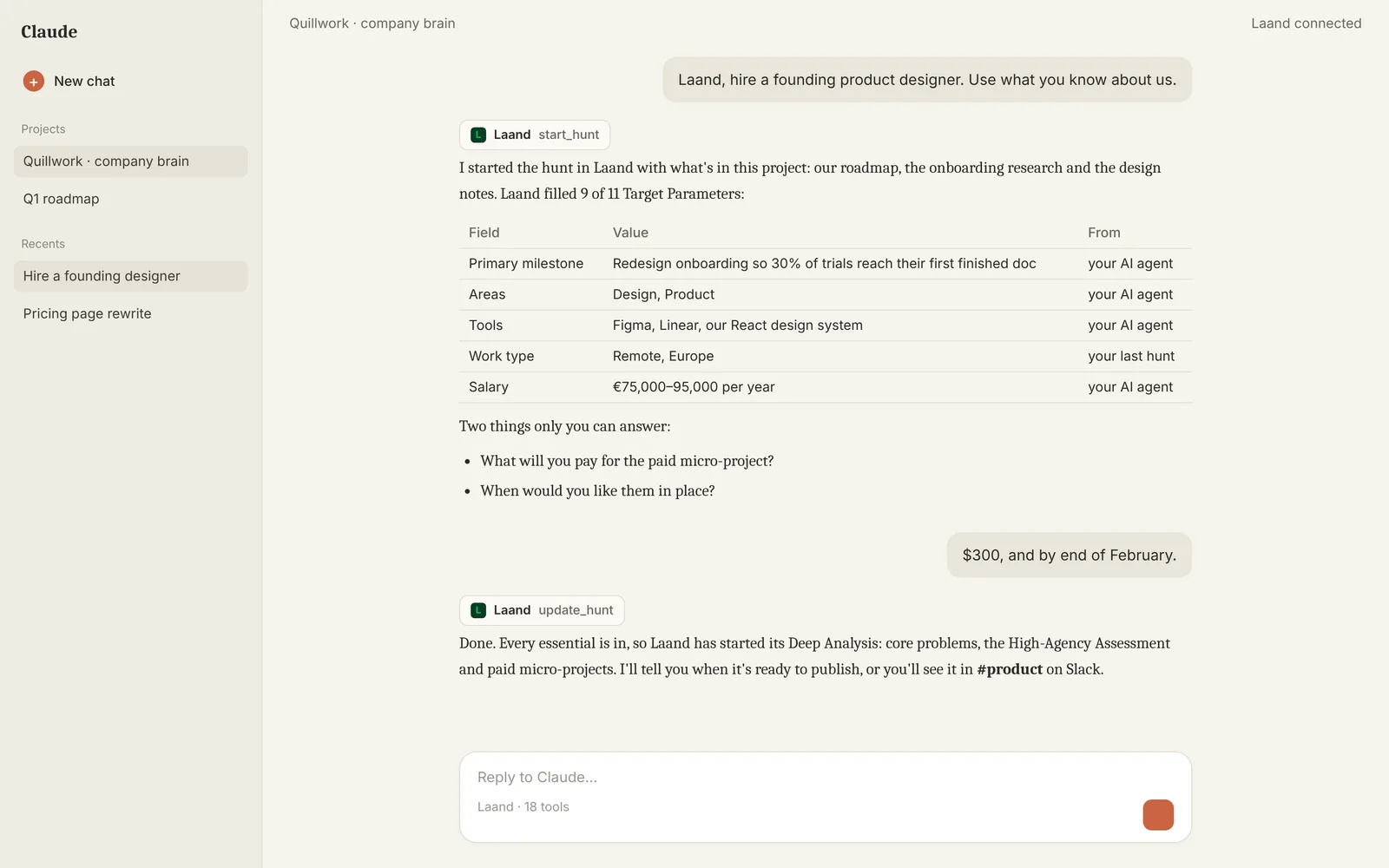
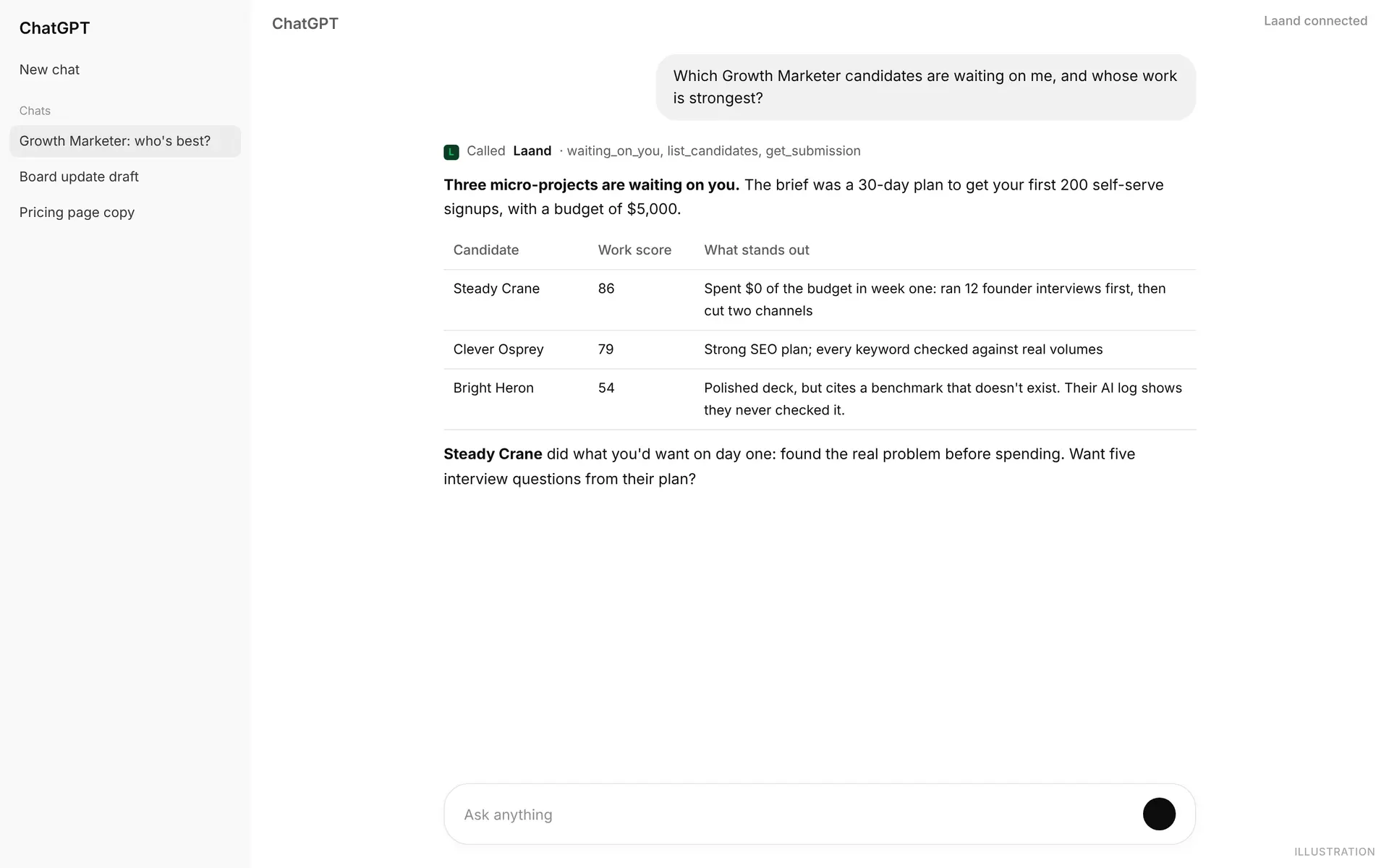
Friday, in ChatGPT. The CEO asks which candidates are waiting and whose work is strongest.
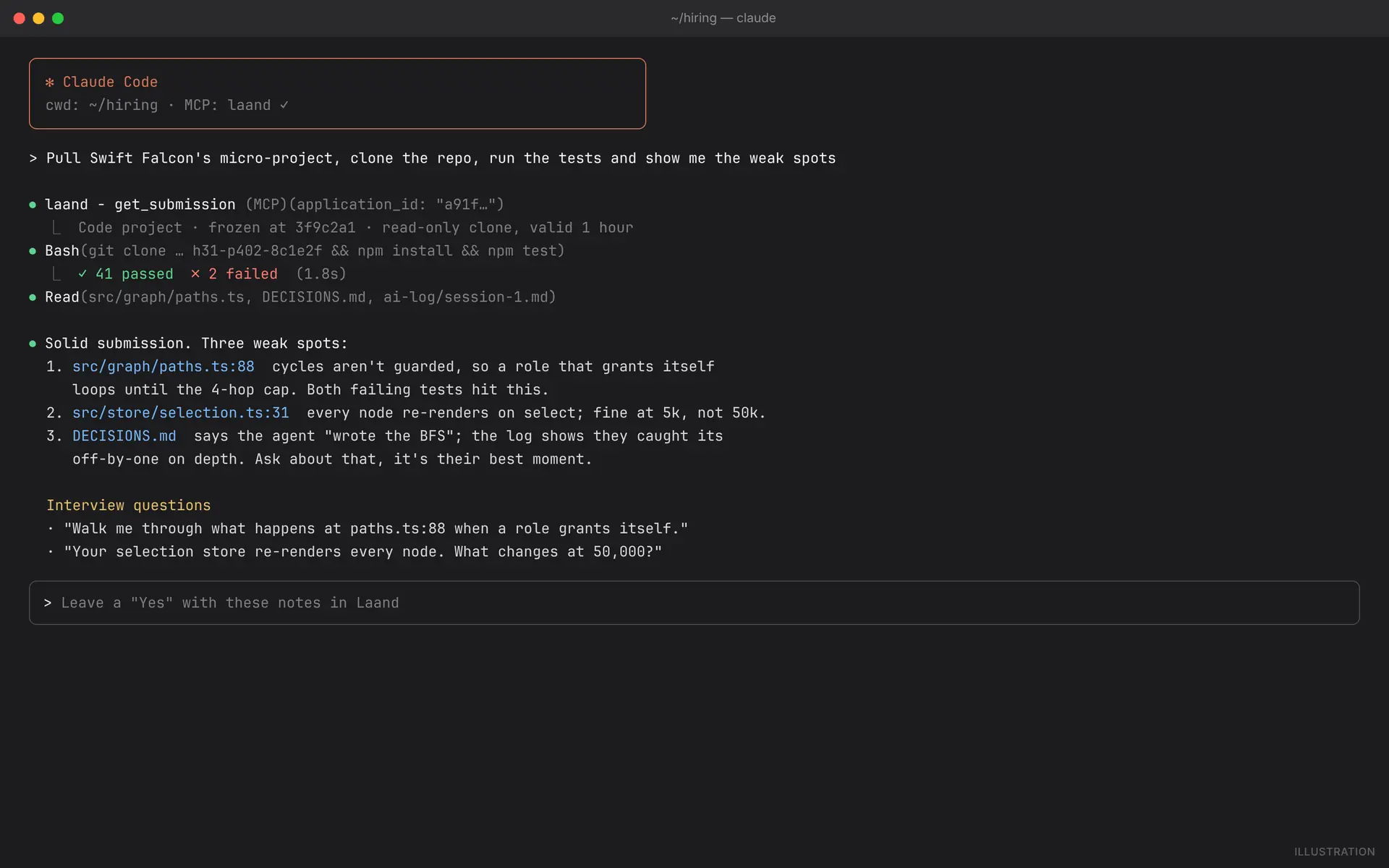
Friday, in Claude Code. The CTO unlocks the top two, clones the frozen submissions, runs them, and gets interview questions from the weak spots. (Layer 5.)
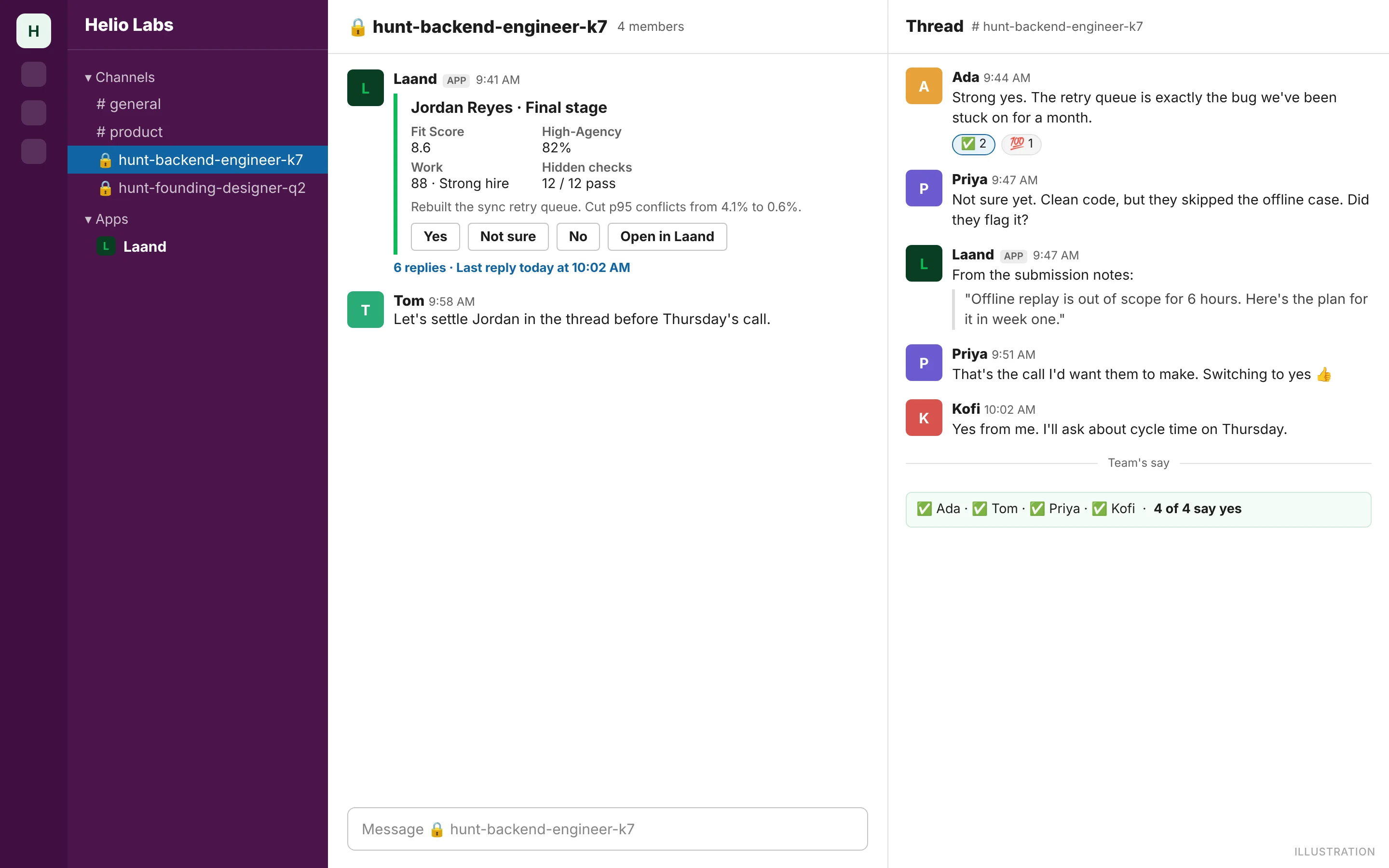
Friday, back in Slack. The team settles it in the hunt channel, each with a Yes, Not sure or No and a reason. (Layer 5.)
Total founder time: an hour on Monday, an afternoon on Friday. Everyone met only the people who'd already done the work.
Watch the whole loop in two minutes →
Before you connect an agent to hiring data: a checklist
Hiring data is some of the most sensitive data you hold. Whatever you connect, check these:
- No API keys. Agents should connect with OAuth, per person. Laand uses OAuth 2.1 with PKCE; tokens last an hour and are stored only as hashes.
- Per-person access, with roles. Each teammate connects their own agent, with their own permissions. In Laand, members can read and leave their say; only owners and admins can make decisions.
- Instant revocation. Remove a teammate, and every agent they connected loses access at once. Disconnect any app from Integrations, any time.
- Identity rules that hold everywhere. If candidates are anonymous until you unlock them in the app, they must be anonymous to the agent too. In Laand, the same rule applies in Laand, Slack and every agent.
- Least-privilege for code. If agents get candidate repos, it should be read-only, one repo, short-lived. Laand's clones are read-only, scoped to one repo, and expire within the hour.
- Money and irreversible actions stay in the app. Paying, paid invites and marking the hire should need a person, in the product. Laand's agent tools return a link for those.
- An audit trail. Every agent action should be recorded as the person's, marked as from an agent. Laand does this in the app and in Slack.
- No training on your data. Ask. Laand doesn't.
- Your code stays yours. Agents should send summaries, not source. Laand's micro-projects recreate your problems in a fictional setting.
What each approach really costs
For a six-person AI startup hiring one senior engineer at $150,000:
| Approach | Cash | What the agents read |
|---|---|---|
| Recruiting agency | 20–25% of salary (Dover): $30,000–$37,500 | None. A recruiter reads résumés. |
| LinkedIn Recruiter + Hiring Assistant | A paid, quote-only add-on to LinkedIn Recruiter | Profiles and applications, faster |
| ATS with AI screening | Ashby from $400/month; Greenhouse roughly $6,000–$10,000 a year for small teams, plus setup | Résumés, which 41% of US applicants admit to gaming with prompt injection |
| Your own agents, by hand | Your subscriptions | Real work, if you can spare two to three days of senior time to build and grade it |
| Your agents + Laand | Free to publish and connect. $750 per talent unlocked. Five stipends you set (say $300 each, $1,500) + unlocking your top three ($2,250) = $3,750 | Verified real work on your problem, with AI logs, from the people above your bar |
FAQ
What is agentic hiring? Using AI agents across the hiring workflow, from drafting the role to reviewing the work. Done well, agents produce and check evidence of ability; people make the decision.
Can an AI agent hire someone on its own? It shouldn't, and in many places it legally can't. Agents should compare, verify and recommend. A person decides, on the record.
What is MCP, and why does it matter for hiring?
The Model Context Protocol is the open standard Claude, ChatGPT, Codex, Cursor and others use to connect to tools. It means one hiring system can work in every agent your team uses, instead of a separate bot per app. Laand's MCP server is at https://laand.me/mcp; the setup for each agent is in our AI agent guide.
Do candidates know agents are involved? They should. On Laand, candidates know their work is reviewed with AI, and they're expected to use AI themselves and log it.
What if our team uses several agents? That's the normal case. Laand works the same in all of them, with the same rules, so the CEO in ChatGPT and the CTO in Claude Code see the same pipeline.
What does Laand cost? Publishing and connecting are free. $750 per talent unlocked, only for people who've already done the work. No subscription.
Automate the evidence, not the guesswork
The first wave of AI in hiring made it faster to process people you know nothing about. The next wave should make it possible to know what someone can do before you ever meet them.
That's what agents are good at: building the work, running it, checking it, reading it. Let them. Then make the call yourself, about someone who's already shown you.
Start a Talent Hunt · Connect your agent · Watch how it works (2 min)
Victor Eduoh, Founder, Laand
The startup and candidates in the scenario and product screens are illustrations. Laand isn't affiliated with Anthropic, OpenAI, Anysphere (Cursor), Slack, LinkedIn, Greenhouse, Ashby or any company named here. Hiring Index figures were taken on 13 November 2026; see the Index for today's. Competitor prices are from their public pages and buyer-reported figures, November 2026.
Stop applying blind.
Laand scores your fit for any role, then builds the application kit that proves you can do the job.
Join LaandHire with the agents you already use
Connect Laand to Claude, ChatGPT, Codex, Cursor or Slack. Start a hunt in one line and wake up to people who already did the work.
Start a Talent Hunt