Hiring with Codex: run an engineering hire where the take-home can't be faked
Picture a CTO at a six-person devtools startup, and the take-home that just broke her process.
She sent the same exercise she'd used for two years: add retries to a flaky webhook consumer, four hours, send a repo. Ten candidates reply. Eight submissions are close to identical: same structure, same helper names, same tidy README with the same three headings. The ninth is brilliant. On the follow-up call, its author can't explain why the retry logic uses jitter.
None of them cheated, exactly. They did what every engineer does now: they opened Codex and asked it to do the task. Her take-home was built to measure whether someone can write code. Today, it measures whether someone has a Codex subscription.
That's the problem this guide solves. You'll get a complete way to use Codex to build, run and grade an engineering hire on agent-assisted work, where using AI is expected and the evidence is how well someone steers it. I'll also show you how we turned that into Laand: you type "Laand, hire a senior backend engineer" inside your repo, and Laand builds a verified work sample from your real problems, runs the hidden tests, and hands Codex everything it needs to review the results.
Take-homes didn't die. It changed what it measures.
The numbers explain the CTO's ten submissions:
- 84% of developers use or plan to use AI tools, according to the 2025 Stack Overflow Developer Survey.
- In 2024, 29% of job seekers said they'd used AI to complete a test assignment or skills assessment (Capterra, via TestGorilla), and that was before agents could do a whole take-home on their own.
- 28% of hiring managers have caught candidates using AI to cheat on online assessments (Resume Genius, same source).
The reflex is to fight it: ban AI, proctor the webcam, go back to whiteboards. That's backwards. You don't want someone who can write a retry loop without Codex. You want someone who can tell when Codex's retry loop is almost right.
That's the actual skill gap now.
In the same survey, 66% of developers said their biggest frustration is AI solutions that are "almost right, but not quite", and 46% don't trust the accuracy of AI output. The engineers worth hiring are the ones who catch the "almost": they frame the problem before prompting, verify what comes back, cut scope on purpose, and can explain every line they kept.
What the market asks for, and how rarely it checks
At Laand we track 678,125 open roles across 15,085 job boards, and read every description sentence by sentence. From the Laand Hiring Index this week:
- Only 7.2% of job ads mention AI fluency at all, even though most engineering teams now ship with agents every day.
- Only 11.4% ask to see a work sample, portfolio or trial project.
- AI companies ask for high agency three times as often as the rest of the market (7.8% of roles against 2.5%).
So the companies building the agentic future mostly still hire for it with a résumé and a LeetCode round. For a team of six, that's not a process quirk; it's a coin flip on a sixth of your company. The fix is real, agent-assisted work, and it can start from your repo.
The agent-assisted take-home: how to build one with Codex
Here's how to design and run a work sample that measures steering, not typing. You can do all of this with Codex today.
1. Mine your repo for the real problem
Open Codex in your main repository and let it find what a new hire would actually own.
Read ingest/, queue/ and docs/adr/. What are the three problems a new
senior backend engineer would own in their first 90 days? For each,
point to the files, the symptom (with numbers if the code or ADRs have
them) and why it hasn't been fixed yet. Don't propose fixes.
2. Recreate it, fictionally
Never hand candidates your real code. Ask Codex to rebuild the shape of the problem in a small, fake service.
Create a standalone starter repo (under 25 files) for a fictional
service with the same failure as our retry storm in queue/worker.ts:
unbounded retries, no back-pressure. Use none of our names, code or
data. Outside systems are local fakes. It must install and pass its own
tests as-is.
3. Write hidden tests that only the right solution passes
This is what makes the exercise gradeable at scale, and it's where most hand-made take-homes fall down.
Write acceptance tests for the starter that (a) fail on the starter
with an assertion, not a crash, and (b) pass with a correct solution.
Then write that solution and prove both. Keep the tests out of the
starter repo.
Then check the opposite: ask Codex in a fresh session to solve the starter naively and confirm the hidden tests catch it. If an agent's first draft passes your tests, your tests are measuring the wrong thing.
4. Require the two files that show how they think
Ask every candidate for:
- DECISIONS.md: what they changed, what they didn't, and why. At least a few paragraphs.
- An AI log: the Codex, Claude Code or Cursor session export, or a written account. Using AI is allowed. Hiding it isn't.
5. Timebox it, and pay for it
Four hours, paid. The timebox is what reveals execution taste: knowing what to cut. The payment is what makes the best engineers say yes; the ones with options don't do free homework.
6. Grade with Codex, then read the evidence yourself
For each submission in ./submissions: run the hidden tests, read the
diff from the starter, DECISIONS.md and ai-log/. Score test results,
problem framing, verification, scope judgment and code quality. Flag
any edits to tests or test config. Quote the lines that support each
score.
That flag matters. In one illustrative run you'll see below, a candidate passed 7 of 12 tests after editing the test config. Without the flag, that looks like a decent score.
7. Interview on their own diff
Write five interview questions for this candidate that name specific
files and decisions in their diff. Each must only be answerable by the
person who wrote it.
That last line is also your best protection against proxy candidates and fakes: nobody can talk through trade-offs they didn't make.
The steering signals to grade
Use this alongside your technical scorecard. It's what separates engineers who steer Codex from engineers who follow it.
| Signal | Strong | Weak |
|---|---|---|
| Framing | Restates the real problem before prompting; spots the back-pressure issue nobody mentioned | Pastes the brief into Codex verbatim |
| Verification | Runs the tests, writes new ones, catches the agent's edge case | Ships the first green run |
| Test integrity | Leaves tests alone; adds cases | Edits tests or config to pass |
| Scope | Cuts on purpose and says so in DECISIONS.md | Tries everything, finishes nothing |
| Ownership | Explains every kept line in their own words | "Codex wrote that bit" |
| AI honesty | Log matches the diff | Log is missing, or tells a different story |
Where doing it by hand breaks
I want to be honest about the cost of the playbook above. It works, but on a team of six:
- Building a fair starter with hidden tests is a day of senior engineering time. Doing it per role, and keeping it from leaking, is more.
- Grading is the hidden tax. Ten submissions at two hours each is 20 hours of your best engineer's week, usually the CTO's.
- You still have to find the candidates. Codex can build the exercise; it can't fill the top of the funnel.
- Repos and access are a mess. Creating private repos, inviting people, starting each person's clock fairly, revoking access, freezing the submission at a commit.
- Identity leaks bias in. A GitHub handle, a commit author or a personal site in the README tells you who someone is before you've judged the work.
- Nobody keeps the record. Who decided what, and why, ends up in DMs.
Every one of those is a solved problem in Laand.
Hiring with Codex, end to end, with Laand
You set the bar. Laand runs the proof-of-work engine: sourcing, a Fit Score against your milestone, a High-Agency Assessment, and a paid, verified code project built from your real problems. Codex connects to every step.
Step 1: Connect Laand to Codex
codex mcp add laand --url https://laand.me/mcp
codex mcp login laand
That's it. Sign in with your company account and press Allow. Each engineer connects their own Codex, with their own role.
Step 2: Start the hunt from your repo
Inside the repository the hire will work on:
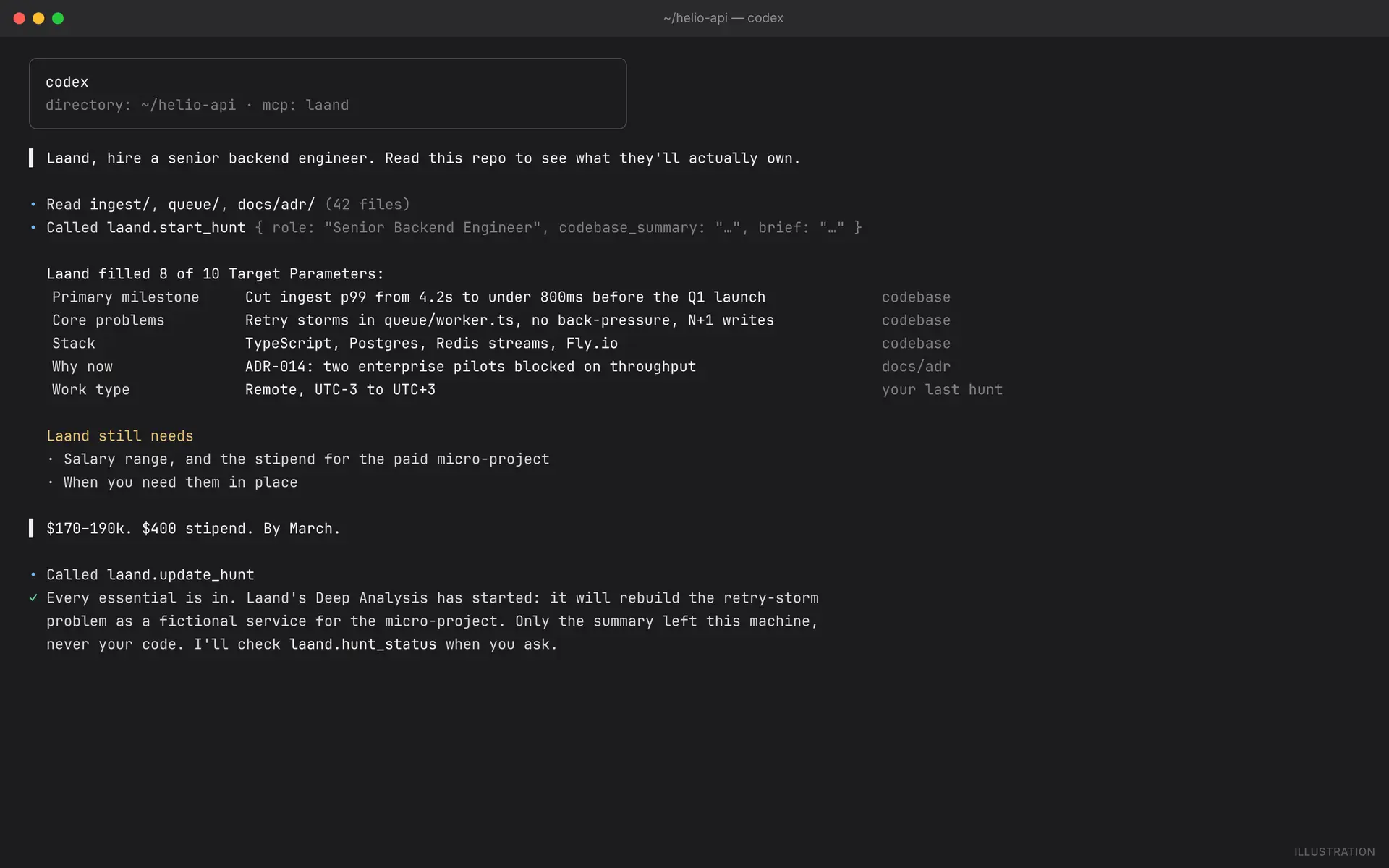
Laand, hire a senior backend engineer. Read this repo to see what they'll actually own.
Codex reads the code and ADRs, and Laand fills the hunt with where every value came from. It asks only what Codex can't know: salary, the micro-project stipend, and the start date.
Only a summary of the codebase goes to Laand, never the code. Laand's Deep Analysis turns it into core problems and code micro-projects that recreate them in a fictional service, exactly like steps 1 and 2 of the playbook, done for you.
Step 3: Laand builds and proves the work sample
This is the part that takes a day by hand. For every code micro-project, Laand:
- generates a starter repo on a pre-tested base (Node, React, Python or Go);
- writes hidden acceptance tests, and proves they fail on the starter and pass with a solution, on real CI runners;
- has a second, independent model review the brief, starter, tests and solution for leaks, fairness and fit to the time limit, before anyone sees it.
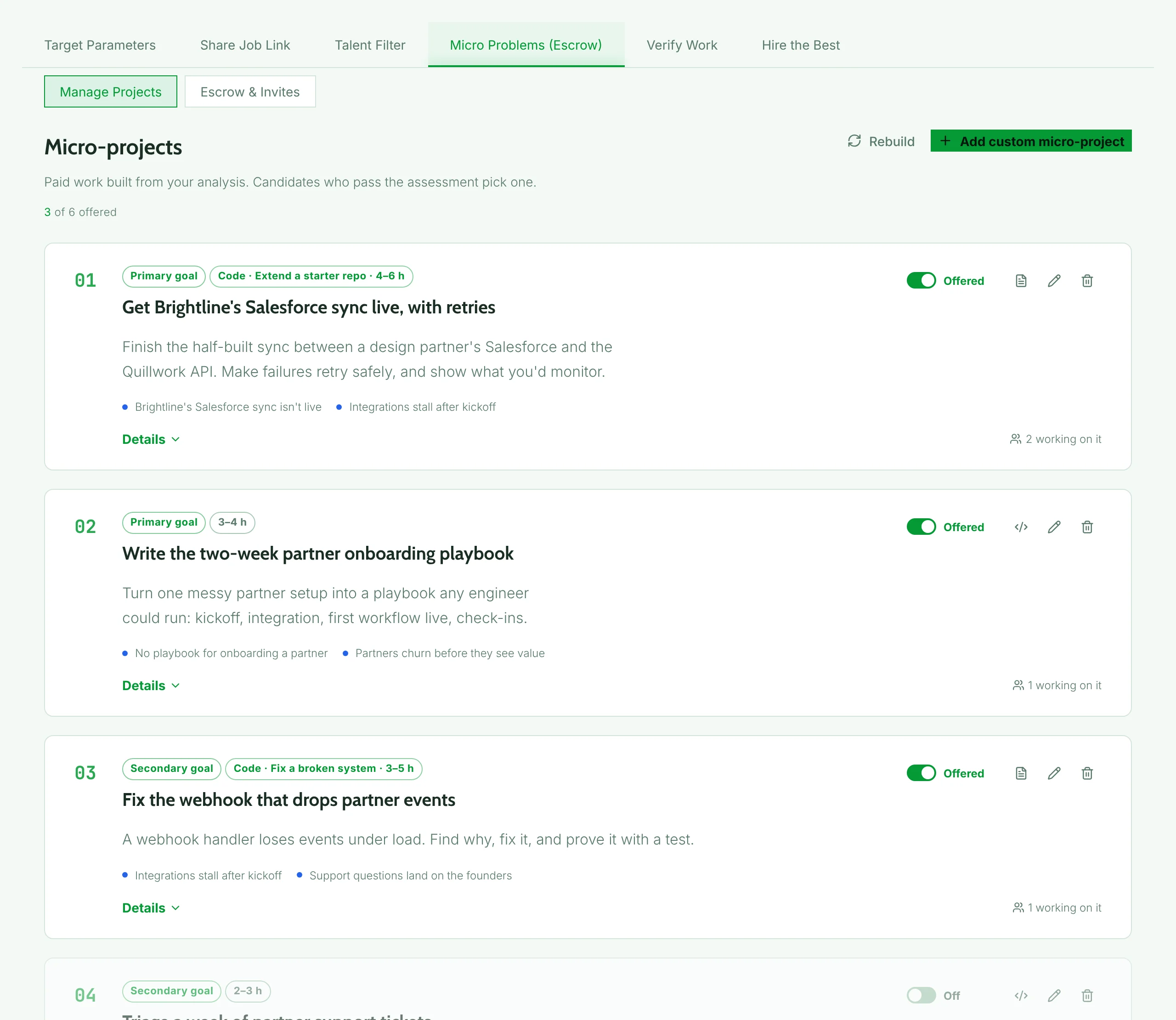
A project with a known problem is never offered.
Step 4: The gates, and a fair clock
Candidates come from Laand's talent network and your free careers page. Below your Fit Score bar, they're a count, not a card. Above it, they take the High-Agency Assessment, some of it on camera or by screen share. The best are invited to the code project:
- a private repo is created for them, without the hidden tests or the solution;
- their clock starts only once they have access, so a GitHub hiccup costs them nothing;
- they must commit their own work, write a DECISIONS.md of at least 150 words, and include their AI log (Codex, Claude Code or Cursor exports are all accepted);
- on submit, the repo is frozen at a commit, their access is removed, and the hidden tests run.
Laand then reads the diff, the test run, DECISIONS.md and the AI log; scores seven dimensions; flags any edits to tests; and writes interview questions that name files and decisions. Commit authors are never shown.
Step 5: Compare everyone in Codex
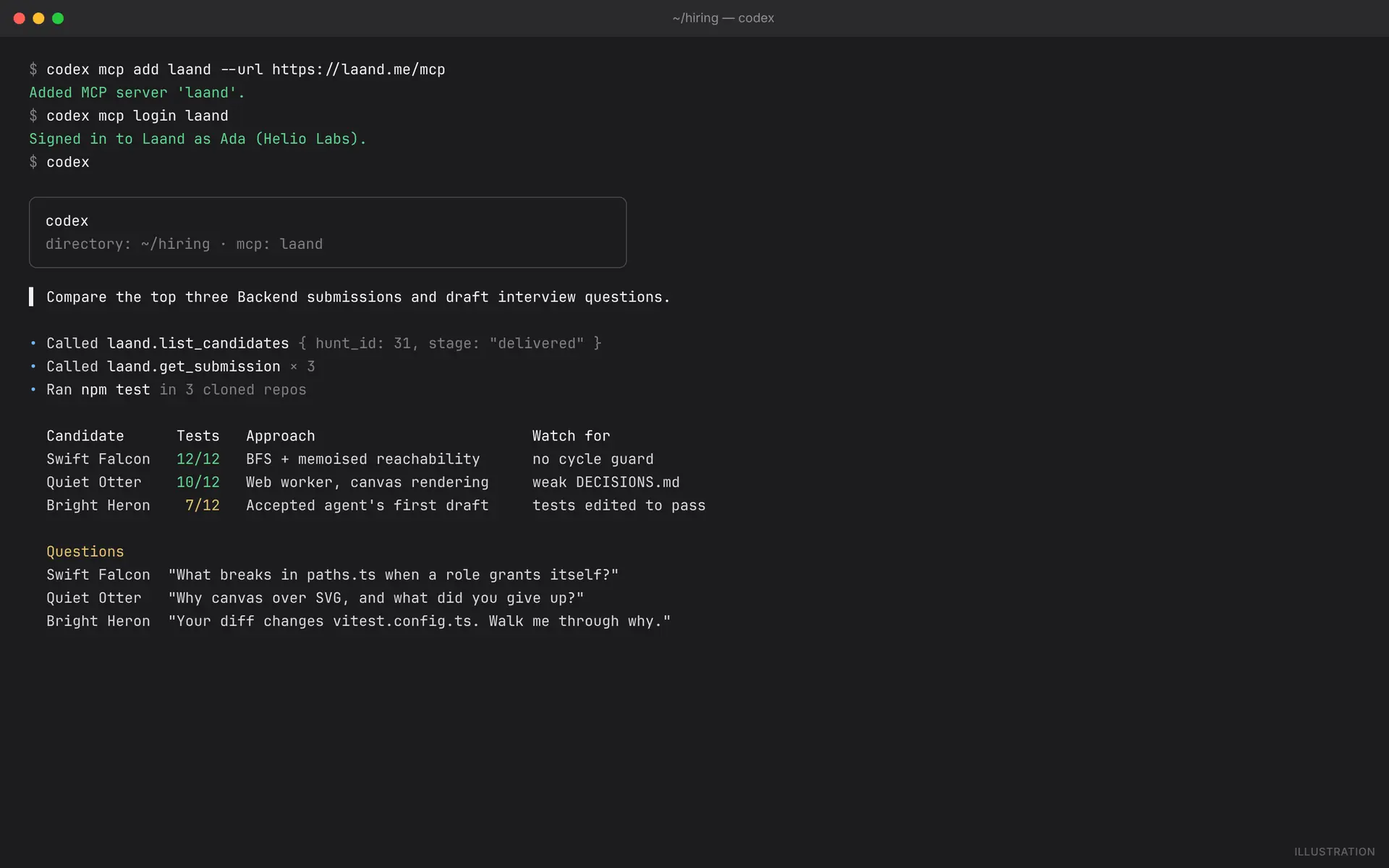
Compare the top three Backend submissions and draft interview questions.
Look at Bright Heron's row: 7 of 12 tests, and "tests edited to pass". That's the Test Integrity signal, caught automatically. Everyone stays anonymous until you unlock them; then Codex gets a read-only clone of their frozen commit (that one repo, for an hour), and you can run, extend or break it with your own tooling.
Step 6: Decide as a team
Leave your say from Codex, Laand or Slack:

Owners can move someone to the final stage from Codex. Paying, paid invites and marking the hire stay in Laand.
Prompts to try once Laand is connected
- "Which Backend submissions are waiting on me?"
- "Clone Swift Falcon's submission, run it against 50k events, and tell me where it falls over."
- "Did anyone edit tests or config to pass? Show me the diff."
- "Compare how each finalist used Codex, from their AI logs. Who pushed back on the agent, and were they right?"
- "Leave a 'Yes' on Swift Falcon: strong verification, ask about cycles."
One backend hire, five ways: the real cost
A six-person devtools startup hires a senior backend engineer at $180,000. Here's what each route really costs.
| Route | Cash | CTO time | What you see before the offer |
|---|---|---|---|
| Recruiting agency | 20–25% of salary is the norm for engineers (Dover): $36,000–$45,000 | Interviews for every shortlisted CV | Résumés. Maybe a LeetCode score. |
| ATS + your own take-home | Ashby from $400/month ($4,800 a year), billed whether you hire or not | A day building the take-home, 20 hours grading ten of them | Ten submissions, eight of them the same Codex output |
| Generic coding-test library | TestGorilla from about $142/month | Light | Pass rates on puzzles that aren't your problem, and that 28% of hiring managers have already seen AI beat |
| Codex + the playbook above | Your seat | About three days, end to end | Real signal, if you have the days |
| Codex + Laand | Free to publish and connect. $750 per talent unlocked. Five $400 stipends ($2,000) + unlocking your top two ($1,500) = $3,500 | An afternoon reviewing in Codex | Frozen repos with hidden-test results, DECISIONS.md, AI logs, flagged test edits, and questions that name files |
What stays human
| How it works | |
|---|---|
| Who decides | Your team. Codex reads, runs and compares; people decide. Actions are recorded as yours "from an AI agent". |
| Identity | Anonymous until you unlock someone who has submitted. Commit authors are never shown. |
| Your code | Only a summary reaches Laand. Micro-projects are fictional recreations. |
| Money and the hire | Paying, paid invites and marking the hire happen in Laand. |
| Access | Clones are read-only, one repo, one hour. Each engineer connects their own Codex. |
FAQ
Should candidates be allowed to use AI on the take-home? Yes, and they should log it. Banning AI tests a skill you don't use. Logging it shows the one you need: how they direct, check and overrule the agent.
How do I stop candidates editing the tests? Keep the acceptance tests out of their repo and run them after a frozen commit. Laand does both, and flags any edits to visible tests or config.
How long should an engineering work sample take? Three to four hours, paid, with a clear brief. Long enough to show judgment, short enough that strong people with jobs will do it.
Does Laand see our code? No. Codex sends a summary of what it read. The work sample is built on a fictional service with the same shape of problem.
Does this work for frontend and full-stack roles? Yes. Laand's bases cover Node, React, Python and Go. For non-code roles, the micro-project is written work, reviewed the same way.
What does it cost? Publishing and connecting are free. $750 per talent you unlock, only after they've submitted. No subscription.
The take-home is back
The take-home stopped working when every candidate got an agent. It works again the moment you stop asking "can they write this?" and start asking "can they steer this, verify it, and explain it?"
Codex makes that easy to build. Laand makes it run while you ship.
Start a Talent Hunt · Set up Laand in Codex · Watch how it works (2 min)
Victor Eduoh, Founder, Laand
The CTO and her startup are a made-up scenario; the company and candidates in the product screens are illustrations. Laand isn't affiliated with OpenAI, Ashby, TestGorilla or any company named here. Hiring Index figures were taken on 13 November 2026; see the Index for today's. Competitor prices are from their public pages, November 2026.
Stop applying blind.
Laand scores your fit for any role, then builds the application kit that proves you can do the job.
Join LaandStart an engineering hunt from your repo
One line in Codex. Laand builds a verified work sample from your real problems, and you review the results where you already work.
Start a Talent Hunt