How to source high-agency engineers: repos, open source, saved proof, and the invitation that gets a yes
The best engineers for an AI-native startup leave a commit history, not a cover letter. Here's how to read it, and how to reach them.

Picture a CTO at an eleven-person AI company, three weeks into hunting for a founding-level engineer.
He's had 230 applications. Most CVs list the same stack. Most mention "AI-assisted development". Most cover letters are clearly written by an agent. He's done nine phone screens and two take-homes, and both take-homes came back suspiciously fast and suspiciously similar.
Then, on a Sunday, he opens an issue thread on an open-source library his team depends on. Someone has diagnosed a nasty concurrency bug in four precise comments, proposed two fixes, explained why the simpler one is better, and opened a pull request with a test that reproduces the bug. The maintainers merged it in a day.
That person never applied. In ten minutes on that thread, the CTO learned more about their agency and taste than in three weeks of CVs.
Why engineering CVs stopped working
Engineering CVs were always a weak signal: lists of languages, frameworks and employers. In the age of coding agents they're weaker still. Everyone lists the same stack, everyone "builds with AI", and polished take-homes arrive in an hour.
Meanwhile the thing you need most in a founding or early engineer isn't a stack. It's high agency (owning outcomes without being told how) and taste (knowing what to build, what to cut and what "simple" looks like). On an AI-native team, it's also whether they steer their agents or follow them.
None of that appears on a CV. Much of it appears in code.
Where high-agency engineers leave traces
| Source | What to look for |
|---|---|
| Their own repos | Tools built to scratch their own itch; a commit history over months, not one weekend |
| Open-source contributions | Bugs diagnosed and fixed in projects they don't own |
| Issue threads | Precise diagnosis, two options, a clear recommendation |
| Pull request reviews | Pushback with reasons; suggestions that simplify |
| Engineering write-ups | "How we fixed…" posts with trade-offs, not just wins |
| Your dependencies' contributor lists | People already working on problems close to yours |
| Your own public repos and issues | Users who sent you a fix along with the bug report |
| Saved proof | Projects with the problem, approach, AI chats and outcome, such as Laand's Career Vault |
How to read code for agency and taste
Agency signals
- Contributions to things they don't own. Fixing someone else's project is agency in its purest form.
- Follow-through. Did the pull request get merged, or abandoned after the first review comment?
- Unglamorous work. Tests, docs, CI fixes, migrations: work nobody applauds.
- Persistence over time. A repo maintained for a year beats ten repos from one weekend.
Taste signals
- Small diffs that solve big problems.
- Declined features, with reasons, in their own issue trackers.
- Readable code and honest READMEs that state limitations.
- The simpler of two fixes, chosen and explained.
AI-use signals
Many engineers now say in their commits or write-ups how they used agents. Look for evidence of steering: tests written to check the agent's work, agent-generated code that was clearly reviewed and reshaped, and honest notes like "the agent's first approach would have done X; I changed it because Y".
A caution
Public code shows how someone worked in a different context. Many excellent engineers have no public code at all, because their work is private. Research finds prior experience is a weak predictor of performance in a new organisation (see does past experience predict job performance?). Use traces to find people, not to hire them.
Outreach that gets a reply
High-agency engineers ignore generic recruiter messages. What works:
- Name the specific work. "Your fix for the connection-pool deadlock in [library] was the clearest bug diagnosis I've read this year."
- Describe a real problem, not a role. "We have a webhook pipeline that drops events for one customer under load, and it's costing us a design partner."
- Offer paid, scoped work. "Would you take a paid, six-hour swing at it? Here's the brief and the stipend."
- Make it easy to say no. No CV required. No five-round loop.
Here's a template:
Hi [name]. I saw your [specific contribution] and the way you [specific thing they did well]. We're an [N]-person team building [product], and we're stuck on [specific problem]. We pay people to take a real swing at it before anyone interviews anyone: about six hours, a stipend of [amount], AI welcome. Interested? Here's the brief: [link].
How Laand sources high-agency engineers
Laand is built to reach engineers who aren't looking, and to show you their agency and taste on your own code.
Start the hunt from your codebase
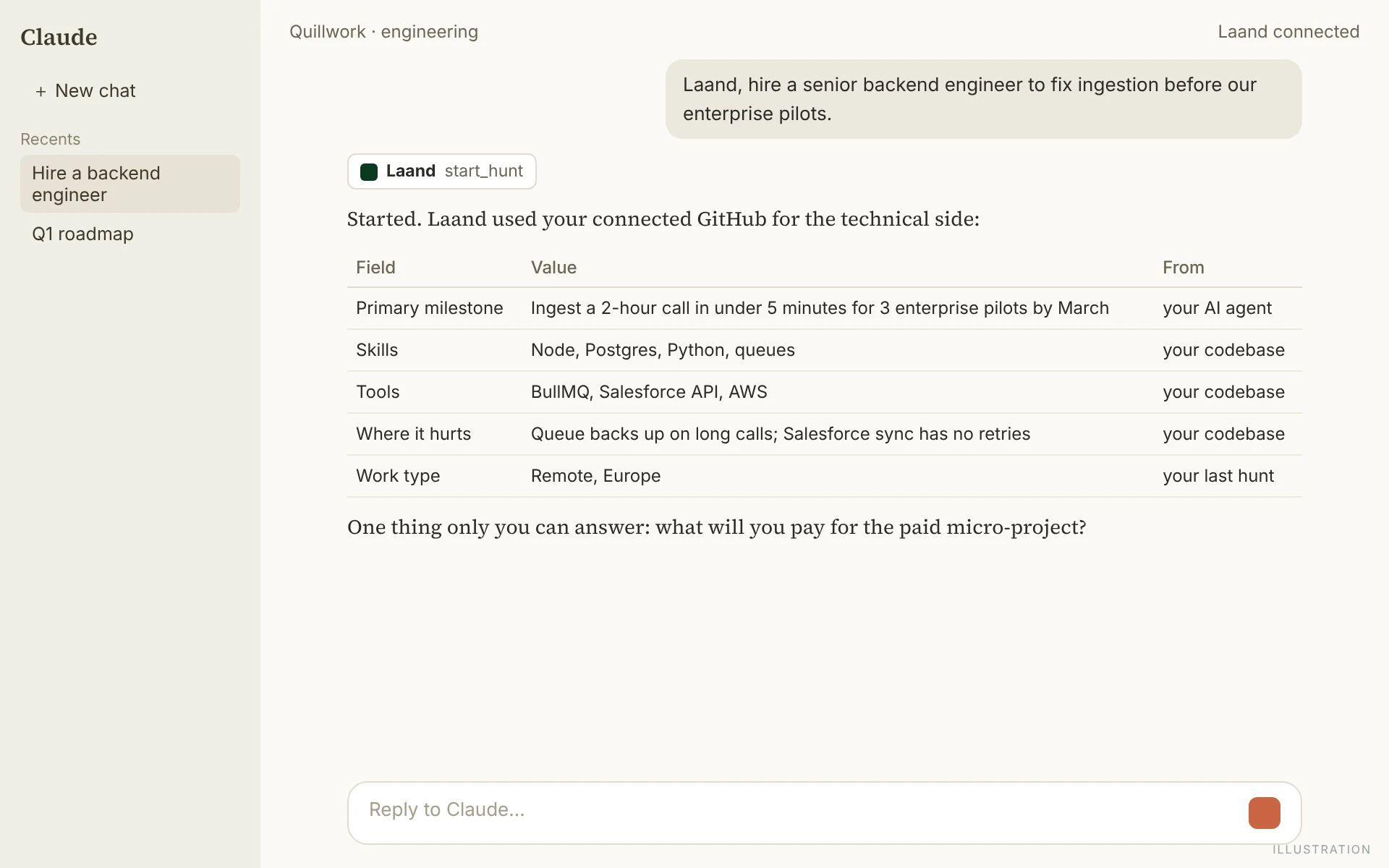
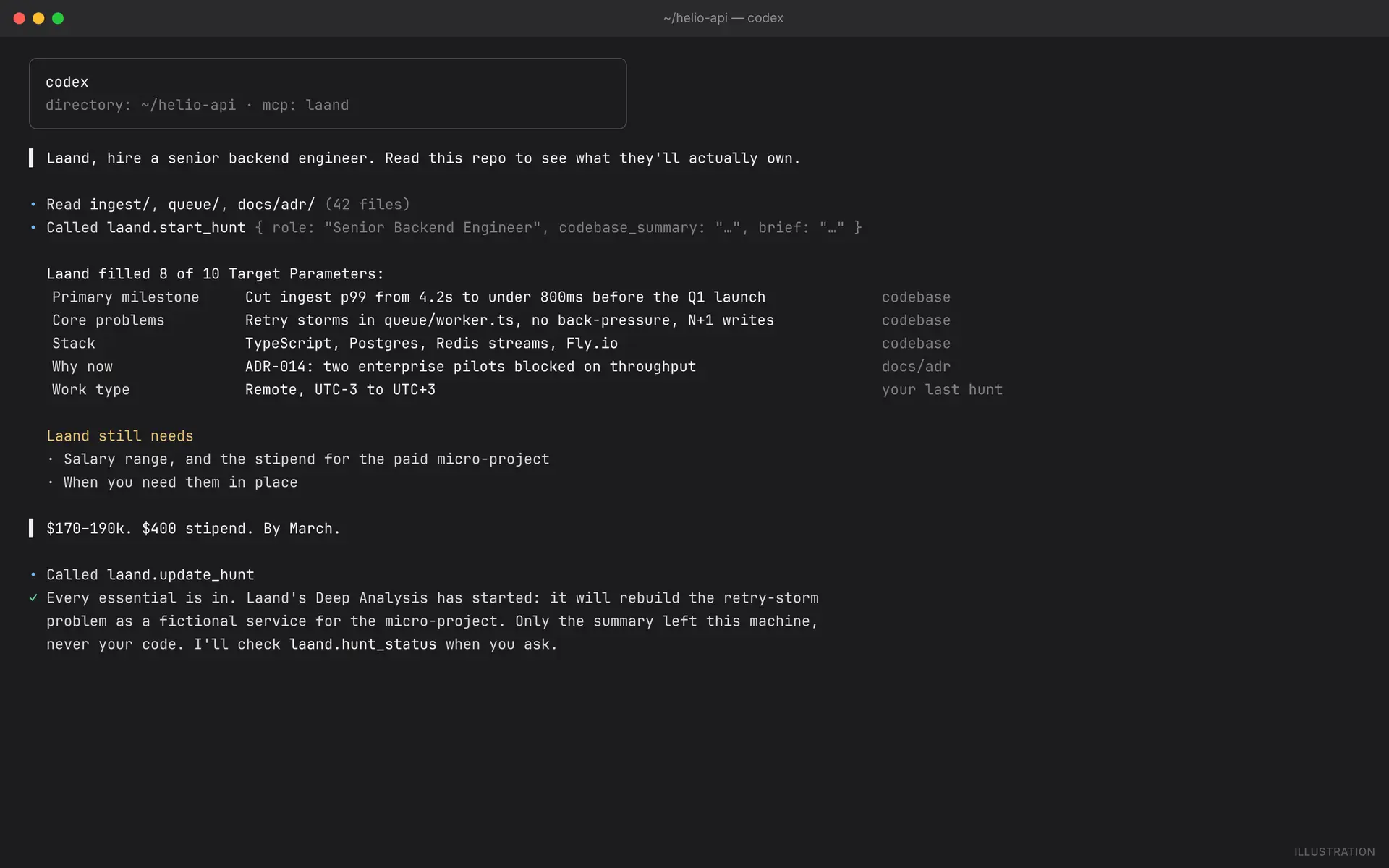
With GitHub connected to Laand (read-only, only the repos you choose), you can start a hunt from Claude Code, Codex or Cursor inside your repo. Laand fills the stack and the core problems from the codebase, marked as coming from it, and asks only what it can't know.
Reach engineers through their saved proof
Engineers on Laand can connect GitHub too, read-only and only the repos they pick. Each repo with their own commits becomes a Career Vault project marked Connected from GitHub, with their share of the commits and signs of how they build with AI, drafted for them to edit. Projects Laand reviewed, connected repos and self-described projects are labelled differently, so you always know what kind of proof you're looking at.
When you publish a hunt that's like work an engineer has saved, Laand may invite them by email, naming the project (a couple of invitations a fortnight at most). They apply like everyone else, Fit Score first.
Filter before anyone spends effort
Candidates get an honest Fit Score, then a High-Agency Assessment drawn from your core problems, some answered on camera or by screen share.
Scope paid work from your real code
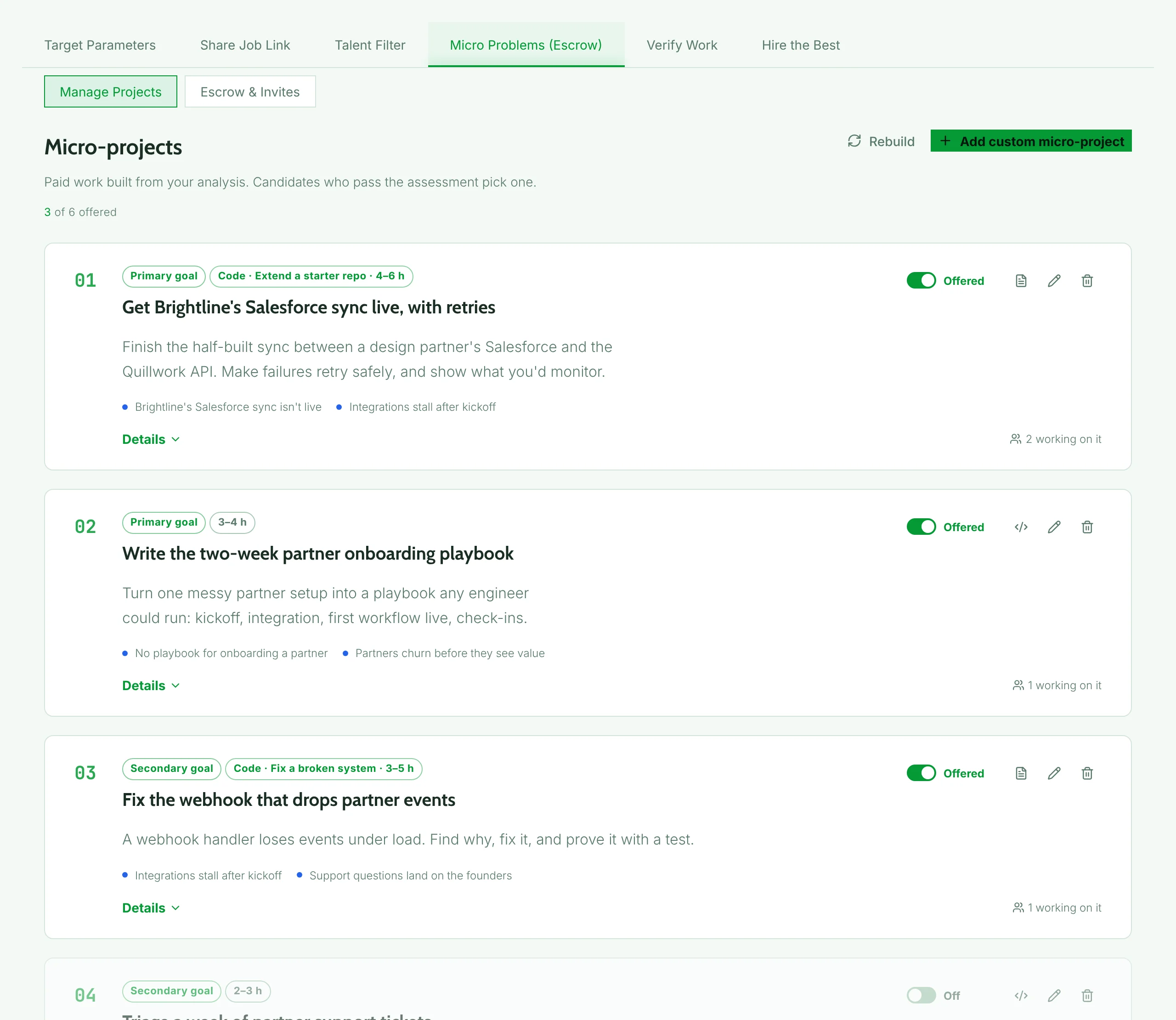
Finalists do a paid code micro-project of about six hours, in a private GitHub repo with a starter, scoped from your core problems. Every brief has a planted mistake; AI is allowed and visible unless you turn it off.
Let your coding agent review it
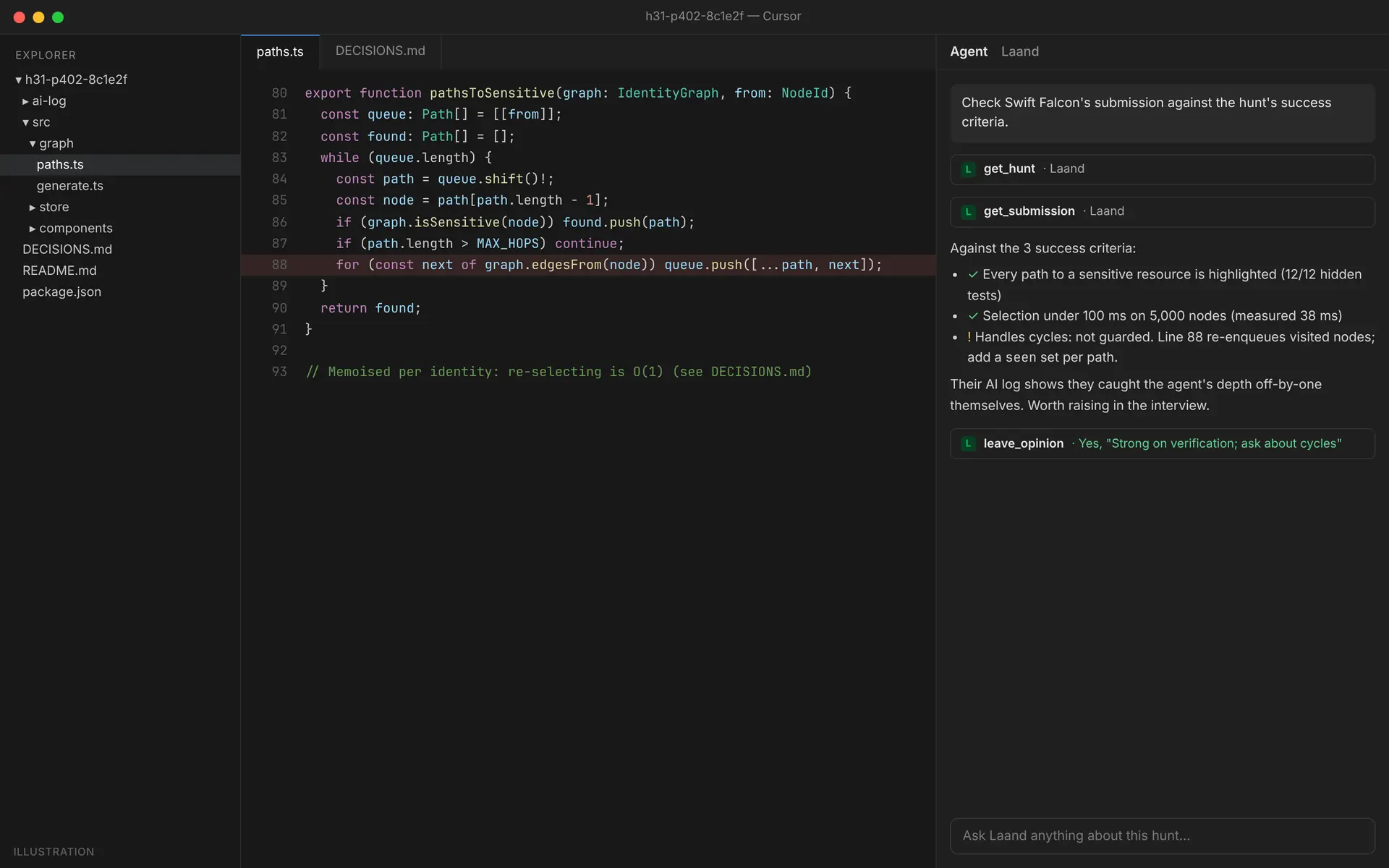
Ask Claude Code, Codex or Cursor to run each finalist's submission against your success criteria and find where it breaks.
Unlock the one you want
Candidates are anonymous until you unlock them, at $750 per talent unlocked. Publishing is free.
Traditional technical sourcing vs trace-based sourcing
| Traditional | Trace-based, work-first | |
|---|---|---|
| Starting point | Keyword search on profiles | Code, issues and saved proof |
| First message | "Exciting opportunity" | A specific problem and their specific work |
| Next step | Phone screen | Paid, scoped work |
| What you learn | Their stack | Their agency, taste and AI use |
| Founder time | Many screens | A few pieces of work and one interview |
A founder's view
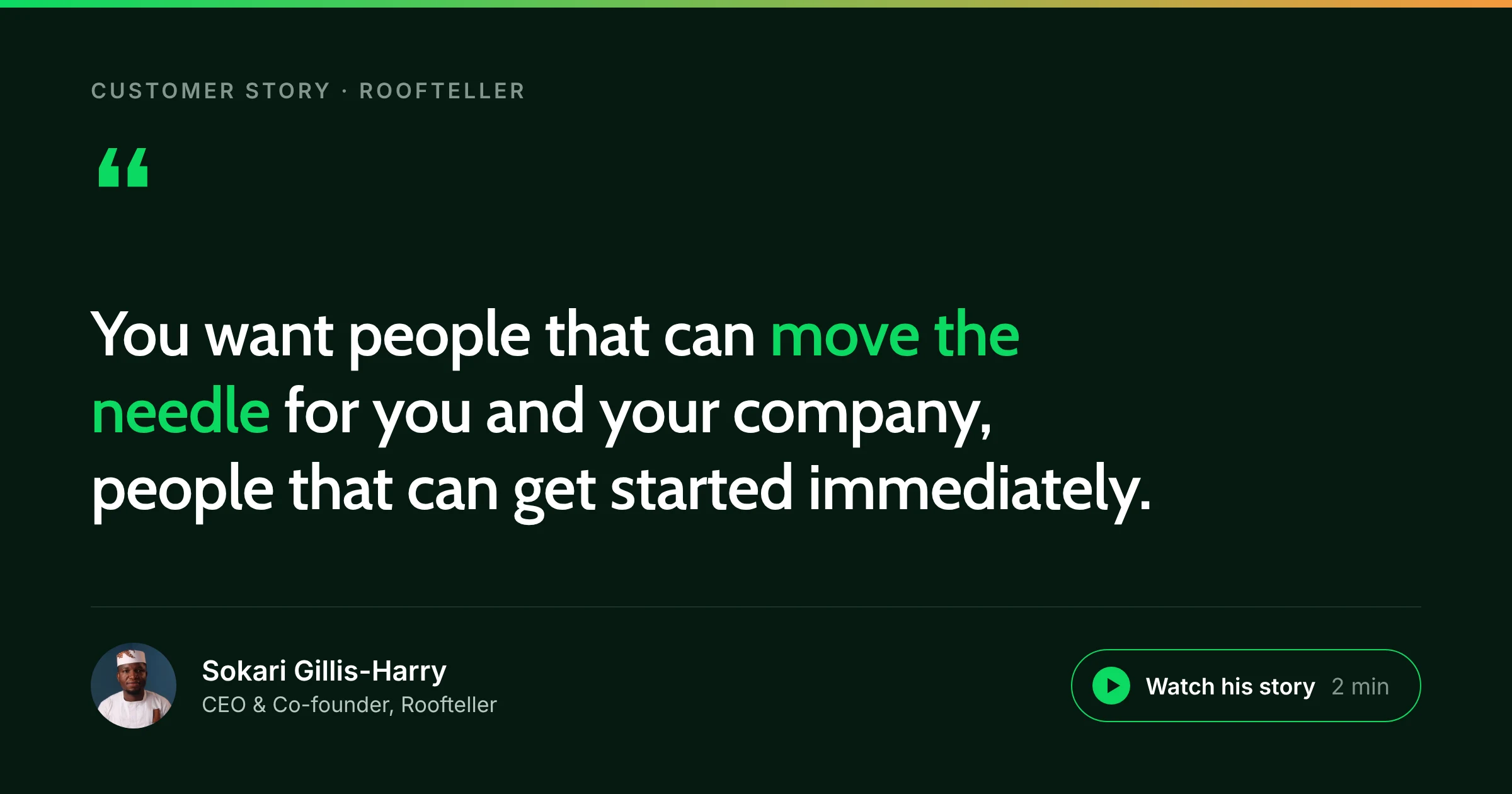
Sokari Gillis-Harry, founder of Roofteller, wanted people who could start delivering immediately:
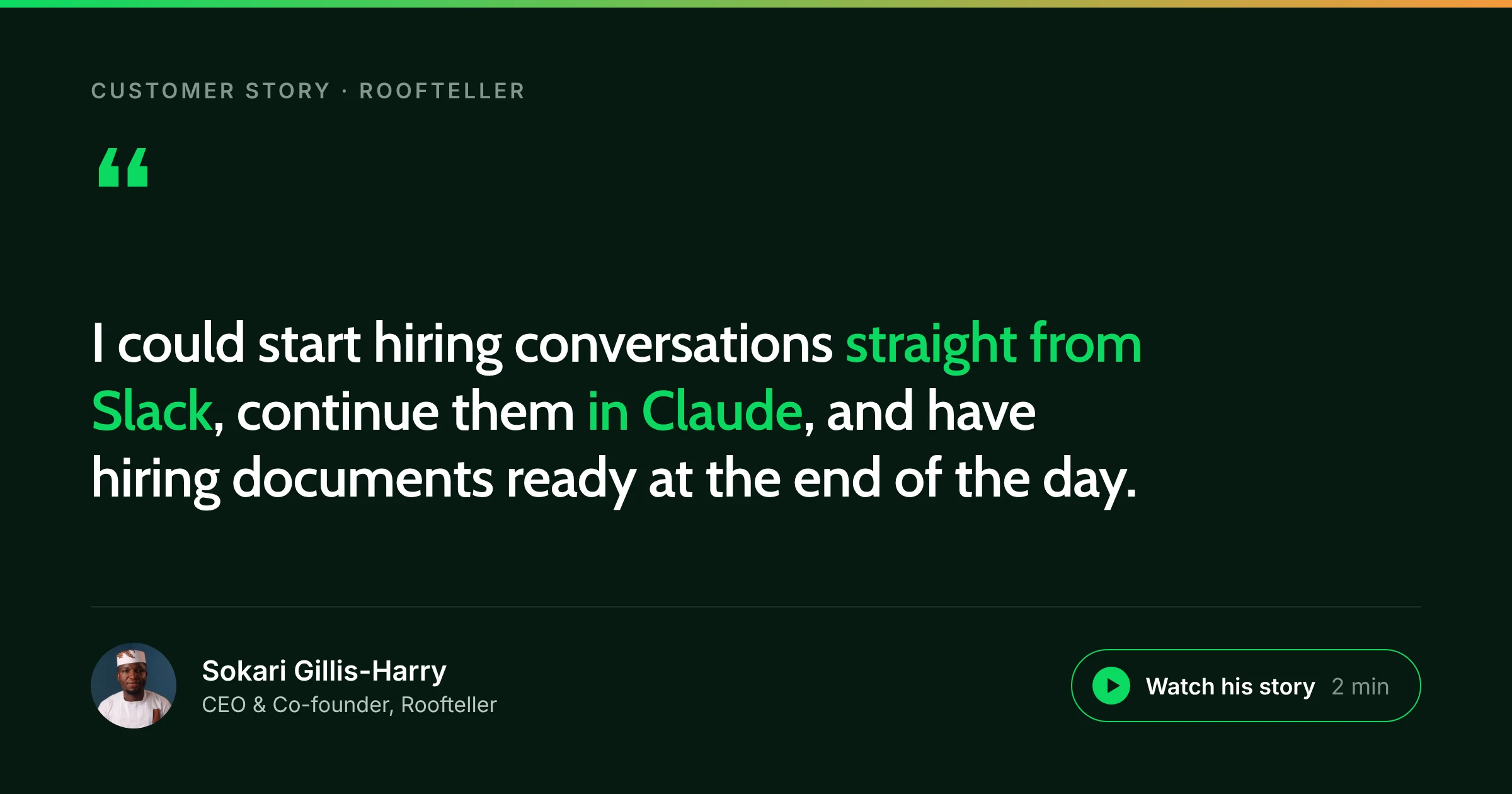
And he wanted to hire without leaving the tools he worked in:
A sourcing week for a busy founder
You don't need a recruiter to source well. You need about five focused hours a week:
| Day | Time | What to do |
|---|---|---|
| Monday | 1 hour | List the five libraries and tools your codebase depends on most. Read their recent issues and merged pull requests. |
| Tuesday | 1 hour | Write down the five people whose work impressed you most. Read their repos and write-ups. |
| Wednesday | 1 hour | Ask three people you trust: "Who's the engineer at your company who fixes things nobody asked them to?" |
| Thursday | 1 hour | Send five specific messages: their work, your problem, the paid project. |
| Friday | 1 hour | Review who replied, send briefs, and note which sources produced replies. |
Five specific messages a week will beat fifty generic ones.
Ways to find traces in code
- Your dependencies' issue trackers: search for issues that are closed with a fix from someone outside the core team.
- Pull requests that remove code: people who simplify are rarer than people who add.
- "Good first issue" mentors: people who help newcomers in open source often have both agency and taste.
- Your own public repos: look at who opened thoughtful issues or sent fixes.
- Release notes: the "thanks to" lists in changelogs of tools you use.
Measure what works
Keep a simple table: source, messages sent, replies, briefs accepted, submissions, hires. After a few weeks, you'll know whether your best engineers come from open source, referrals, your own users or saved proof, and you can spend your five hours accordingly.
Key takeaways
- Engineering CVs are weak signals; code traces are strong ones.
- Look for contributions to things they don't own, follow-through, unglamorous work and small diffs that solve big problems.
- Read traces for agency, taste and AI steering, then confirm on your own code.
- Outreach should name their specific work, describe a real problem and offer paid, scoped work.
- Laand reaches engineers through saved proof and lets your coding agent review their submissions.
Frequently asked questions
How do you source high-agency engineers?
Look for traces in code (their own repos, open-source fixes, issue threads and pull request reviews), read them for agency and taste, then reach out with a specific problem and a paid, scoped project.
What GitHub signals show high agency?
Contributions to projects they don't own, follow-through on pull requests, unglamorous maintenance work, and repos maintained over time.
What GitHub signals show taste?
Small diffs that solve big problems, declined features with reasons, readable code, honest READMEs, and choosing the simpler of two fixes.
What if an engineer has no public code?
Many great engineers don't. Use saved proof, referrals and your own community, then judge everyone on the same paid work scoped from your codebase.
How do I get passive engineers to respond?
Name their specific work, describe a real problem, offer a paid six-hour project instead of an interview loop, and make it easy to say no.
How many engineers should I contact to make one hire?
There's no fixed number, but specific outreach changes the maths. Ten messages that name someone's real work and offer a paid project on a real problem usually produce more serious candidates than a hundred generic messages. Track replies, briefs accepted and submissions by source, and spend your time on whichever sources produce people who finish the work.
Should I use a recruiter to source engineers?
You can, but brief them on traces rather than keywords: contributions to projects people don't own, follow-through, small diffs and saved proof. And keep the paid project as the decision point, so the recruiter finds people and the work decides.
What makes a good paid project for an engineer?
A real slice of your codebase that takes about six hours, with a starter repo, a clear deliverable, hidden tests, one planted contradiction and AI allowed. It should require choices, such as what to build, what to skip and what to test, so you see judgment and not just typing speed.
Keep reading
- Where to find high-agency talent
- How to attract high-agency candidates
- Hiring a high-agency founding engineer
Or start a Talent Hunt from your repo.
Stop applying blind.
Laand scores your fit for any role, then builds the application kit that proves you can do the job.
Join LaandSource engineers on your own codebase
Connect GitHub read-only, start a hunt from your repo, and see engineers do paid work scoped from your real problems. Free to publish; $750 per talent you unlock.
Start a Talent Hunt