Where to find high-agency talent: they aren't job hunting, so follow their traces
The people you want are busy owning outcomes somewhere else. They leave evidence wherever they've acted without being asked.

Picture the person you actually want for your next hire.
She's an engineer at a 200-person company. Six months ago she noticed the customer-support team was copying data between three tools by hand, so she spent two weekends building them an internal tool. It saves them a day a week. Nobody asked her to. Last month she rewrote the onboarding doc for new engineers because the old one was wrong. She has a small open-source library with a few hundred stars, built because the existing one annoyed her.
She is not on any job board. She hasn't updated her LinkedIn in two years. If you post a job, she won't see it. If a recruiter messages her about "an exciting opportunity", she'll ignore it.
But she has left traces everywhere. Of the kind of person she is. Of what she does when nobody's asking.
Why high-agency people aren't where you're looking
Job boards are full of people actively looking. That includes many excellent people, but it over-represents those between things and under-represents those who are deep in something.
High-agency people are usually in the second group, for an obvious reason: someone who owns outcomes tends to have outcomes to own. They're valued where they are. They're not refreshing job sites.
And when they do look, they look differently. They hear about a problem from a friend, or see a founder describe something hard in public, or get invited to do something specific. They respond to problems, not postings.
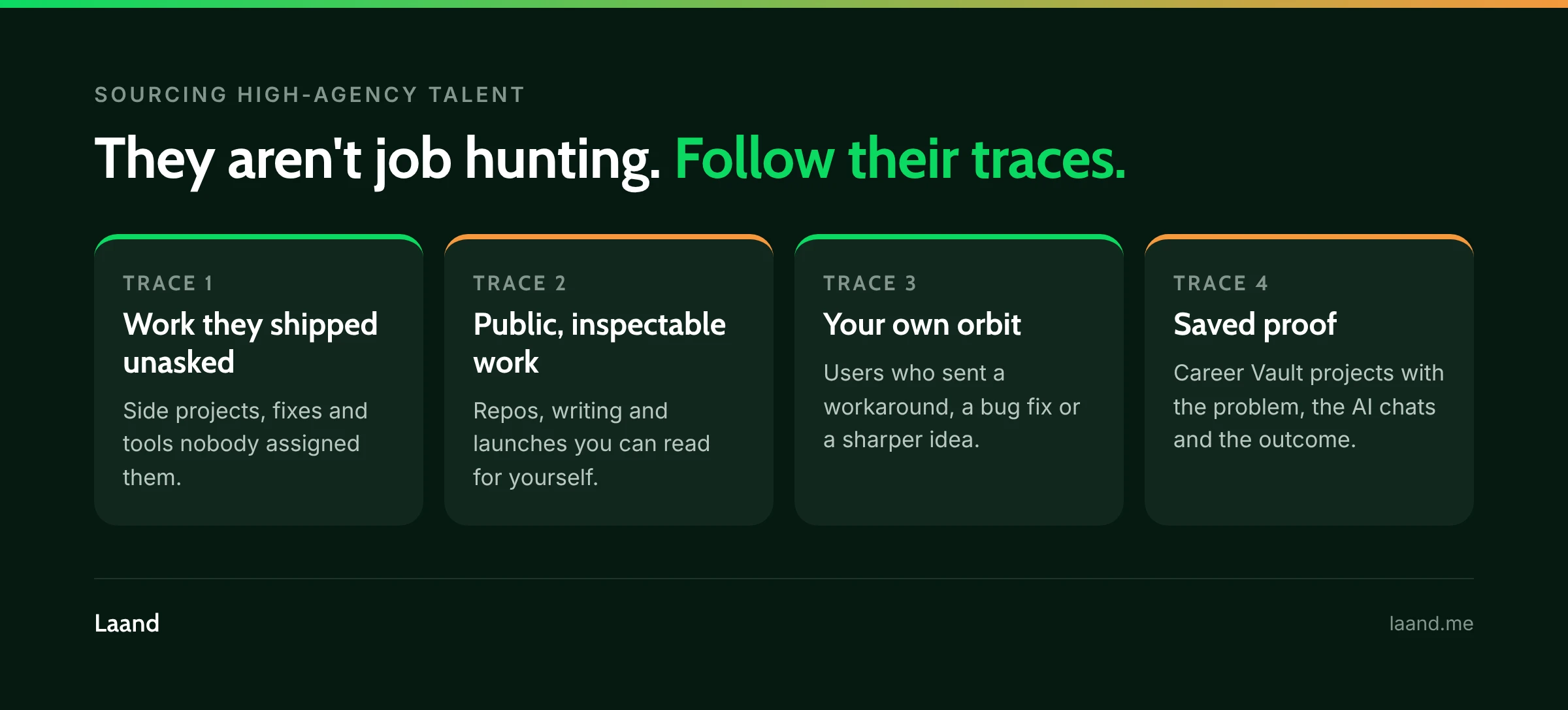
The four traces high-agency people leave
Trace 1: Work they shipped unasked
The single strongest signal of agency is something built or fixed without a mandate. Internal tools, process fixes, side projects, a migration somebody "just did".
Where to look: engineering and product blogs ("how we fixed…"), launch posts, side-project communities, talks at small meetups, and simply asking your network "who's the person at your company who fixes things nobody asked them to?" That question gets better names than any search.
Trace 2: Public, inspectable work
Work you can read for yourself: code repositories with a real commit history, issue threads where someone diagnosed a hard bug, newsletters, essays, design files, public analyses, open-source contributions.
Where to look: GitHub and other code hosts, technical forums, Substack and personal blogs, design communities, and the contributor lists of tools your team relies on.
Trace 3: Your own orbit
Some of the best high-agency people already know your product. They're the user who sent you a workaround, the customer whose bug report included the fix, the community member who answers other people's questions better than your docs do.
Where to look: your support inbox, your community Slack or Discord, GitHub issues on your public repos, and the people who reply thoughtfully to your posts.
Trace 4: Saved proof
Some people deliberately keep evidence of their work, ready to show. The most useful version records not just the outcome but the problem, the approach, how they used AI and what they checked.
Where to look: portfolios, case studies, and on Laand, the Career Vault: projects written the way a hiring team reads them, with the problem, what they did, the public links to the AI chats behind it (or that they didn't use AI), what they checked, the outcome and the proof.
Reading a trace for taste, not just agency
Agency is relatively easy to spot in a trace: they acted. Taste is the harder part, and it matters just as much. Agency without taste ships the wrong thing, fast. (More in high agency and taste.)
| Look at | Agency signal | Taste signal |
|---|---|---|
| A side project | They built it | They kept it small and focused; it does one thing well |
| A repo | Commits over time, issues answered | Clean, readable code; features declined in issues, with reasons |
| A blog post | They wrote it | It's short, specific and makes one point |
| A fix at work | They noticed and fixed it | They fixed the cause, not just the symptom |
| A customer message | They wrote in | Their suggestion was the right size |
Even so, a trace shows what someone did in a different context. It's a reason to start a conversation, not a reason to hire. Research consistently finds prior experience is a weak predictor of performance in a new organisation. (See does past experience predict job performance?)
Turning a trace into a hire
Finding a high-agency person is half the job. They're busy and they have options. Three things turn a trace into a conversation, and a conversation into a hire.
1. Lead with a real problem, not a role
"We're looking for a senior engineer" gets ignored. "Our customers' integrations take six weeks to go live and it's costing us deals. Your write-up on webhook retries is the best thing I've read on this. Want to take a swing at it?" gets a reply. (More in how to attract high-agency candidates.)
2. Offer paid, scoped work, not interviews
A busy person won't sit through five rounds. Many will do six hours of interesting, paid work on a real problem. It respects their time, and it shows you what you actually need to see: how they perform on your problem.
3. Make the next step small
One short brief, a clear stipend, a deadline window that fits around a job, and a promise of feedback either way.
How Laand finds and converts high-agency talent
Laand is built to reach people who aren't looking, and to convert them on work.
Your hunt leads with the problem. Every Talent Hunt is written around the result you need, and its public Job Link shows the milestone the hire must move, how the process works, the pay, and the paid micro-projects.
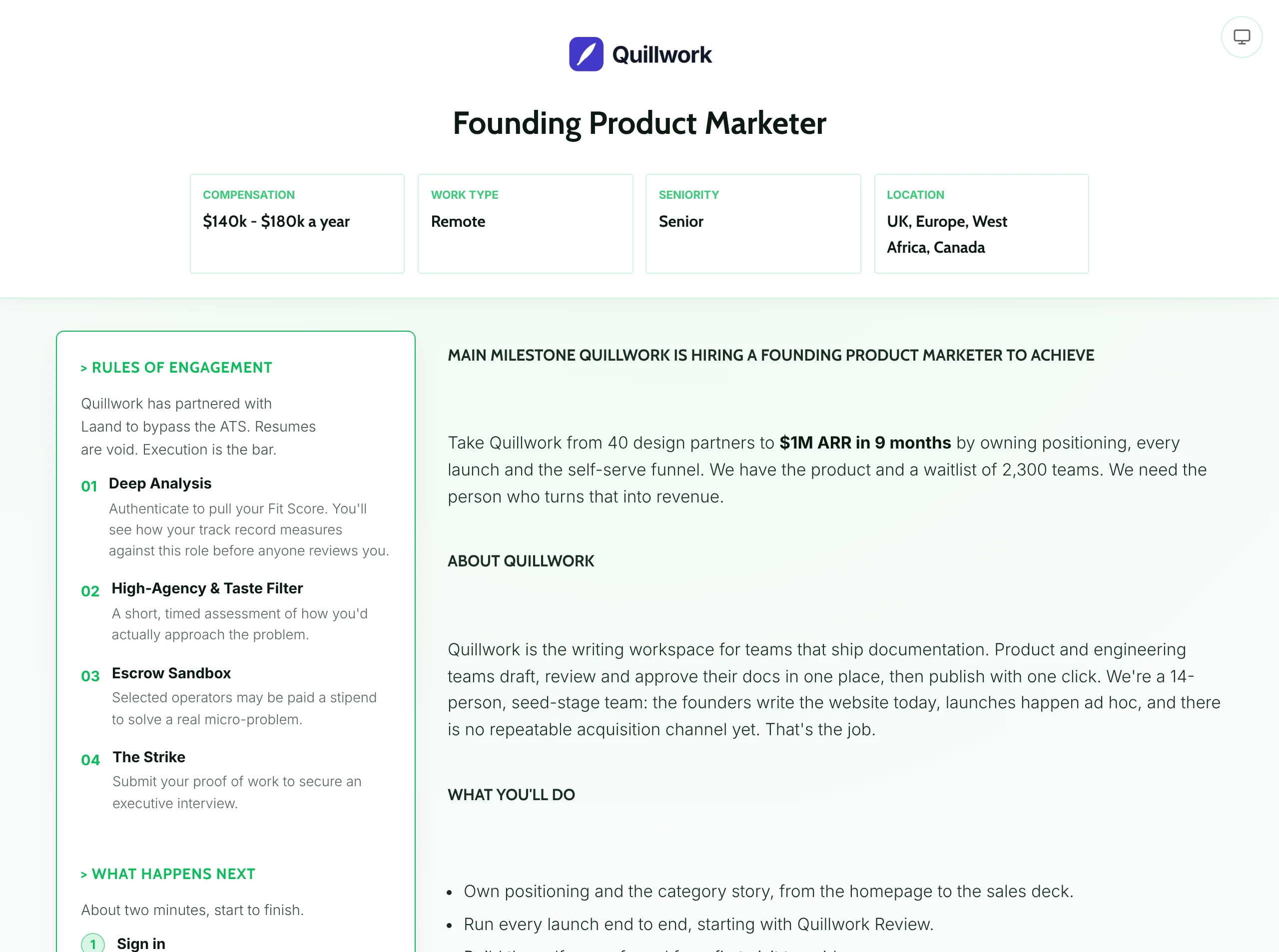
Saved proof reaches you. When you publish a hunt that's like work someone has saved in their Career Vault, Laand may invite them by email, naming the project (a couple of invitations a fortnight at most, so it never becomes spam). They then apply like everyone else, Fit Score first.
Published hunts go where these people look. Publishing puts the hunt on Laand's job board and alerts matching talent the day it opens. And Laand's audience is built around this kind of work: its daily high-agency jobs digest is read by people looking for exactly these roles.
The work does the converting. Candidates above your bar take the High-Agency Assessment, then the best do a paid micro-project scoped from your real problems, with a planted mistake and AI visible. You see their agency and taste on your problem before you meet them.
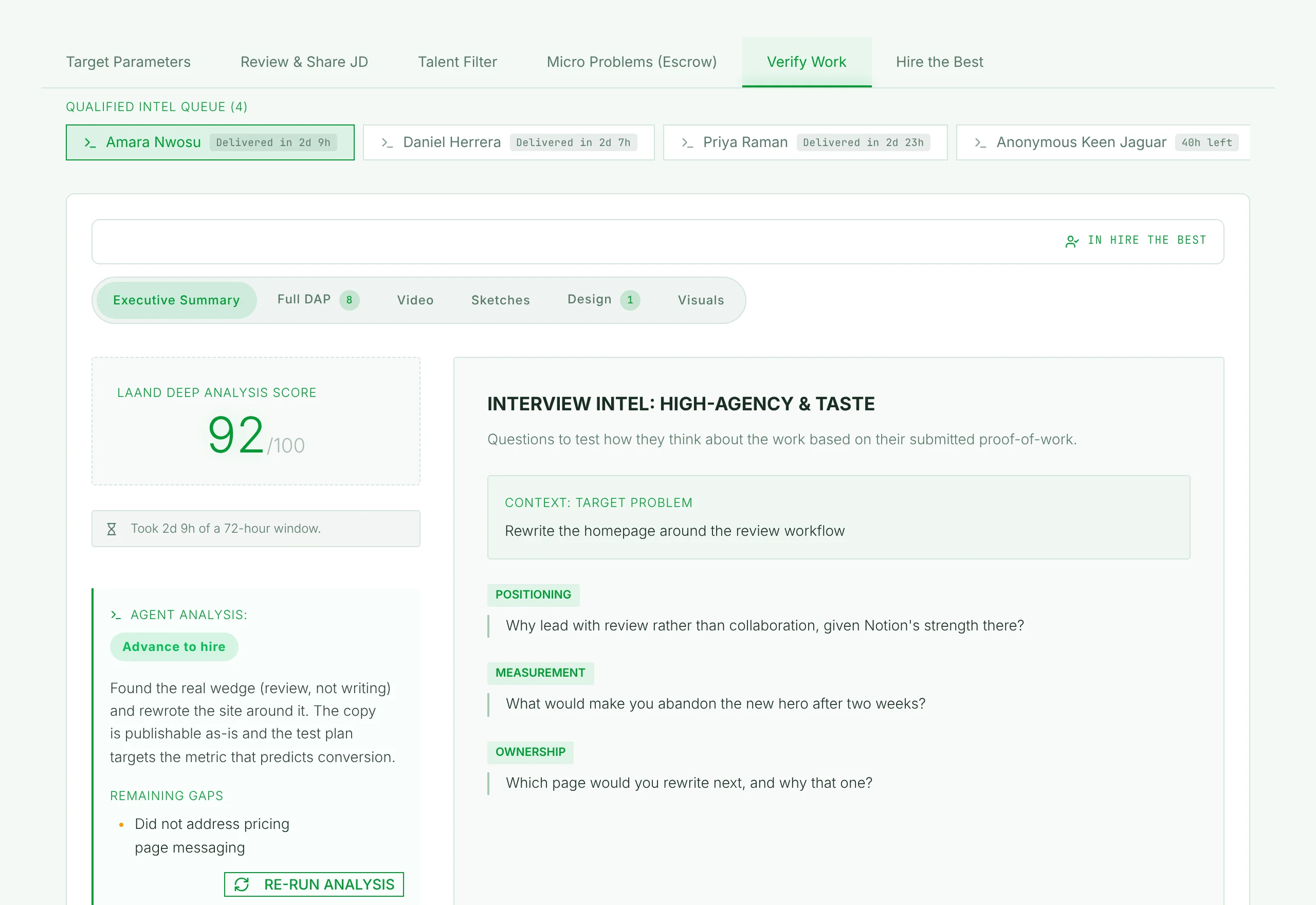
You pay for the person, not the search. Publishing is free. You unlock the person you want at $750.
The market is crowded with people asking for agency
In October 2026, the Laand Hiring Index found high-agency language most often in Forward-Deployed, Product Marketing, Product Management and Design roles.

Everyone's chasing the same people. The companies that find them first look at traces, not titles, and offer real problems, not interview loops.
A founder's version
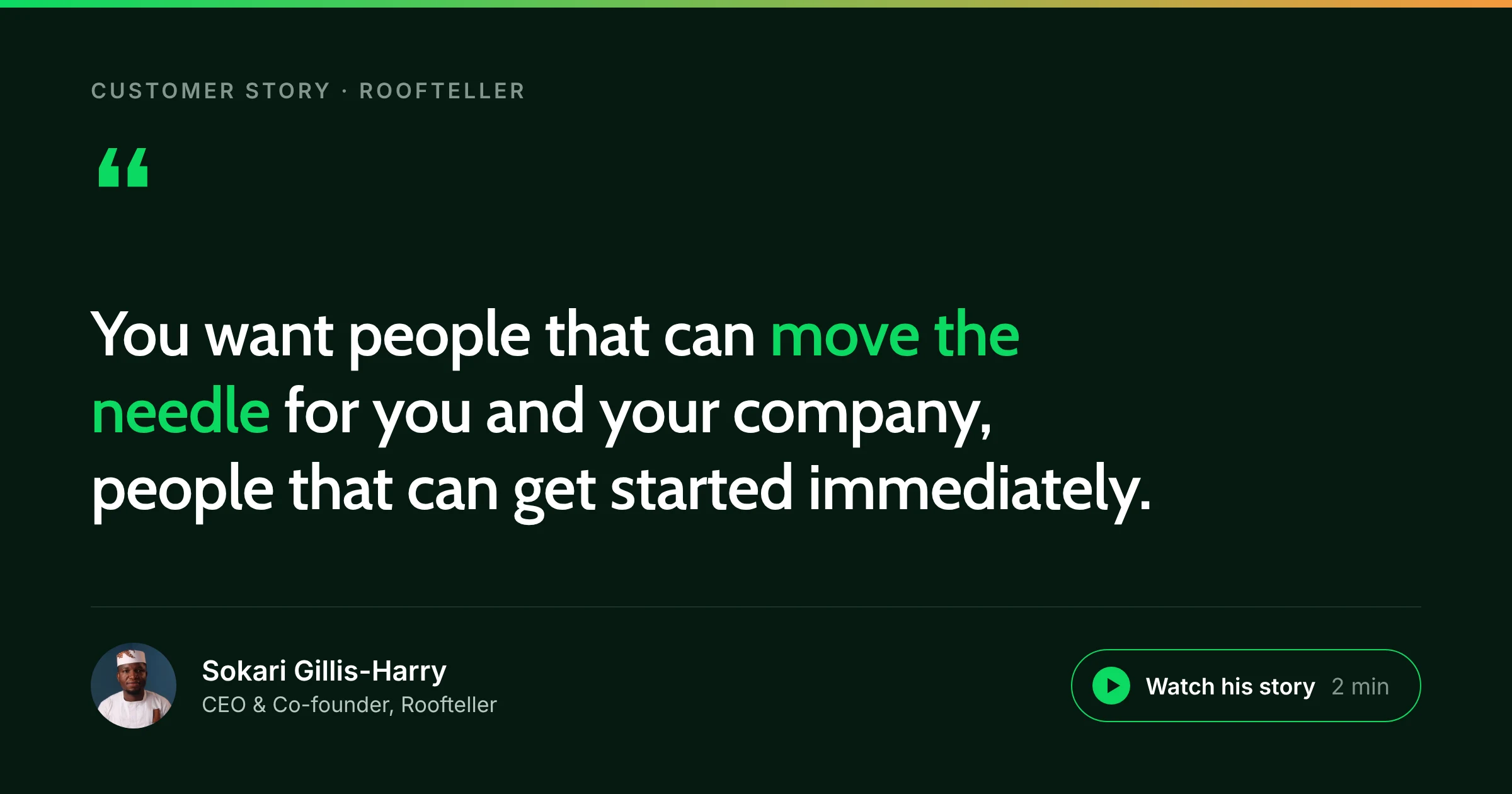
Sokari Gillis-Harry, founder of Roofteller, didn't want to wade through applications:
Brian Chesky's principle points the same way: "Start with the results and work backwards to the people. Most [startups] start with resumes." Traces are the closest thing to results you can see before someone works for you.
A two-week sourcing sprint
| Days | Focus | Output |
|---|---|---|
| 1–2 | Write the result and the problem statement you'll lead with | A one-paragraph problem, a paid project, a stipend |
| 3–4 | Mine your own orbit: support inbox, community, public repos | 10 names |
| 5–6 | Ask your network the referral questions below | 10 more names |
| 7–8 | Read public traces for each name; keep the strongest | A shortlist of 8–12 |
| 9–10 | Send specific messages: their work, your problem, the paid project | 8–12 messages |
| 11–14 | Send briefs to those who reply; publish the hunt publicly too | 3–5 people doing paid work |
Referral questions that surface agency and taste
Ask people who've worked with lots of others. Generic questions ("know anyone good?") get generic names. Specific questions get the people you want:
- "Who's the person at your company who fixes things nobody asked them to?"
- "Who would you call if something broke on a Sunday and nobody owned it?"
- "Whose work do you never have to redo?"
- "Who's the person who always says what we should stop doing?"
- "Who left your company, and you were sad about it for a month?"
Questions 3 and 4 find taste. Questions 1 and 2 find agency. Question 5 usually finds both.
Mistakes when sourcing passive talent
- Leading with the company, not the problem. They don't care about your round yet.
- Asking for a CV first. It signals you'll judge them on the document.
- Proposing five interviews. Offer paid work and one conversation.
- Messaging fifty people generically. Ten specific messages beat a hundred templates.
- Going quiet after they reply. Busy people take silence as an answer.
Key takeaways
- High-agency people are rarely job hunting; they're busy owning outcomes.
- Find them through traces: work shipped unasked, public work, your own orbit and saved proof.
- Read traces for taste as well as agency: small, focused, well-judged work.
- A trace starts a conversation; it doesn't prove fit in your context.
- Convert with a real problem and paid, scoped work, not a role and five interviews.
Frequently asked questions
Where can I find high-agency talent?
In the traces they leave: things they built or fixed without being asked, public work like repos and writing, your own users and community, and saved proof such as portfolios or Laand Career Vault projects.
Why aren't high-agency people on job boards?
Because they're usually employed and busy owning outcomes. They respond to specific problems and invitations, not generic postings.
How do I reach passive high-agency candidates?
Lead with a real problem, reference the specific work of theirs that caught your eye, and offer a short, paid piece of scoped work instead of an interview loop.
How do I know a trace shows real agency?
Look for evidence of action without a mandate, and for taste: focused, well-judged work. Then confirm with paid work on your own problem, because traces come from different contexts.
Does Laand source candidates for me?
Laand publishes your hunt to its job board, alerts matching talent, and may invite people whose saved Career Vault work matches your hunt. Then it filters and tests them on work scoped from your problems.
What referral question finds high-agency people?
Ask: "Who's the person at your company who fixes things nobody asked them to?" Specific questions surface specific people. Generic ones ("know anyone good?") don't.
How long does it take to source high-agency talent?
A focused two-week sprint can get three to five strong people doing paid work: a few days on the problem statement, a week mining traces and referrals, and a few days of specific outreach.
Keep reading
- How to source high-agency engineers
- How to attract high-agency candidates
- How to identify high-agency candidates
- Today's high-agency jobs
Or start a Talent Hunt and reach the people who aren't looking.
Stop applying blind.
Laand scores your fit for any role, then builds the application kit that proves you can do the job.
Join LaandReach people who aren't looking
Publish a Talent Hunt and Laand invites people whose saved work matches your problem, then shows you what they do on paid, scoped work. Free to publish.
Start a Talent Hunt